At the end of that year's TV season, this show ranked #18 in the Nielsens, with a rating of 24.7, while The Addams Family came in at #23, with a 23.9 rating. At the time, Nielsens indicated what percentage of American TV households tuned in to any given program. By the end of the following year, both series were cancelled.
The journalist/historian David Craddock used the term "convergent evolution" to describe circumstances where -- due to cultural and technical reasons -- eerily similar forms of media appear at the same time. He used the term in relation to the "roguelike game" genre, which was independently invented (by people/groups that hadn't heard of each other) with Beneath Apple Manor (1978), Rogue (1980), and Sword of Fargoal (1982); however, the same phenomenon can appear in any kind of media.
For a recent example, consider the raw number of people who realized the obvious pun on "Netflix and Chill" and created -- almost certainly independent of each other -- a large number of TV episodes, shorts, and videos with the title Netflix and Kill (from 2016, 2016, 2017, 2017, 2018, and 2019, not including the 2019 short Netflix and Kill Kill Kill 3D, produced at a budget of $500).
So, it is certainly possible for the two series to have arisen at the same time by coincidence. In the early 1960s, sitcoms had just passed through a "Leave it to Beaver" phase and there was the notion of "let's keep the sitcom format, but make it magical and weird" leading not only to Bewitched and I Dream of Jeannie but also the spectacularly named My Mother the Car, wherein a man's mother has been reincarnated as a 1928 Porter.
However, all this does not seem to be the circumstances with The Addams Family and The Munsters, both debuting in September 1964. There is at least one link that is not in dispute, and another that is, and rather than saying one ripped off the other, it is perhaps more appropriate to say there was a symbiosis.
...
The Addams Family started as a one-off joke in 1938 by the New Yorker cartoonist Charles Addams, but grew into a whole series where the unnamed spooky family found themselves in "ordinary" situations. Crucially for our story, Cousin Itt (covered entirely by hair) and Thing (the hand, just a hand) were not developed yet.
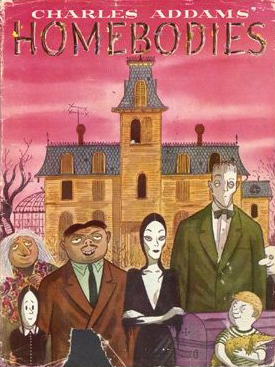
According to the producer David Levy, who already had a previous TV hit with Bonanza: he was in New York on 5th avenue came by a display of books from Addams (compiling his prior cartoons) with the cover of Homebodies showing the entire family. He then told his friend:
There's a hit series!
and contacted the author to work on development, including giving the family names.
Addams never conceived of them as a family. He never called them that. They were all just foils for his humor. They were … simply his outrageous comment on society. I knew in a situation comedy they would become America’s most beloved family.
The new characters Cousin Itt and Thing* were developed with Addams working together with Levy, and Cousin Itt even made its way into the cartoon in October of 1963. (You'll note this is a full year before the TV show.)
Now, here's the problem: the story above is according to the producer David Levy. There's another story (advocated by the historian Stephen Cox, who has written books on both shows) that The Munsters was in pre-production first with CBS (he states it was in the "fall of 1963" when it started), which Levy knew about, and this caused the spark for developing his own show with Addams. The big catch here is that means the Levy story about discovering the book display with his friend and immediately deciding it could make a show was either a.) an outright fabrication b.) conspicuously leaving out the bit where he was knew about The Munsters when he made that declaration.
Additionally (and this is where the symbiosis comes in) while there was a "Munsters-like pitch" Bob Clampett (of Looney Toons fame) made in the 40s, and the Munsters were owned by Universal who were clearly drawing out of their monster movies (starting with Frankenstein and Dracula which were adapted off of plays that were adapted off of the books), the Addams books were fairly famous by the time Munsters development started in earnest, so it is quite possible there was still some idea-cross-pollination. This is what I mean by the two series forming in symbiosis; the New Yorker cartoons likely helped inspire the TV series whose approval helped inspire creating a TV series based on the original comic.
The New Yorker incidentally stopped running the cartoons; the editor William Shawn didn't want the magazine to be associated with anything as lowly as a sitcom.
Oh, and if you really want a ripoff, turn to The Flintstones. In November of 1964 they introduced The Gruesomes, a family of monsters that move into Tombstone Manor and became recurring characters and clearly were riffing off both The Addams Family and The Munsters at the same time. The monster designs are drawn more closely to The Munsters, and rather than Gobby the Goblin (the son) having just an octopus pet (like Aristotle from The Addams Family), he has a octopus and a spidersaurus. See, different!
[*] Thing appeared as a one-off joke already, but Levy helped develop it into a full character. The fact he helped developed Cousin Itt and Thing was the basis for a lawsuit regarding the 1991 film, where Levy claimed he was owed royalties. The suit was settled out of court.
...
Cox, S. (2006). The Munsters: A Trip Down Mockingbird Lane. United States: Back Stage Books.
Jowett, L., Abbott, S. (2013). TV Horror: Investigating the Darker Side of the Small Screen. United Kingdom: I.B.Tauris.