The character Messenio appears in Plautus' Menaechmi.
"Great heavens, what poor specimens of humanity the men were! Their entire bodies formed a pattern of livid bruises. Their backs, which bore the marks of the whip, were not so much covered as shaded by torn shirts of patchwork cloth... They had letters branded on their foreheads, half-shaved heads, and chains round their ankles. Their faces were a ghastly yellow, and their eyes had contracted in the smoke-filled gloom of that steaming, dank atmosphere, making them half-blind. They resembled boxers who coat themselves with dust when they fight, for their bodies were a dirty white from the oven-baked flour."
This is how Apuleius introduces us to the workers at a Roman bakery in his novel The Golden Ass. Milling isn't an inherently low-status job. Medieval millers were quite high-status, typically among the wealthiest (and most resented) members of their village. But in the context of Roman slavery milling was one of the most feared, low-status duties available. To understand why, we should start by looking at the alternatives. What could a Roman slave be doing instead of milling?
Roman slavery took a near-infinite variety of forms. It's useful to think of "slave" as a Roman legal status, rather than a single social role or form of forced labor. Here are a few of the dimensions on which Roman slaves' roles differed:
Strenuousness. Some slaves served in physically strenuous roles, like miners. This could take a severe toll on your body over time. Others served in less strenuous roles, like secretarial work.
Specialization. Some slaves had highly specialized skills, like doctors, making them more expensive and less replaceable. Others performed unskilled labor, and were easy to replace.
Health. Some slaves served in unhealthy or dangerous conditions, like gladiators or dung-collectors. Others served in safer positions that did not pose health risks.
Social isolation. Some slaves served in roles that placed them in close proximity to their enslavers, like nursemaids. Personal familiarity with their enslavers greatly increased the chance that they would be manumitted or otherwise get preferential treatment. Others would never interact with their enslavers, and were highly unlikely to ever be manumitted.
Physical restrictions. Some slaves were physically bound while they worked. For example, vineyard workers often worked in chain-gangs (Columella, a Roman who wrote agriculture guides, says this is because vineyard workers needed to be "Not only strong, but also clever"-- an ambiguously desirable trait to an enslaver). Others had fewer physical restrictions, and may not have even been locked in at night.
As a rule of thumb, desirable roles for slaves were non-strenuous, specialized, healthy, socially close to their enslavers, and trusted enough that they were not forced into physical restrictions. These desirable roles were broadly associated with the familia urbana, urban slaves, as opposed to the familia rustica, rural slaves, the latter of whom could almost never expect to be manumitted.
That is, of course, not to say these desirable qualities made for good jobs. Even the enslaved secretary or doctor was a legal unperson, subject to the possibility of physical abuse, expected to be sexually available to their enslaver with no right to withhold consent, suffering from the terrible psychological vulnerability of knowing their life, future, and potential freedom was in the hands of someone who sought to squeeze them for every last as they were worth. Defeated peoples such as the Xanthians and Dacians are known to have committed mass suicide rather than be enslaved by Romans. But a slave whose role had the above desirable qualities stood a greater chance of enjoying more comfort, living a longer life, starting a family, and possibly attaining their freedom. A slave whose role had none of these qualities could be used up quickly and die young.
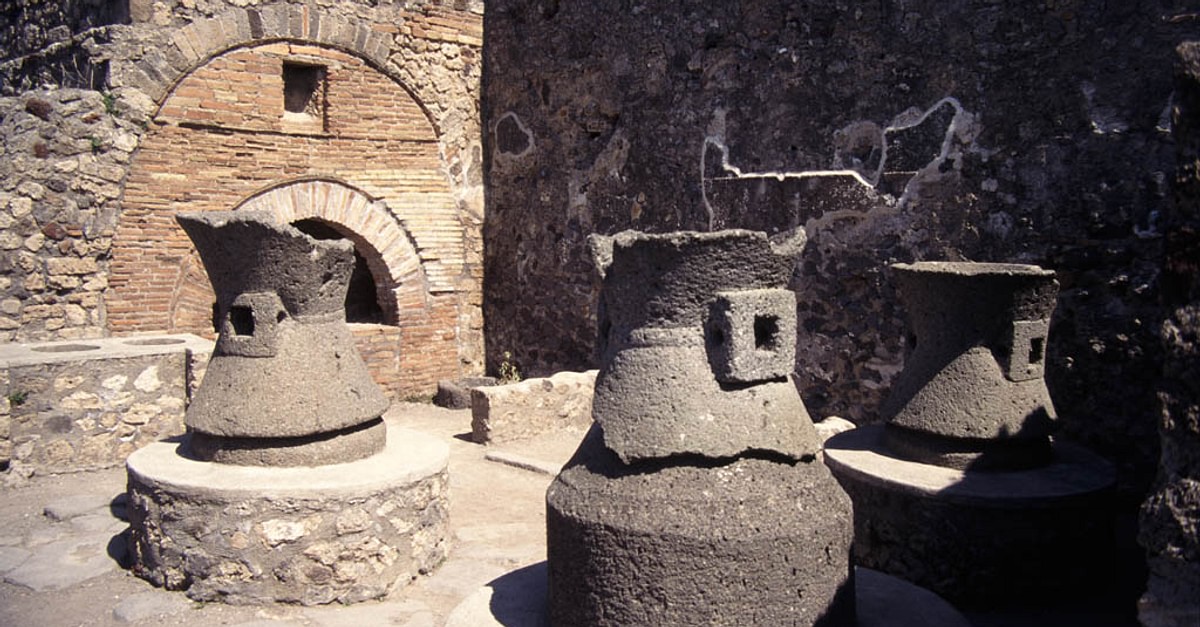
Milling is undesirable on every single one of these metrics. It was strenuous, unspecialized, unhealthy, socially isolated, and physically restrictive. We're not talking about the small hand-mill a farmer might own to grind their own grain. We're talking about big commercial mills like these ones (picture from the World History Encyclopedia). Large villae may have required large mills, but I'm going to focus on mills in the context of the urban commercial bakery. Several of these have survived at Pompeii, most notably at the House of the Baker.
Roman mills were almost always part of bakeries, with the rare exception of water-mills. Outside preparation of grain consisted of threshing and winnowing, but it would generally be ground into flour on location. Once a bakery received a shipment of grain, it might be tempered in salt water to produce a whiter flour. The mill is shaped like an hourglass; grain is poured into the top which rotates over the bottom. The top is pulled in circles by a donkey or mule guided by a man with a goad. The floor around the mill is made of basalt to prevent it being worn away under their hooves. Scoopers carry flour falling out the bottom to a table where it is sifted to remove impurities, and sifted up to two more times depending on the intended quality of the bread. It is brought to be mixed with water and leaven, at this point, a larger bakery might have a kneading machine operated by another mule. Loaves are shaped, leavened, then placed in an oven with a long flat shovel. The finished loaves are weighed and inspected, then either brought to a storefront for direct sale or shipped out in baskets for delivery. The House of the Baker is designed so that a supervisor sitting in the tablinum (office) could see directly into the atrium at the front of the house, the mill area at the back, as well as entrances and exits at the back door, kitchen, and stable, suggesting constant supervision.
Did you notice who the millers were? They were animals, chained to a mill and driven with a stick. This would be a terrible fate for a human being, assigned as an especially cruel punishment. It would be a terrible fate for an animal, for that matter. Returning to The Golden Ass, the narrator (who has been magically transformed into a donkey) is forced to work turning a mill. He describes its physical effects on the animals:
"As for my fellow-beasts... their necks, pockmarked with running sores, were twitching; their limp nostrils gaped wide from constant bouts of coughing; their chests were a mass of raw patches from the continual rubbing of their rope-harnesses; their flanks were exposed to the bone from constant beatings; their hooves were distended and misshapen through their incessant circling of the millstones; their entire skins were coarse with age and scurvy emaciation."
The Golden Ass is a work of fiction, and this scene may run towards the extreme end of life in a bakery, but there is little reason to doubt this is a life many slaves and beasts of burden (the distinction being a faint one in the mind of the enslaver) could expect. The narrator specifies that "In my earlier life among men I had often watched millstones being rotated in this way," which suggests this was a scene that was not unknown to Apuleius's Roman readership.
It's not clear how common fettered human labor was in Roman bakeries. Human shackles have not been found at Pompeian bakeries, though it's possible that they used non-metal fetters that haven't survived. But even unchained, a bakery would have been a miserable work environment. Glass was rare in Roman windows and ventilation seems to have been poor, so a bakery would be hot, dark, smokey, and-- worst of all-- full of airborne flour. (Larger bakeries, like the enormous production halls that fed Ostia, would be deafeningly loud as well.) The animals described as experiencing "constant bouts of coughing" have been inhaling flour all day long. This can cause a lung condition known as baker's asthma, which likely shortened the lives of many slaves in Roman bakeries.
So that is what is bad about mills. To be chained to a mill was to be reduced to a beast, to be hit with sticks, to breathe flour and smoke until your lungs gave out. It was one of the most terrible punishments a slaver could devise.
One last image of the Roman mill comes to us from graffiti left on the Palatine Paedagogium, a school training young slaves for imperial service. It shows a donkey harnessed to a mill and is captioned "Work, little ass, as I have worked, and it will advance you." The artist is almost certainly a slave, and I read the caption as a dark joke. This is the cruel prize dangled before the Roman slave: dance for us, wear out your body and your soul, and maybe we will set you free, maybe you can be Roman too. But no matter how hard the donkey pulls his mill, he is pulling in a circle, and his hooves will wear down long before the basalt floor.
My overview of Roman slavery draws on Bradley's Slavery and Society at Rome and the sources collected in Wiedemann's Greek and Roman Slavery. The section on bakeries draws on Monteix's "Contextualizing the Operational Sequence: Pompeian Bakeries as a Case Study" from Urban Craftsmen and Traders in the Roman World and Joshel & Petersen's The Material Life of Roman Slaves.