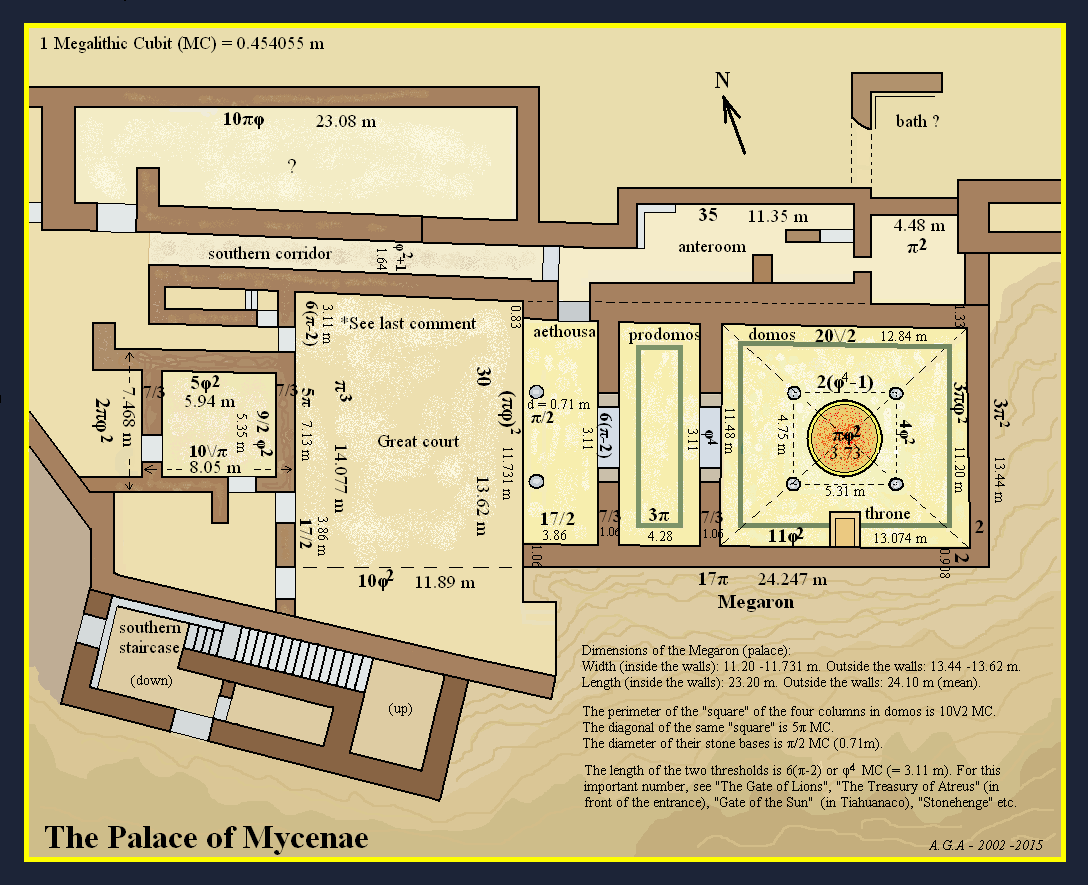
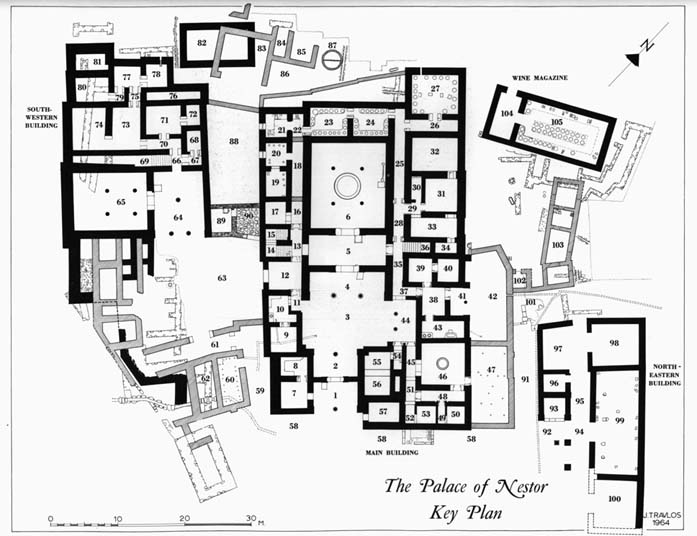
The megaron was an architectural form found in Mycenaean building in the Bronze Age, especially from the 14th to 12th centuries BCE. It was probably adopted from an earlier, Minoan "great hall" shape. There are also shape comparanda from the Bronze Age Near East. It was, in essence, a long, rectangular room with four evenly-spaced central support columns, between which was a roof opening (oculus). Beneath the oculus was a hearth, and facing the hearth was the throne of the local Mycenaean big-man, the wanax, often at a right angle to the axis of entry (see examples). The hall was fronted by an open porch supported by two columns. It is a very distinctive Mycenaean structure and is found in virtually all known Mycenaean palaces in some form or another. It is also thought to be an architectural precursor for the earliest Greek temples of the Doric type, especially the arrangement of the inner room fronted by an open, columned porch. Finding a megaron arrangement in any future discovery at a site is a pretty good indication that the site is LBA Mycenaean—it is a distinctive architectural marker of the Mycenaean palace and therefore of the presence of a Myc. wanax and palace economy in the region. The megaron arrangement of space does not continue into "Dark Age" Greece and beyond, except in specific niche contexts and of course in the basic plan seen in many Greek temples.
Example from Tiryns link
Example from Mycenae link
Example from Pylos link
All three above, isolated from other buildings and compared link
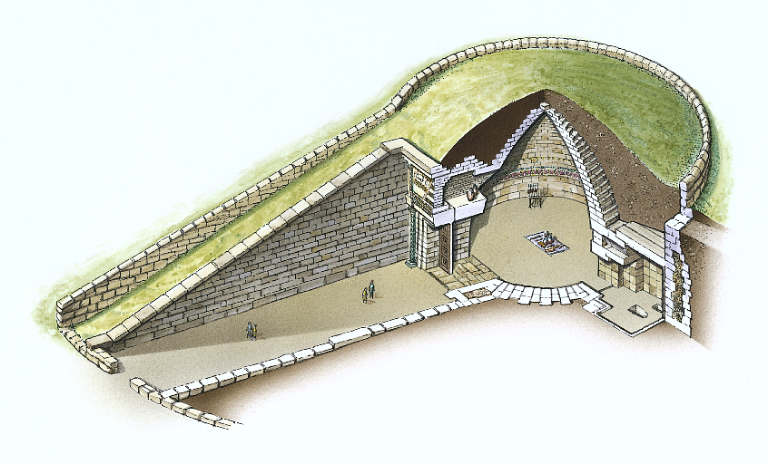
The tholos is one of several very distinctive Mycenaean burial structure shapes. example. It is a bigger, better form of a basic Mycenaean chamber tomb, the former usually constructed instead of cut into rock like the latter. The round, central chamber was constructed of ashlar blocks and was accessed by a long walkway, called a dromos. Tholoi are fairly common in the Mycenaean heartland areas, dotting the countryside at many (but not all) of these places. They were not single burials, but groups. They are also often the site of cult for post-Mycenaean populations who lived there later and had no conception of who had built them. So the famous tholos at Mycenae was thought to be the "Treasury of Atreus." In Attica, tholos tombs were "claimed" by the early aristocrats of Athens and became sites of ancestor cult: these Athenians invented a past and an association with the tombs which asserted their connection to the land and their identity as autochthonos denizens.