Reading When Montezuma Met Cortés by Restall, and he posits the elaborate and extensive zoo developed over the reigns of several Triple Alliance tlahtoani ("speaker"/imperial leader) in Tenochtitlan was the inspiration for the emergence of a royal/elite European collection culture, and eventual development of zoos.
Traditionally, the I thought the narrative is European elites started accruing collections, mostly of religious artifacts, and the practice gradually morphed into secular items, and eventually living collections in zoos.
Is Restall on his own with this idea of the Old World copying the culture of New World empires? Do historians think the obsession with collections and curiosities emerged in Europe after contact?
Thanks in advance!
Sorry if I misunderstand the connotation of OP's question.
As illustrated by /u/Steelcan909 and me before in: In the television show Vikings, various Medieval European courts and nobles are pictured as having a variety of rare or exotic animals such as monkeys and parrots. The leader of the Vikings is also shown petting both a rat and a python at one point. Are such portrayals historically accurate?, medieval European rulers had certainly known the concept of the menagerie in the court, though the term itself only dates back to Early Modern Period. London Tower was probably the most famous example of its sort, and this blog entry of British Library has an illustration of the elephant of the 13th century, presented to King Henry III of England by King Louis IX of France. Medieval Englanders meticulously record the expenditure for the transportation of the elephant to London Tower- and for the payment to the keeper as well.
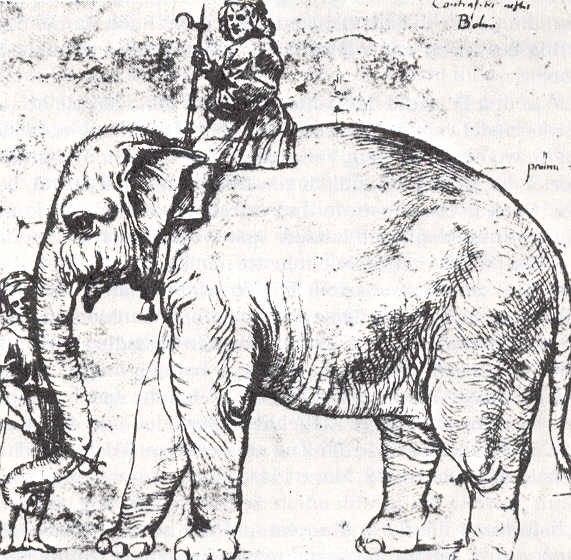
Just before the meeting between Montezuma and Cortez, King Manuel I of Portugal also managed to get an elephant called Hanno from India as Charlemagne had done almost 7 centuries ago [by asking the Caliph of Abbasid Empire], and presented it to Pope Leo X in Rome.
On the other hand, turning our attention to the Eastern Eurasia, we have an illustration of the giraffe with the keeper in the imperial court of Ming China brought to China probably by the famous expedition of the fleet led by Zheng He in the beginning of the 15th century.
So, I suppose that the concept of such a 'zoo in the court' must have also been popular in pre-Columbian Old World, and few researcher would object this explanation. Of course, one can argue that the encounter of the new world with exotic products must have incited the desire of European rulers to collect such exotic items (including living animals)......