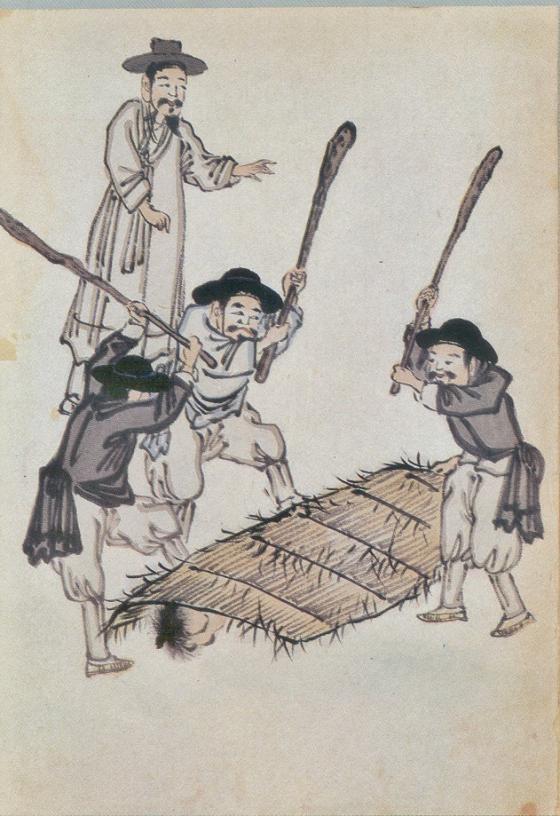
I saw this in a Korean drama and am looking for more information: a person is wrapped in a straw mat, then beaten with clubs. This was presented twice in the series I watched, once as a form of torture, but the other time it was done to a person suffering from mental illness (what we'd probably describe today as being catatonic, though the portrayal isn't precise).
According to Google, this practice was called meongseok-mari (멍석말이) and was abolished in 1769 by King Yeongjo. However, the same source said that it lingered as a popular punishment for rape and incest, and another article (with no sources at all) stated that this is a punishment parents in Korea commonly used for disobedience as recently as 50 years ago (I can't find anything else to back up this claim).
I'd like to know how commonplace this punishment was, how it was viewed by people during the late Joseon period (1700s roughly, around the time it was abolished), and if it was really practiced routinely as a punishment for children and not just criminals. I'm particularly interested to know if it would be normal for a mentally ill person to be treated in this way during that time.
https://gwangjunewsgic.com/arts-culture/korean-culture/harsh-punishments/
I'm guessing this is the article you read, and while it does a decent job of introducing the various punishment one might encounter in premodern Korea, it is slightly misleading to describe all practices in which a person wrapped and beaten with a stick as meongseok-mari.
Instead, meongseok-mari was a very specific set of practice; it was a communal punishment outside the realm of officialdom. It was not meant to be a form of torture, and it was not meant to seriously harm the target. This practice was also called 덕석말이 deokseok-mari, and the beating was given by the entire community. If you can read Korean, you can read about it on the online encyclopedia by the Academy of Korean Studies, which has articles written by its faculty, and it is very reputable for all things Korean (link)
Yun Chi-ho, a famous and controversial figure in Korean history, used meongseok-mari as a way to describe what he saw as a fault in the Korean characteristic:
조선인의 특징은 한 사람이 멍석말이를 당하면 그 사람에 대해서 알아보려고는 하지 않고 다 함께 달려들어 무조건 몰매를 때리고 보는 것입니다.
(My rough translation: "The characteristic of the Joseon people is that if one person receives meongseok-mari [as a punishment], they will not seek to know why this person has received the punishment, instead they will join in on the beating.")
Now, for the picture on the article above, which it describes as meongseok-mari, is not actually meongseok-mari. According to this article by the National Institute of Korean History (part of the South Korean government), this drawing depicts another practice called 피점난장타살(被苫亂杖打殺) pijeomnanjangtasal, which essentially means death by beating. Unlike meongseok-mari, it appears this punishment given by Joseon officialdom was intended to kill the target. The strawmat was likely there just to ease the act of killing for the ones performing the execution.
Since it was a method of social control within small villages, it would not surprise me that the practice continued well into the 1950's, possibly longer. At the very least from the Yun Chi-ho quote, we know it existed at least until the 20th century.