For extra points:
- What happens if I'm not a noble, could someone get instruction still?
- Could a woman get fencing lessons, perhaps in the use of the knife and abrazare(wrestling), so she can defend herself?
- What is the church's opinion on fencing lessons? (Since technically speaking they're meant to kill people)
This is a bigger question than you might think! The culture around weapons and training in the medieval period was largely informal, and so instruction was at once easy to come by but not coherent or consistent, and was largely driven by peerage networks and class dynamics.
Let's start out with your first question: you've heard of Fiore, a famous fencing instructor, and you want to become a better fencer. This already implies a bit about you - you're likely from a class for whom martial skill was an expectation, and so you'd likely spent a good deal of your youth in unstructured martial play, as well as directed personal training, from a friend, relative, or other skilled community member. By the late 14th century, men of non-noble classes were increasingly bearing the martial burden of Christendom, and mercenaries from various Italian states were frequently present in wars waged all over Europe and the Levant. The Swiss and the Holy Roman Empire, too, were exporting mercenaries, many of whom were drawn from the artisan classes, men whose towns or cities expected them to bear arms in their defense, and so had grown up with the expectation to wield weapons with skill. Friuli, the area Fiore was originally from, was a part of the Empire, and as such the cities therein were organized on an imperial pattern, so whether or not your specific class of man was responsible for bearing arms or not was up either to your town Rat, or ecclesiastical or secular lord. Local laws were hyper-local, the only consistency being that, generally, if you were a noble of any income level, or a citizen of a state or city, chances are you spent a good deal of your youth playing martial games suited to whatever class you were a part of. Citizens would be expected to carry halberds or some sort of polearm - not only for fighting but also for firefighting, a perennial risk in late medieval cities - own armor, and carry a sidearm as well. Depending on the city or particular town organization, you might substitute the polearm for a crossbow or a firearm. Which meant that you'd practice with those weapons in various martial games and training exercises.
These games were sportive and competitive, but were meant to encourage men to practice on their own time and at their own expense. Archery contests between archery guilds were popular, and might take place during a city fair or a market day, when travelers from the countryside would meet up, and there they'd set up butts to shoot at, a field in which to wrestle and fence. Noblemen, of course, fought in tournaments, at jousting and at the barriers, in foot combats and mounted melees and half a hundred variations. Martial games were the training regimen of the 14th and 15th centuries. This was how you prepared for war; by playing at it. And by playing at it, you got better at it, and warfare itself in many ways resembled the playing, until the lines between "real combat" and preparation for it became blurry. The performance, in other words, was the point.
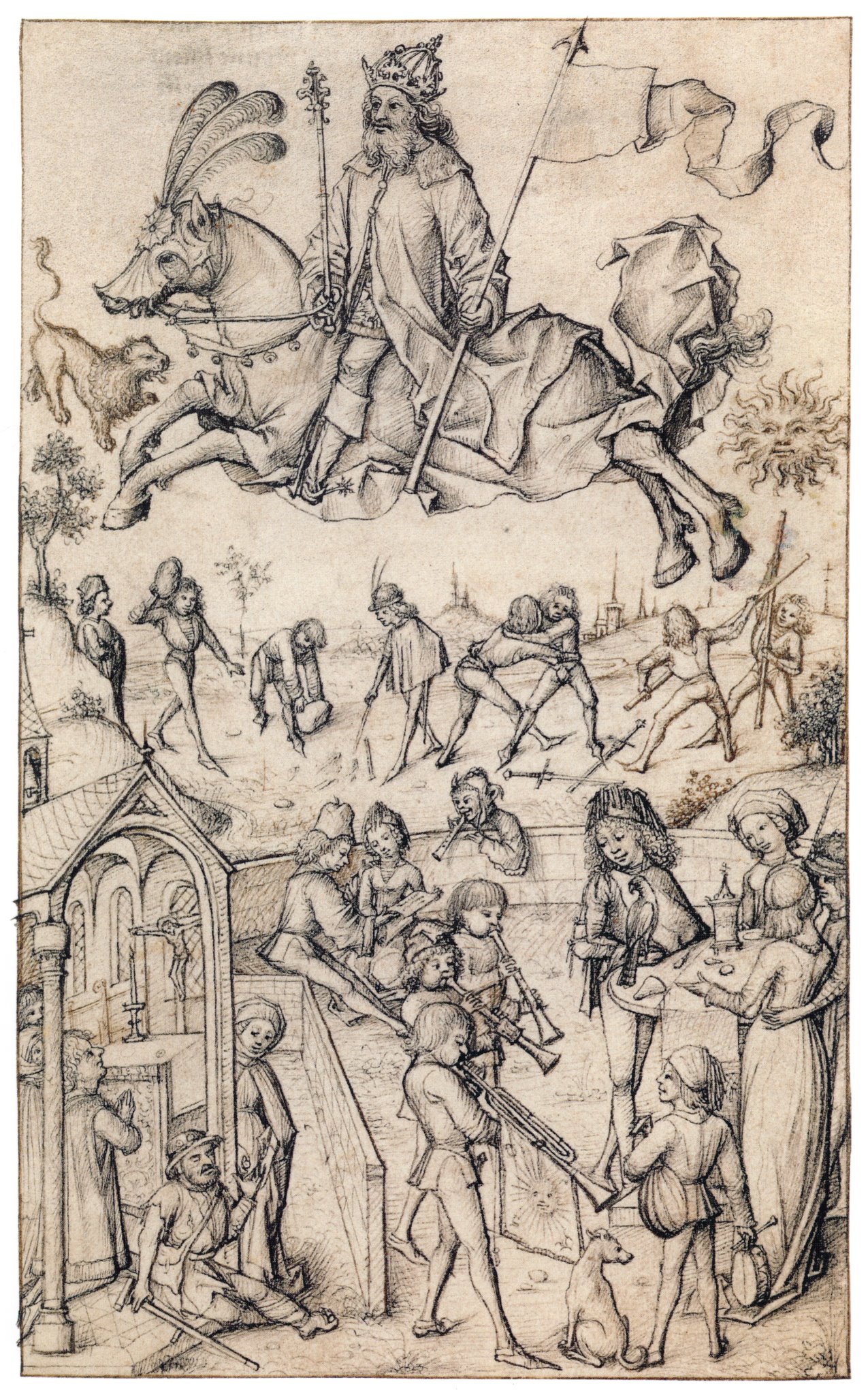
To get better at all this, medieval writers knew that one must also train the body, and many recommended exercises that included throwing stones - Pietro Monte, a 15th century writer, warrior, and traveler, gave extensive advice on how to throw stones for the best effect - running and hiking, riding, jumping and leaping, and even swimming. Dancing, too, was often recommended, as a practice that would teach coordination, nimbleness, and grace, all qualities that were expected of fencers. Art that depicts peasant weddings and market days often included young men wrestling in play, brawling, or fencing, as well as folk dancing of various kinds. A particular artistic milieu called the Planetenkinder or Children of the Planets often depicted young athletes as Children of the Sun.
All of which is to say that if you've heard of Fiore, you'd likely already be pretty experienced as a fencer and as a wrestler, at least in a sort of provincial, intuitive sense. Civic authorities were "keen to encourage able-bodied men to train in using weapons of war for the purposes of state security." Lacking standing armies or perpetually embodied police forces, a state's security rested on the interested members of the community, the citizenry, to protect it themselves. What that doesn't mean is that there was any consciously constructed infrastructure for this training. Instead, just like with every other learned skill or art, you would have to learn much by yourself, until you could find and hire an expert to instruct you. In the mercantile and artisan worlds, this was done through apprenticeship and travel, and based on Fiore's - and many other Fechtbucher authors' - writing, travel to learn from other instructors was a major part of learning to fence, too.
We've established that just about everyone fences. So what's the difference between the best fencer in town and someone like Fiore? What, in other words, is different between men who fence and fencers? There's much we can infer from various treatise writers, but in essence the constant reference to fencing as an art, as a particular valuable social skill, can be read as a means by which men like Fiore attempted to elevate the art. Fiore, just like every other author, clearly separates what he intends his students to learn from the common riffraff. As he puts it:
I also desired to learn the wondrous secrets of this art known only by very few men in this world.
The art of the sword was secret, it was protected knowledge, and to learn how to fence was to be introduced into the mysteries of a particular art. You wouldn't just learn how to beat people with a sword, you'd be brought into a select social subgroup based on shared ideals and ideas of fencing. This subgroup had long been established in art and in language, as well; prior to the late 15th century the primary weapon associated with the social subgroup of fencers was the sword and buckler, a weapon pair that remained prominent in fencing books until the latter half of the 16th century. The longsword, or the sword held in two hands, was quickly becoming more prominent, and certainly by the time Fiore wrote his manuscript it had taken a place alongside the sword and buckler as the fencer's preferred weapon. By the early 16th century, the particular artistic use of the Feder (this is a retronym favored by the modern historical fencing community to denote a foiled training longsword, with distinct morphological features) had almost entirely replaced the sword and buckler as artistic shorthand for "fencer."
You would have known at least some of this. You wanted to learn how to fence not just for battlefield success or to perform well at tournaments or in market contests, but to enter into the mysteries of the sword. To train under Fiore, you gotta know him. That's really about all there is to it. You have to be in the same social groups as him, to know someone who knows someone who might introduce you. You'd have to find him when he has free time and the leisure to train someone. If he doesn't have time or doesn't feel like it, you're shit out of luck. But never fear! There were fencing instructors everywhere. Northern Italy was a battleground for states, cities, and empires for hundreds of years, and there was likely no lack of experienced men who'd be willing to teach a trick or two for some coin.
Now, if you knew him, if he was interested, and if you could work it out, we don't really know exactly what the training would entail. Would he teach you a cut or two and then stand there with his hand out, like a beggar asking for alms? Or would this be a dedicated, weeks-long effort to unteach you your bad provincial habits and replace them with the cruel physical intellect of the martial arts? We don't know. We only get very few references to training, and all they agree on was that it was likely done in small groups in private settings, not as a big class doing rote drills. One of the more prominent is a reference or two in, of all things, a costume book kept by Matthaus Schwarz in the early 16th century, which references his "learning to fence" in 1518, showing him holding a Feder in a small room. His cousin, who continued his costume book, has another, similar image, showing him and a couple of friends engage a fencing master. No details about the cost or the duration of the training, merely that it was done in private for individuals and small groups. We have no evidence to suggest anything like large-scale schools that would be the norm today. So, your fellow students likely look an awful lot like you.
Regarding women, one likely could, and girls likely grew up wrestling as much as boys did before they turned old enough that it was socially discouraged, and was likely discouraged for adult women.
As far as the church goes, they treated fencing just like they treated many martial pastimes: one the one hand it was violent and driven in no small part by pride, but on the other hand, Christendom needed the strong arm of the second estate to protect itself, and so it was a necessary evil in many ways. There is a great deal more we could get into about violence and the church, but I'm running out of space. Happy to answer follow ups!
Of course I referenced Fiore himself, accessible through Wiktenauer
Details on the civic responsibility of bearing arms comes from Tlusty, The Martial Ethic of Early Modern Germany, and Dean, Crime in Medieval Europe, archery guild stuff see Crombie, Archery and Crossbow Guilds in Medieval Flanders
Planetenkinder from the Wolfegg Hausbuch
For Schwarz's Trachtenbuch see Rublack, Hayward, and Tiramani, The First Book of Fashion