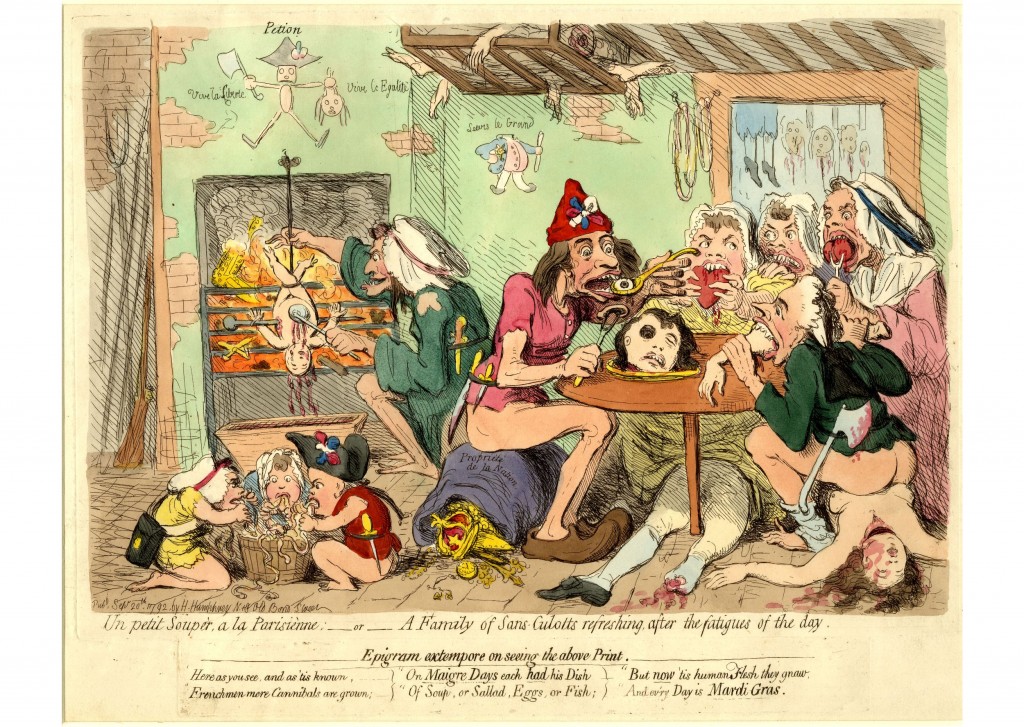
Oh boy did monarchist / anti-democratic propaganda exist. For this answer I will focus on the French revolution, as a wealth of anti-democratic propaganda was created in reaction to it.
Here is a nice clear example of anti-revolutionary and anti-democracy propaganda, published in England 1792. It depicts a family sans-culottes (poor often urban supporters of the revolution) eating aristocrats. They are depicted as naked from the waist down (a mocking play on the term sans-culottes which means those without culottes [because they could not afford them]), deformed, violent, uneducated, thieving, ungodly and probably most importantly cannibals, a symbol of the fact that during the revolution the social order had (at least in the authors mind) cataclysmically broken down. What right could such vile people possibly have to govern themselves, let alone overthrow their lawful king? In the top left of the image, you can see a clear attack on the ideals of the revolution. There is a drawing of a revolutionary who in their right hand holds a meat clever above which is written ‘long live liberty’ and in their left hand a severed head above which is written ‘long live equality’. The implication here is clear, all these abstract democratic ideals are merely the justification for a horde of ignorant, thieving, murderers to pillage and kill with impunity. Works like this one were far from being unique, you can find plenty of anti revolution cartoons criticising various aspects of the revolution if you search on google.
But perhaps you want some more intellectual examples of anti-democratic propaganda. I’ll go over two other examples, the works of Abbe Augustin Barruel and Edmund Burke.
Barruel (sometimes named the father of conspiracy theories) held that the revolution should fundamentally be understood as the successful seizure of power by a cabal of ungodly Freemasons, philosophes and the Order of the Illuminati. In his immensely popular best seller Memoirs Illustrating the History of Jacobinism Barruel outlines three forms of conspiracy which the revolutionaries engaged in a “conspiracy of impiety” attacking Christianity, a “conspiracy of rebellion” in which they attacked their lawful rulers – the reigning monarch and a “conspiracy of anarchy” in which the revolutionaries attempt to destroy the general social order. These conspiracies to destroy society were carried out by an elite cabal that numbered roughly 300,000 and which included amongst others Voltaire, Denis Diderot and the King of Prussia, Fredrick the Great. In order to stay secret the conspiracy employed a cell structure of independent lodges, so that even if one lodge was discovered the rest would remain hidden and continue to plot in the shadows. The members of this Enlightenment-Freemason-Illuminati-Jacobin mega conspiracy were finally able to enact their dastardly plans in August 1792 after the fall of the French monarchy. Soon Jacobin clubs sprung up all over France, organised by the Jacobin members of the conspiracy who were “the adepts of impiety, the adepts of rebellion, and the adepts of anarchy”, tying in with his earlier message about the three conspiracies. The revolutionary’s commitment to liberty and equality were merely a commitment to “pride and revolt”. There was a choice at hand for all the people of Europe, between monarchy and obedience to God and a “reign of anarchy and absolute independence”.
Basically, to supporters of democracy he says, no you don’t get it, while it may look like the people want to govern themselves they actually are being duped by an Enlightenment-Freemason-Illuminati-Jacobin mega cabal which is dedicated to destroying all that is good in society. Clearly the only sane choice of government is a monarchy.
Somewhat more sensible are the arguments put forth by Burke in his again extremely popular work Reflections on the Revolution in France as well as other later works. Burke (who was a member of parliament) saw a fundamental difference between American and British democracy and the French version, the main one being that the French version involved far too much popular participation of the common people.
Burke has many different arguments against what he regards as too much democracy. First ruling requires a degree of intelligence and knowledge that ordinary people simply don’t have. Leading on from that the common people because they lack that knowledge and intelligence will likely be inspired by populists who will undermine various important traditional parts of society such as the church, property rights, nobility etc. Burke also worries about a tyranny of the majority where unpopular minority groups are oppressed. In a monarchist system of government he argues that these unpopular minority groups can (if the nobles like them) call upon the nobility for protection.
Burke was also deeply skeptical of the idea that we can simply create a new, more just society by attempting to implement positive ideals. Famously he warned that just as you should always be aware of why a fence was created before you take it down, attempting to unmake societal traditions which you don’t know the reason for will just lead to pointless chaos and destruction. Whilst it is impossible to stop change entirely change should be enacted as slowly and carefully as possible, because “Very plausible schemes, with very pleasing commencements, have often shameful and lamentable conclusions”. Grand schemes to restructure society along more just and egalitarian lines are a mistake in Burkes mind. Reform at a snails pace if at all is Burkes game.
Now all this sounds rather pragmatic and unemotional, but Burke seems to have been very emotionally invested in the idea of an ordered society. When describing the proponents of the new French regime in 1792 in parliament he announced “When they (revolutionaries) smile, I see blood trickling down their faces; I see their insidious purposes; I see that the object of all their cajoling is—blood! I now warn my countrymen to beware of these execrable philosophers, whose only object it is to destroy every thing that is good here, and to establish immorality and murder by precept and example”. Similarly, he works himself into a rage in his Reflections on the Revolution in France when describing Marie Antoinette being attacked by a group of women armed with knives angry at the high price of bread. How dare they assault one of their betters in the comfort of their home, over so measly a thing as not being able to afford enough food for themselves and their families he seems to splutter in outrage.
As you can probably see there are few themes running through these critiques of democracy and the French revolution. There is the argument that it fundamentally undermines the public order, that democracy is simply not Christian and that the common person on the street is simply unqualified to decide who should rule. Ruling is fundamentally the task of the educated and qualified many of those who opposed democracy held. Democracy they say ends up just being the rule of the ignorant mob, who are easily mislead through their own ignorance by dangerous, destabilizing radical demagogues.