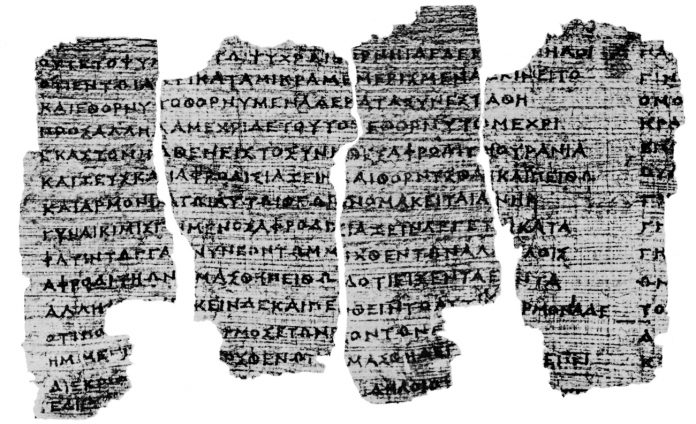
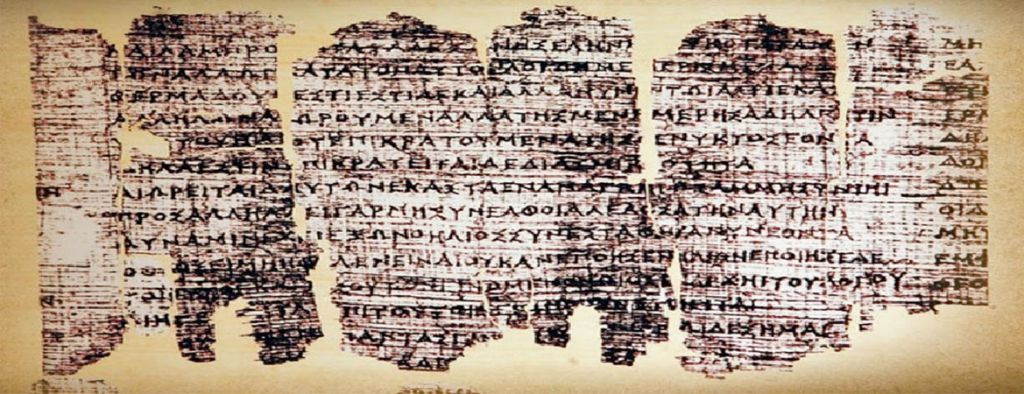
I recently found a document which states that in ancient Hellas only uppercase letters were used and that the lowercase letters were only developed later on in monasteries. So if I stumbled across Plato's Apology in the fourth century b.c. what would the thing have looked like? A scroll with only uppercase letters?
Yes, that's correct. It's perhaps best to think of it not as 'upper case', since there was no lower case, but as a single set of letter forms.
We don't have any handwritten manuscripts from Plato's time, but we do have some from around Aristotle's time, just a few decades later: the Derveni papyrus, a religious tract found in a grave in Macedonia. Here are a couple of images of parts of it: 1 2. You can tell it's badly damaged -- Greek soil isn't good for preserving papyrus. The 'panels' are bits of the papyrus that got squashed while it was rolled up, so the gaps between each 'panel' are where the scroll got folded.
As well as having only the one set of letter forms, you may notice that there's no punctuation, no accents, and no spaces between words. Punctuation began to develop a couple of centuries after this papyrus was made, but it was never used consistently in antiquity because it wasn't really needed. Same thing with word spaces: the sequence of letters gives an adequate phonological representation of the sounds of the language without the need for word divisions, because Greek doesn't split the sounds of words up the way English and other Germanic languages do, with glottal stops at the beginning of every vowel-initial word. Word spaces are a late development in most languages.
This bit isn't exactly right, by the way:
the lowercase letters were only developed later on in monasteries
Monastic scribal culture certainly was important in the Byzantine world, but it didn't have a monopoly on book culture to the extent that it did in the Latin west. The major developments in Greek-language scribal culture in the 9th-10th centuries, including the development of the minuscule (lower-case) script, were at least as much a secular thing as a clerical/monastic thing, with particular interest from the emperors and imperial schools.
The Derveni papyrus is the oldest artefact of its kind -- the oldest papyrus found in Greece itself, at least -- but we do have lots and lots of later papyri, as well as epigraphic evidence going back all the way to the 8th century, and the practice you've noticed is consistent. There are some tweaks in earlier epigraphic evidence -- different parts of the Greek-speaking world had slightly different alphabets (Attic, for example, lacked the letters η ξ ψ ω until 404 BCE), and early inscriptions swap between left-to-right and right-to-left writing. But the single inventory of letter forms is consistent, as is the absence of accents and punctuation.