In the history of technology, people schooled on marathon sessions of Civilization might think of it as a series of inevitable leaps, where later innovations outdo earlier ones in a cavalcade of forward progress. For example, people think of the "iron age" outdating the "bronze age" even though bronze is easier to make and work with. Iron is cheaper, and it being cheaper it allowed for more widespread use of metal overall, but it isn't the superior metal on a performance level, and use of both metals still co-existed.
To take a more recent example, the switch in music sales from records to tapes to CDs to digital seemed to leave prior formats obsolete, yet vinyl has returned from near-death and as of this writing still has rising sales.
The slightly erratic switch in British artillery from muzzle-loading (filling artillery from the front) vs. breech-loading (opening the back and filling your artillery from there) has similar zigs and zags, and is a slightly different story for the Navy vs. the Army. By the time the British Army started switching over from breech-loading to muzzle-loading by late 1870, the Navy had already done so; but the Navy is nonetheless an integral part of the story.
...
The start of the Crimean War (1853) saw a flood of ideas for new weapons from professional engineers and confused amateurs; the British government eventually overrode concerns of the War Office to allow for new developments with full funding, like a giant mortar shell of James Nasmyth that he had previously proposed; only now the government was wiling to pay attention. It became something of a mini-revolution in the military technology industry, and attracted the attention of William Armstrong. Armstrong was an engineer but not of military bent, but he had read about how Britain's artillery -- essentially dating back to Napoleon, and that's Napoleon I, not Napoleon III -- had trouble in the battlefield. He designed a breech-loaded iron gun on a carriage that returned to firing position once triggered (recoil causing aim to go haywire otherwise being a problem). He didn't finish his design before the end of War (1856) but the financial support kept flowing, and by 1858 several models were approved for "special service in the field" including a 6-pounder, 9-pounder, and 12-pounder, all field guns.
Armstrong was not thinking in terms of larger guns -- he originally didn't think they'd work with the design -- but directive from the government saw him develop a 20-pounder usable both in the field and on ships, and a 40 and 110 pounder.
His guns saw actual battle in China, Japan, and New Zealand, and the artillery was used to fire over the heads of ground troops at Maori lines; as one of the Forest Rangers later said:
It was as pretty a bit of hot firing as I have ever seen. The Armstrongs were sending their shells screeching over us, and the Maori bullets were cutting down the fern near me with as even a swathe almost as you could cut it with a slash-hook.
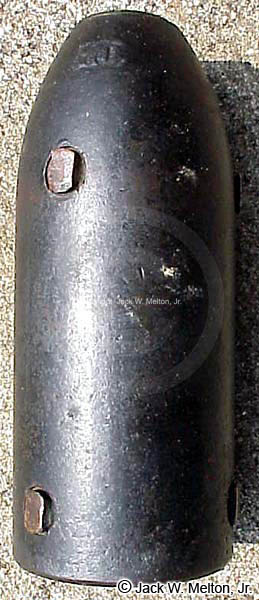
This was in 1864, the same time as the American Civil War, which also saw some Armstrong 12-pounders in combat; here's a shell that was buried by the Confederates in 1865 as they were retreating.
However, this was the same time there was skepticism building (especially amongst the British Navy) about the Armstrong breech-loaders. An Ordnance Select committee met starting in 1863 and did a number of "face-off" tests, eventually concluding in August 1865:
The many-grooved system of rifling with its lead-coated projectiles and complicated breech-loading arrangements is far inferior for the general purpose of war to the muzzle-loading system and has the disadvantage of being more expensive in both original cost and ammunition. Muzzle-loading guns are far superior to breech-loaders in simplicity of construction and efficiency in this respect for active service; they can be loaded and worked with perfect ease and abundant rapidity.
The Navy apparently also saw failures and overheating. Armstrong's original design, remember, was for the field guns, and it appears he was somewhat correct; the larger guns suffered more failures and complaints, leading to the Navy substitution of a muzzle-loading weapon which they found in comparison tests to have acceptable loading time, less maintenance, and, due to a new muzzle-loading design by R.S. Fraser in 1865, cheaper. Specifically, Armstrong built his guns with iron tubes in sequence around a barrel, while Fraser's design used longer tubes but less iron. This also crucially led to a cost of 70 pounds per ton as opposed to 100 (and money was not flowing like it was in the previous decade).
Still, the Royal Artillery stuck to their guns, so to speak; although the first indication they were still bothered is a bronze 9-pounder model muzzle-loader sent to India in 1869. British forces in India, where parts could take weeks or months to arrive, needed absolute reliability, and in a strong sense their desires could lead the direction of the entire Army.
The Battle of Sedan in 1870 provided even sharper emphasis on the point, as Prussia using artillery (manufactured by the German Krupp) annihilated Marshal Patrice de MacMahon's army to a level previously unseen, and a clear echo of what would later happen in World War I; as the newspaper writer Russel would write:
...the earth was torn asunder from all sides with a real tempest of iron hissing, and screeching, and bursting into the heavy masses [of soldiers]....
Then came Sir John Adye, veteran of the Crimean War and India, who was tasked as Director of Artillery and Stores in 1870, and included in his mentality the need for not only low-maintenance equipment, but consistency across the Army and Navy.
In addition to the test vs. the bronze cannon, there was one against a breech-loading model sent by Krupp (who really would have liked the money selling to the British government) where, at least according to the people doing the test, the British model still did favorably.
The Pall Mall Gazette noted
...the essence of the argument against the breech-loading Armstrong guns [is] that their equipment will not continue good and serviceable under the trying conditions of service...
While there were still some new breach-loaders ordered in November, by December 1870 the Gazette had wrote "a beginning has at last been made" of switching to new muzzle-loaders; these ones were steel instead of bronze.
The change wasn't immediate in 1871 but essentially new orders went exclusively for muzzle-loading models all the way until 1879 when the ship Thunderer had an accident where a muzzle-loading gun exploded during a test exercise. There were two guns being loaded and firing, and one of them misfired, but the misfire wasn't noticed, so the gun was double-loaded; 11 died in the resulting explosion.
This marked the beginning of the end, as both French and German forces were using breech-loading cannons by now in a reliable way. As far as what happened for the British to fall behind, part of it was institutional unwillingness to change, part of it was cost-saving (Prime Minister Gladstone, who was in the position from '68 to '74, was particularly tight with finances) but part of it had to do with issues with gunpowder.
There was quite a lot of failure of breech-loading guns in the 1860s, which the British was using as their touchstone, but while focused on the development of guns, they lost track of the development of gunpowder; with breech-loading the gunpowder would often explode prematurely, before a seal could be made when closing the artillery. With slow-burning gunpowder used roughly starting 1870 (and it seems not being used in the face-off with the Krupp breech-loading model), not only were accidents reduced, but larger explosives could be used, and by extension, longer bores, and by more extension, longer range. This meant by the time of the 1879 French and German artillery vastly outpaced the British, and as the historian LeClair notes, it was perhaps fortunate that the discovery of obsolescence was made with an accident rather than during actual war, because for the British it might have been much more deadly.
...
In brief, then:
1.) the Navy had failures with the Armstrong breech-loading model, which maybe was scaled too large from the original design, but the Army kept with theirs
2.) the new administrator Adye was used to being far in the field and was determined to standardize between Army and Navy and increase simplicity of use
3.) the Battle of Sedan made the British fear they were falling behind
4.) even though the muzzle-loading was "retro" in that respect it was still a newer model that crucially reduced cost
5.) tests done at that time, especially a face-off with the Krupp gun, might have showed superiority of breech-loading anyway, but the big link in the puzzle (the gunpowder improvement) doesn't appear to have been used in that test
...
Bastable, M. J. Science, Technology and the Armaments Industry in Great-Britain (1854-1914). In Technology and Engineering: Proceedings of the XXth International Congress of History of Science (Liège, 20-26 July 1997) Vol. VII (pp. 309-315).
Hall, D. D. (1972). Field Artillery of the British Army 1860-1960. Military History Journal, 2(4), 1-10.
LeClair, D. R. (2019). The British Military Revolution of the 19th Century: "The Great Gun Question" and the Modernization of Ordnance and Administration. United States: McFarland, Incorporated, Publishers. (Absolutely the main source on all this, and the best read if this sort of thing interests you.)