The problem is you're making an assumption that is incorrect. Namely this: that the Dutch claimed land by adding soil. What we did instead is that we built dikes around for instance a lake (regularly an 'emptied' peat field), and we used (wind) mills to pump out the water. The former lake floor became the new dry land. NB: This is why many parts of the Netherlands are below sea level: because we literally took out the water and started living on it. We created polders. This is a very schematic picture of how a polder works.
When you pump water out of the soil, however, it settles - becomes more dense, I guess. This especially happens in peat soil, and we had and still have a lot of peat soil especially in the west of the country (not always as the top layer of the soil but also below the top layer(s)). This process is actually what pushed many low-lying areas of the Netherlands below sea level.
Many peat marshes in the west of the Netherlands were harvested in the early to high middle ages. After an area had been cut, it filled up with water. These former peat marshes turned lakes, as well as wetlands close to rivers and other types of marshes, were from the 11th century onward reclaimed by the above explained process. A famous example is the Beemster polder, which was reclaimed in the early 17th century. It's actually a Unesco world heritage site now and as such has an English page I can link!
So short answer to your question: they didn't need any soil, they just started farming/living on the bottom of the lakes/marshes they drained :)
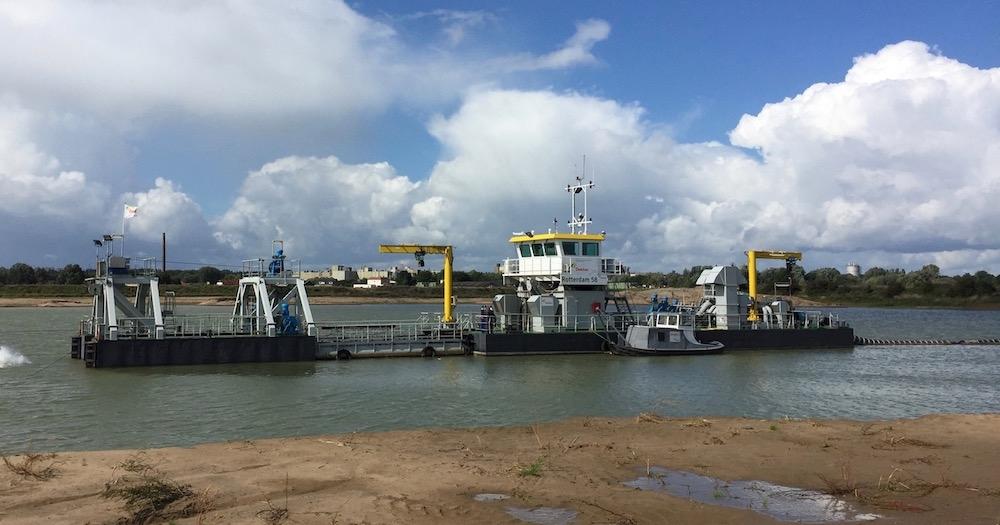
Something else you might find interesting: The Netherlands actually does produce sand for building and other uses. A significant part of the east and south of the country is actually above sea level and has a sandy soil. In many places, sand is taken directly from the soil, creating lakes, or from the bottom of already existing lakes. This happens for example along the Rhine and Waal rivers, but also quite 'randomly' in slightly less populated areas in for example the province Overijssel. Sand is also extracted from the North Sea bed. It's just not used to fill up polders; it is used in building, roads, etc. Sand also is suppleted again in front of the Dutch shores as an additional part of our coastal protection, both on the beaches and under water just in front of the shore. Part of the reason why this needs to be done is the fact that we made so many polders and channeled our rivers so much: there's a lot less sand actually ending up in the North Sea, which leads to 'sand hunger', a sand shortage at the coast, which increases the risks of flooding.
Sources:
"Leefbaar laagland: Geschiedenis van de waterbeheersing en landaanwinning in Nederland" by G.P. van der Ven and Edward van de Vendel.
"Landschap in delen: overzicht van de geofactoren" by H.J.A. Berendsen.
Website of Stichting De Noordzee (Foundation 'the North Sea'): https://www.noordzee.nl
https://bodemdata.nl/: current geological data gathered by Wageningen Environmental Research as a project by the Wageningen University and the Ministry of Agriculture, Nature and Food Quality.
Edit: My apologies for any mistakes in the terms I've used! I thought I was pretty close to near native, but this topic has made me realise there's many words I don't actually know the exact English translation for!
TLDR: most of the land reclaimed by the Netherlands wasn't about building up soil, but rather pumping out water, leaving essentially empty dry bowls of land.
Longer Version: The earliest settlements in the Low Countries were mostly along rivers, which actually created their own higher land areas via the depositing of soil on their banks. Right around the iron age people began purposely altering the landscape. To regulate the rivers cities and towns would construct dams which would often then give their names to the town in question: Amsterdam is named after the dam on the river Amstel, for example. These provided drier locations on which to place town squares, churches, and civic buildings. The first purposeful land reclamation processes in the Netherlands were arguably terps, or mounds of land built up from surrounding soil, usually topped with the local church or a cluster of houses. These were built so that when the surrounding marshy lowland would occasionally flood, the people and farm animals would have somewhere higher to flee to. some terps have been excavated and show that some were built up from small initial dikes, often only a few feet high. Both the dams and the terps essentially built up land from the surrounding areas, creating slightly lower areas around them but were small enough that the soil displacement was essentially negligible.
It wasn't until the mid to late medieval period that dike building really began to hit a high gear. During that time the low Countries were pretty populated and fairly rich, relying on fishing, trade, and clothing industries. A combination of natural processes causing water levels to rise and land to subside as well as the need for more arible land for the growing population led to a rising need to dike up land. Often these dikes used wood as a frame to hold the soil together, as the low Countries have very few useful rocky outcroppings.
The polders that we think of today when we talk land reclamation began right around the beginning of the early modern period. Essentially a lake or swamp was surrounded by a low earthen dike. The earth was excavated from the outside of the dike itself, creating a small trench around the dike. Then pumps, typically wind powered, were used to empty the lake and place the water in the trench, creating canals around the dikes, with arable land where the lake used to be. This process incidentally caused the soil to compact, lowering the land even further. As technology improved steam took over for wind power in many places and the naval shipworm forced the dutch to import stone from Norway to form the basic framework of the dikes instead of using wood, but the essential technology remained the same. Creating the massive Flevoland polders required all sorts of advancements in terms of essentially teraforming the bottom of the ocean, but they didn't mess with what worked: surround the wet spot with soil dredged from nearby, pump the water out, leaving a dry bowl for farming in, no additional land needed!