Gobekli Tepe is currently dated around 12,000 years old, but someone I know is in denial of this as they believe humanity was created around 6000 years ago (Biblical chronology believer). They assert that Gobekli Tepe (and all other sites that prove human existence) dated over 6000 years are not valid as they rely on carbon dating. I'm not an expert by any means, and would appreciate any sources that prove the age of historical sites 6000+ years that do not rely on carbon dating, or how Tepe is currently being dated. Thank you in advance.
A lot of people here have said, essentially, you're probably wasting your time. And that might be true. But I want to encourage you to try.When I was a teen one of my friends (and his family) was a Creationist, and he got me interested in it. Reading the Answers in Genesis magazine made me question a lot of what I heard in Biology class at school, and I think subconsciously I probably liked the idea that I knew something the so-called adult experts didn't understand.
For example, I remember an argument that Carbon Dating is inaccurate because maybe there was a different amount of Carbon in the atmosphere in the past. What they didn't mention is that actually a lot of work has been done to discover how much Carbon there was. But over time, I began to regard it as ludicrous, and in fact dishonest (so quite un-Christian).
I read more and more evidence, huge amounts of things backing each other up. For example, Creationists would say that fossils are due to the Flood... well, then, shouldn't there only be one fossil layer, evidence of one great extinction event? How come before the early extinction events, there's no dogs or cats or human skeletons, but mostly things that don't exist anymore (and Genesis never says Noah left the dinosaurs behind, does it, their so-called belief in the literal truth of Genesis is actually full of their own interpretations and metaphors).
And so, the sheer weight of evidence and unanswered questions convinced me. Young Earth creationists are good at poking holes in the scientific knowledge of people who aren't well-educated. But they don't really have answers to people who know their stuff, and they can't really defend their views.
(The guy who got me into Creationism is also, I believe, no longer a Creationist.)
It may be that this person doesn't easily change their mind (people don't like to admit they're wrong). But you may influence them to slowly change.
Ultimately, we don't actually date using carbon directly. We date using carbon, plus tree-ring data, lake bed data, and ice core data.
Tree rings (dendrochronology) give us an overwhelming amount of data, accurate to the season, going back nearly fourteen thousand years.
Lake bed data goes back something like sixty thousand years, but there aren't as many suitable lakes for this sort of study. Still, it provides an annual account.
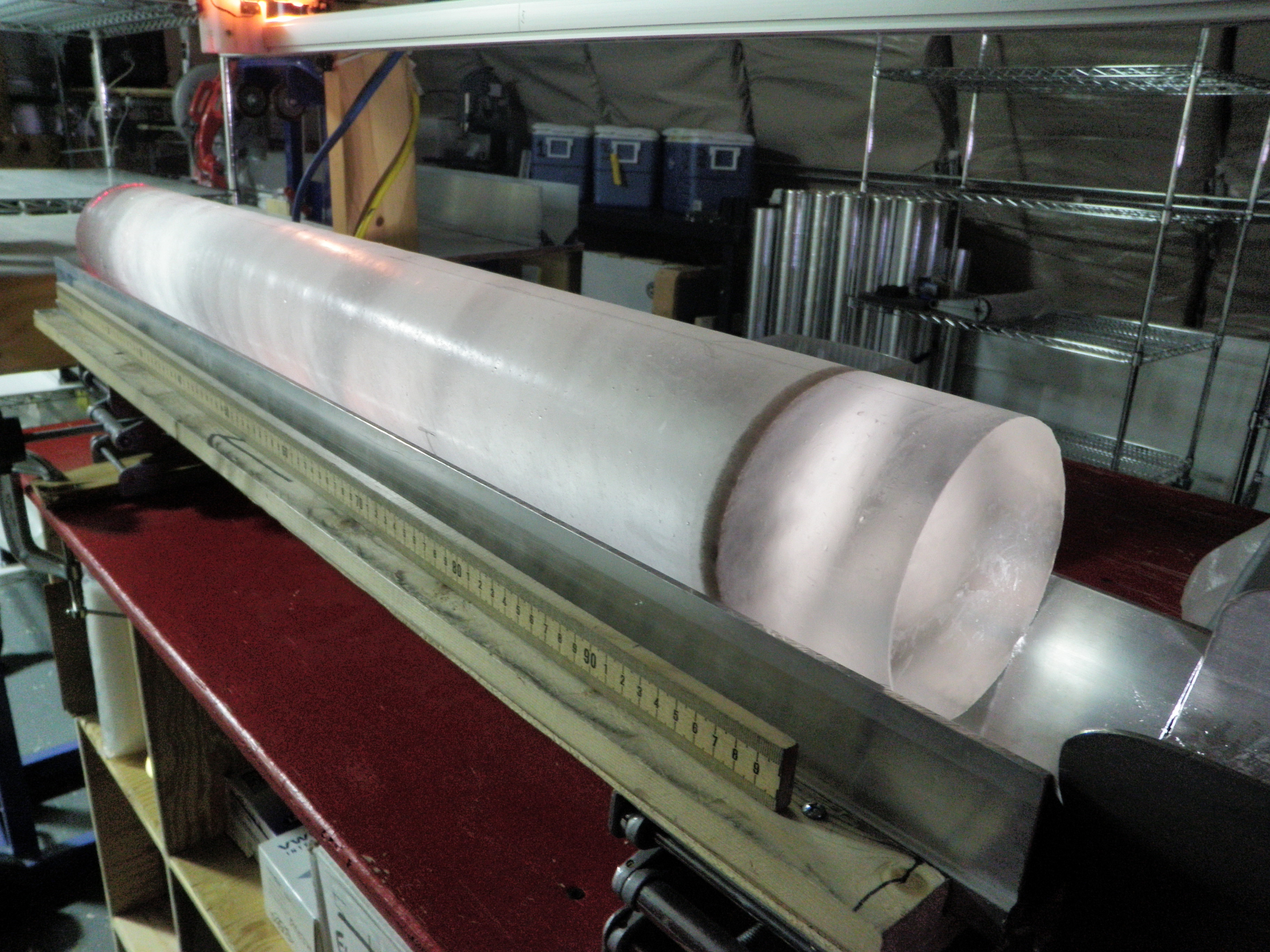
Ice core data comes from Tibet, Greenland, and Antarctica, stretching back hundreds of thousands to even millions of years (though stuff older than a hundred thousand years is sparse and/or fragmentary). This is not complicated stuff to grasp, you can clearly see the banding on these ice cores. From here - warning a ton of autoplaying videos.
Going back even further are sediment cores.
Ultimately, Creationists' only argument against the totality of this evidence is to declare God to be a deceiver. They can wrap it in whatever way they like, the ultimate responsibility lays with their God.
So far, the comments, while helpful, do not directly address the question.
The problem with dating a site like this is that you usually can’t analyze the structure itself - it is built of stone and, while there are some dating methods that work on certain kinds of stone, they are not useful on these particular stone structures.
Rather, generally archeologists date the stuff used to bury the structures. As it turns out, these particular structures were at some point deliberately buried. The infill contains organic material and that can be dated - which will not of course tell you when they were built, but will tell you when the stuff used to bury them lived … and the structures must be older than that.
However, these structures were not just stone - they also contain traces of plaster. An even better source of dating is the plaster used on the structures, which can be dated directly.
Here’s a paper on the particular problems of dating these structures.
A paper on the current state of research:
Edit: this account of how carbon-14 dating is calibrated by use of other methods (like dendrochronology) may also be helpful:
(Biblical chronology believer).
It appears that someone is a young Earth creationist.
This makes the age of Gobekli Tepe fairly irrelevant: our planet is four billions years old, the Universe is much older. Someone who denies that will not be convinced by any argument about a minor (relatively speaking) artifact like Gobekli Tepe. Personally, I think young Earthers are gone too far to be helped..
PS. beware also: (s)he can always make a catch-all argument that the Universe was made to look much older than it actually is.