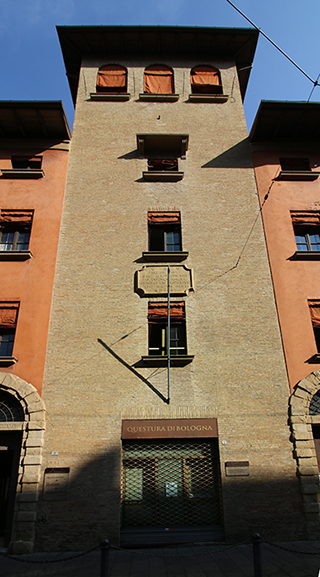
Curiously enough, this topic was one of my first answers on this sub. I thought I had enshrined it on my profile, but have only now discovered the link erroneously directs to a discussion on the use of Tuscan Vernacular in Italian literature. As it stands, my answers seems to have been lost to the annals of the internet.
But it’s probably for the better, as my answer was mostly focused on the historical context as to why medieval Italians built towers, but as I recall I didn’t really examine why they were so interested in building them specifically in Bologna, which as you mentioned is famous for its towers.
So let’s get the unhappy news out of the way: most hard estimates of the number of towers in Bologna are inflated. The higher numbers in the range were derived by 19th century historians (like Giuseppe Guidicini) who probably counted the same tower multiple times across various source documents. The actual number is probably closer to 100 (of which I think 22 are still standing) and while the city is famous for the frightfully tall tower of the Asinelli, most towers would have been much more modest in height. Those illustrations of medieval Bologna looking like modern Manhattan you can find on the internet are fanciful depictions composed in the 19th and early 20th century, in reality most towers would have only stood a few storeys above the roof line.
In all, this pattern of tower construction is fairly well aligned with the preferences of builders of medieval aristocratic homes in the rest of medieval Italy. We just don’t really notice towers outside really notable examples like the half-dozen truly tall towers still standing in Bologna. This is because if they weren't outright demolished in the following centuries, many got “Gobbled Up” as buildings grew around them. Here are some examples of what that looks like:
In Milan, the tower of the Meravigli: http://blog.urbanfile.org/wp-content/uploads/2015/01/2014-10-18-Meravigli-0.jpg
In Florence, the tower of the Giuochi: https://museocasadidante.it/wp-content/uploads/1970/01/esterno-museo-casa-di-dante.jpg (commonly referred to as, “Dante’s House” and home to the eponymous museum, however the consensus is that the poet was actually born in one of the neighboring homes and certainly not in this building)
And in Bologna itself, the tower of the Agresti: http://www.torridibologna.it/wp-content/uploads/2018/11/agrestintera.jpg
To see what these towers would have looked like in their prime, you can take note of all the towers in this depiction of the "Ideal" city as envisioned in the late the 13th century: https://www.flickr.com/photos/117367017@N06/12560175855
So even though nowadays they don't seem so impressive beside the large buildings that have sprung up beside them, in their day these these towers would have stood prominently in their neighborhood without being shockingly tall, in Bologna as elsewhere.
Towers appear in lots of places, and you might imagine building towers is not an arbitrary choice. They’re fairly simple and efficient defensive structures, which we wouldn’t be surprised to find attached to even the most modest rural baron’s manor, as well as over bridges, gatehouses, or even as stand-alone structures. The fashion of building towers in Bologna, much like in the rest of Italy, probably began precisely with gatehouses. In the communal governments of the Italian cities, it was common for powerful and influential dynasties to be assigned the responsibility of a gatehouse’s maintenance and defense in exchange for special powers and privileges (in Milan, this was actually an integral part of the government system). Notably, the aforementioned Torre degli Asinelli in Bologna, in its earliest form, stood over “Porta Ravegnina” (or “Porta Ravennate”) from which the road from Bologna to Ravenna began (the postal address of the intersection where the tower stands is still formally, “Piazza di Porta Ravegnina,” although nowadays there is little to no remnant of this earliest circle of walls, save some hints in the street grid).
As the urban aristocracy grew in influence in parallel with the Italian cities growing in prosperity, up-and-comers began to build towers imitate the older “Senatorial” dynasties in the construction of gate-house and other fortifications. But these were still not arbitrary constructions: They often appears around courtyards, which could be built-up by a single dynasty or acquired over the years by one or more interconnected dynasty. In the urban dynasty's neighborhood "Complex," these towers provided a safe redoubt in which the family and their associates could bar themselves, and offered a high vantage point overlooking the courtyard and surrounding streets from which trouble could be spotted. In short, they acted as strong points constructed to guard and defend each dynasty's little corner of the city. We don’t always see this pattern of construction nowadays as buildings adjacent to the tower might have been modified, restructured, or even outright demolished as the city changed, but in their day the towers would have been an integral part of the dynasty's local neighborhood.
Did Bologna develop a uniquely competitive approach to tower construction? Maybe. We don’t really have any contemporary commentary explicitly telling us, “Wowza, these Bolognese are building absurdly tall towers!” Can we ascertain via circumstantial evidence that internal conflicts in Bologna were particularly competitive as to stimulate performative tower construction? Possibly, but there’s no objective measure for that. Besides, when reading about the internal conflicts in larger communities like Milan and Florence, you don’t get the impression that political life in Bologna was any more competitive or cutthroat than in other Italian cities. Ultimately, it’s only really likely that it was a small group of Bolognese aristocrats who competed in the tower building-craze in a very tight temporal window (sometime in the twelfth century) so it must follow that in some way, conditions in that window were particularly inductive to reaching the conclusion that “Needlessly Large Tower” was a desirable thing to build. And we also cannot exclude that the Asinelli were uniquely hellbent on building a tall tower for reasons which were not entirely rational, which itself could have done a lot to influence other tower-builders to increase their desired tower height (at any rate, in medieval and renaissance depictions of the city the tower of the Asinelli is consistently depicted as standing a fair way above all other towers).
We can, if we’d like, focus on the fact that the Bolognese aristocracy’s tower-building phase coincided with events which had a particular impact on unrest in the city: Notably, the investiture controversy was very divisive in Bologna, with a three-way split in the city’s aristocracy which included an imperial faction, a papal faction, and the burghers who didn’t much like either; this is contrastable with other Italian cities, where analogously significant divisions instead manifested around a half century later, and instead during the earlier conflicts between Pope and Emperor the bulk of the aristocracy instead generally got behind one single camp (even though there were also instances of minority camps staging a fearsome opposition — notably in Tuscany). Also of note is Bologna’s stagnation: for a city of its size and relative prosperity, it actually begins to architecturally stagnate fairly early on (much smaller states, like the Malatesta’s lordship around Rimini, or the city of Ferrara to the north, not only appear more artistically and socially vibrant long into later periods but also play an outsize role in local geopolitics, all in spite of being smaller and probably less prosperous than Bologna). So this means that more towers than we might expect were allowed to continue standing where they were and have survived to the modern day, while in other Italian cities there was a desire to knock medieval towers down as the needs of the city’s inhabitants changed. This ultimately contributed to Bologna being considered, "A place with more towers than other places" even though in the past, it might not have had a notably more numerous number of towers.
So what of your questions on tower life for the dozen twelfth century Bolognese aristocrats who sat down and said, “We have a tower, yes. But what about a TALLER tower?” As I insinuated above, these were primarily defensive structures, often built as a component of a multi-family complex. Some towers were inhabitable and might have more spacious floors and rooms (with possible uses as varied as storage space for mercantile goods, servant's quarters, armories, treasure rooms, and maybe quarters for a redoubt) and these were generally the shorter and squatter variety, while taller towers instead tended to be purely defensive and were generally not inhabitable (they originally might not even have a doorway, only being accessible from adjacent buildings or external gangways, and inside might not have much more than wooden platforms).
As for climbing up and down the tower’s innumerable steps, this was certainly not a frequently contemplated activity. Laws even emerged forbidding the construction of stairs within a tower above a certain height (although enforcement was probably difficult) and many did not even have windows at their highest levels. While we cannot exclude that a Bolognese aristocrat might occasionally climb to the top of their tower and admire the view, they did not need to climb all that high up should they ever need to drop projectiles onto a mob of adversaries crowding the street below.