The only information I can find on crucible material and design comes from medieval/renaissance Europe, where kaolin clay was used to make the famous "Hessian Crucible."
The problem is, that comes from the 15th/16th century, whereas the ancient Chinese were using blast furnaces since before the birth of Christ.
As such, I really want to know:
How different these ancient Chinese blast furnaces were to European early modern ones
What materials the ancient Chinese used to both make the actual furnaces themselves and the crucibles or other containers used to melt and hold the molten metal
Whether or not the technological innovations from China influenced the European blast furnaces, or vice versa
Why it took nearly two millennia for Europeans to start using blast furnaces compared to the Chinese or, equivalently, why the Chinese felt blast furnaces were better for their usage than bloomeries
Any help or sources are appreciated!
The earliest iron metalworking in ancient China were done using the technique known as kuan-lian (塊煉), where pulverized iron ore are heated in a charcoal clay bloomery and turned into highly impure chunks of spongy slag-iron lumps called kuaitie (塊鉄). These lumps must then be heated and hammered repeatedly to remove their impurities and turn into workable iron. The earliest examples of this type of iron smelting process are found in Moguo burial sites in modern day eastern Gansu province, from around 11th century BC. Until the end of the Spring and Autumn period or 6th century BC, pretty much all irons in China were produced via this type of kuan-lian low temperature smelting process. [1] The earliest cast iron ingots was found in a Spring and Autumn era (c. 8th century BC) tomb from the ㆝马-曲村 (Tianma-Qucun) site, but they contain high amount of impurities and are extremely brittle. [1] The major shift from kuan-lian to **ye-zhu ** (冶鑄, lit. “melt-casting”) method for iron production in ancient China took place during the Warring States period, and it was a rather rapid transformation due to intense interstate warfare and competition during this historical moment. The wide availability of iron during the late Warring States period is evident from both archaeological artifacts and text records from this period. [2] For example, Mo Di (c. 470 – 391 BC), a famous Warring States era siege engineer and the founding of the Mohist school of philosophy, wrote the following on his Fortification of the City Gate,:
門植關必環錮,以錮金若鐵鍱之。門關再重,鍱之以鐵,必堅。 ……二十五步一灶,灶有鐵鐕容石以上者一,戒以為湯。(My rough translation: “The reinforcement beams and bolts of the city gate must be firm and strong and wrapped with tough iron sheets. The horizontal bolts of the gate must have double redundancy, both must be strong and wrapped with iron. … [On top of the city walls] there must be a stove every twenty-five bu apart (~35 meters), each equipped with an iron caldron which holds at least one dan (~30.4 liters) of water ready to boil.[3]
Sima Qian’s Shiji mentions that the melt-casting ironwork first appeared in the state of Zhao and Wei, then quickly spread to other major states such as Chu and Qin. To raise income for the state, both Qin and Han imperial authorities took exclusive control over the iron production industry, establishing an extensive network of state-owned iron mines and foundries across China. This metalmaking revolution was possible largely due to the invention the ye-zhu iron melting method: pulverized iron ores and the flux (usually 石灰 or limestone powder) are continuously fed into the top of a shaft-shaped furnace known as 熔爐 (rong lu “melting furnace”) [4], which is usually 3-4 meters tall, built with multiple layers of brick walls (as opposed to earlier bloomeries made with clay), and at the bottom of the furnace comes with a series of ceramic “wind pipes” which continuously blows hot air from the bottom to the top of the furnace. The earliest example of this type of melting furnace was found in a late Warring States era site in present day Jiudian, Henan province, which corresponds to the territory of the Wei state (consistent with Sima Qian’s narrative that cast iron production began in Zhao and Wei). See here for a photo of the Jiudian furnace (showing the wind pipe entrance at the bottom of the furnace), and this picture for a reconstruction of what the furnace might have looked like.
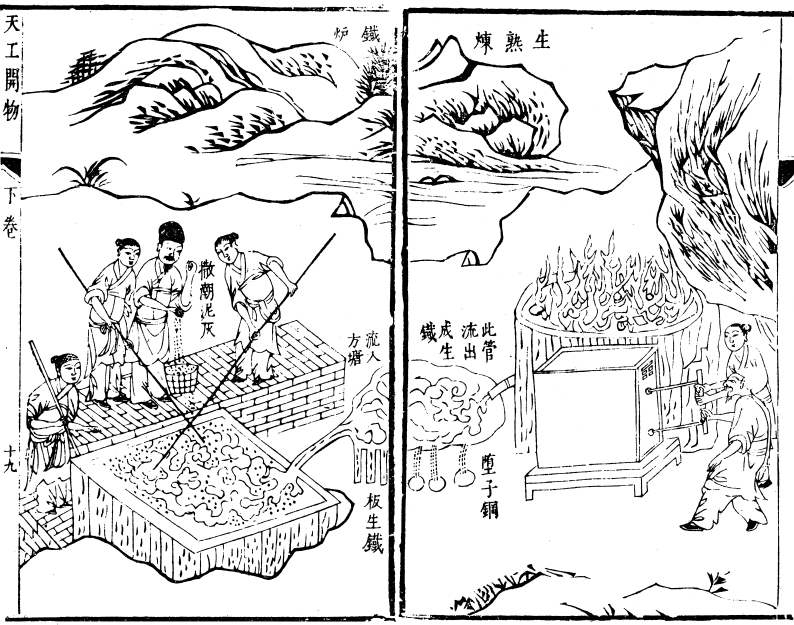
Currently there are more than 30 major iron foundry archaeological sites from the Han dynasty discovered throughout China. I have visited one of these sites near Zhengzhou in person some years ago, see this page for some photos of that site. By early Han period, iron production in China have evolved into a process which remained relatively static until the Song dynasty (when coke-fired furnace became prevalent). First, a stream molten iron (鐵水, lit. “iron water”) is tapped from a continuously operating blast furnace flows through a series of narrow channels on the foundry ground. The hot blast is provided by multiple human powered bellows made of animal skin during early Han period, and from mid Han period it has become more common to use bellows powered by water wheels such as the one seen in this photo. A small portion of the molten iron from the blast furnace are casted into brittle ingots with high carbon content known as 生鐵 (shengtie or literally “raw iron”), for reprocessing or recasting. Most of the molten iron stream from the blast furnace would then be directed into a rectangular ground-level open furnace known as 炒鋼爐 (chaogang lu or literally “stir-frying steel furnace”) seen in this photo. [6]
Atop of the stir-frying steel furnace, which is basically a rectangular pool of molten iron, foundry workers would sprinkle highly refined iron power into the molten ore while continuously stirring it with long poles (thus “stir-frying the steel”), until a relatively homogenous mixture is reached with relatively few impurities and low carbon content. From there, the “stir-fried” molten iron is casted into ingots known as 熟鐵 (shutie, lit. “cooked iron”) of various sizes and shapes, ready to be forged into their final form. See this illustration from Tiangong Kaiwu for an excellent visualization of this iron making process.
[1]陈建立等. "甘肃临潭磨沟寺洼文化墓葬出土铁器与中国冶铁技术起源." 文物 8(2012):9. [2]韩汝玢《天马—曲村遗址出土铁器的鉴定》,北京大学考古系商周组等《天马—曲村1980~1989》, 第1178~1180 页,科学出版社,2000 年。 [3] Mo Di (c. 470 – 391 BC), 《備城門》available: 墨子 : 卷十四 : 備城門 - 中國哲學書電子化計劃 (ctext.org) [4]新書 : 卷四 : 鑄錢 - 熔 - 中國哲學書電子化計劃 (ctext.org) [5]Wang Zhen 《王氏農書》(1271 - 1333), 王禎農書 - 维基文库,自由的图书馆 (wikisource.org) [6]考古中国. “铁器时代 · 汉代冶铁遗址” http://kgzg.cn/a/448.html Wei Qian, Xing Huang “Invention of cast iron smelting in early China: Archaeological survey and numerical simulation。” Advances in Archaeomaterials, Volume 2, Issue 1, 2021, Pages 4-14,