I will admit that I am not exactly sure how one should phrase this question and what part of what is now modern day China can be qualified for this topic, as my knowledge of early Chinese history is very limited. I suddenly realized that names, positions, relations and broad course of events concerning notable adversaries in Roman history, such as Carthage, Gauls, Germanic tribes and Parthians, are well known and researched, while I can hardly name anyone on the Chinese side during the period up to early AD, except for Xiongnu. Everybody knows that Carthage was fighting Roman republic for many years, and everybody knows that Caesar conquered Celts. What is the direct or broadly similar counterpart to these events, say, for Han empire? Who was Chinese Hannibal and what Gauls were actively resisting their conquests?
Excellent question! Exonymic adversaries are important components of traditional Chinese historiography, and there are indeed many of them mentioned in pre-Qin and Early Imperial historical texts. Many of the earliest ones are almost entirely mythological, such as the 九黎 (Jiu-li or “nine tribes of Li people) whose leader Chiyou fought against the alliance of Huang Di and Yan Di in the epic Battle of Zhuolu, which formed the classical legendary narrative for the birth of the Chinese civilization. I will skip over the quasi-legendary and focus my answer on the historical major “foreign” adversaries in Chinese Antiquity and Early Imperial periods. Please keep in mind that almost all our understandings on this topic, especially for “the period up to early AD” are from ancient Chinese historical writings, mostly official records. It is inevitable that classical Chinese sources about their external “barbarian” adversaries will contain bias and one-sided narratives. Modern archaeological findings are helpful to an extent to confirm and/or reject portions of classical accounts, but given the considerable time span, we still predominately rely on contemporaneous Chinese sources for our understanding of this subject.
1. The Qiang people:
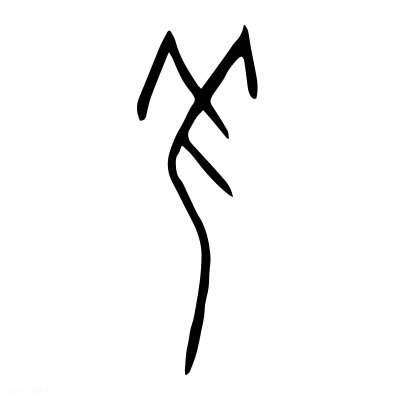
Not to be confused with the contemporary Qiang people, who are one of the 55 ethnic minority groups officially recognized by the PRC. The ancient [羌 / Qiang people](https://en.wikipedia.org/wiki/Qiang_(historical_people)) represent one of the most well-known outside adversaries during early Chinese Antiquity. Both the present-day Qiang ethnic group and the historical Tangut people – who established the Great Xia Empire (大夏) during Mid Imperial China – claim to be descendants of the ancient Qiang people. The actual historical connections between these groups remain unknown. The Chinese character for Qiang – 羌 – is derived from the Shang era oracle bone glyph which combines 羊 “sheep / goat” 人 “people” glyphs to mean “Shepards.” Historical documents typically describe the Qiang people as the most common military adversaries for Chinese states prior to the Spring and Autumn period. This is confirmed by oracle bone writings from the Shang period (c. 13th century to 11th century BC), which regularly mention Shang military expeditions to Qiang states and ritual killings of Qiang war captives. I have discussed oracle bone scripts and Shang human sacrifices in an earlier post, you could read them here and here. In Early Imperial Chinese historical documents such as Shiji, the Qiang is typically referred as Xi-Qiang or “Qiang of the West lands.” In pre-Qin bronze inscriptions and oracle bone scripts they are commonly referred as “氐羌 (Di-Qiang) and “羌方” (Qiangfang lit. “Qiang state”). The exact origin and geographical location of the Qiang people is unclear, but most scholars believe Qiang in ancient Chinese writings is used as an umbrella term for various bronze-age cultures to the west of China proper. Given the high frequency of military engagement between Shang and Qiang people, it was once popularly thought that the ancient Qiang land was geographically close to the Shang domain, perhaps in the mountainous regions of present-day border between Henan Shaanxi provinces.[1] Interestingly, recent DNA analysis of bone fragments of human remains uncovered from Shang human sacrifice sites suggests that the Qiang people during the Shang period were from areas much further west than previously thought – around the northeastern edge of the Tibetan plateau which is more than 1,000 kilometers (or 650 miles) away from the Shang capital!
(To be continued...)
[1] 王明珂《羌在漢藏之間》ISBN 9787101061673