Portative Organs were very popular instruments for thousands of years, apparently one was found in the ruins of Pompeii, however it seems that at some point in the Middle Ages they fell out of use and they haven't been revived despite the fact that we could make far superior versions of that instrument with out modern technology
What happened?, why did people stop using this instrument entirely?
In short, portatives simultaneously became aesthetically unfashionable with the more elaborate polyphony of the late medieval period and were superseded by technical advances in larger organs.
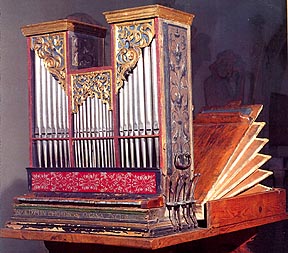
For the purposes of your question, I'm going to define a portative Organ as a small, one-manual instrument played with one hand and blown with the other, achieving all its winding from a single bellows without an attached reservoir. More on this later.
I wouldn't call the Pompeii organ a portative per se, even though it's small: Organs before about 250 AD used water displacement to ensure consistent wind pressure, which meant that they had to incorporate a water tank into the base of the organ. While it would be portable by a few people and sometimes operable by one, the water-filled base required meant that they needed at least two people to safely move, and were probably most comparable in size and weight to a modern continuo organ. The best English-language source on water organs is probably Werner Walcker-Meyer's book on the early 3rd century organ found at the Aquincum firehouse, though it's more of a case study than a general book about organs of that time. I recall the Cambridge Companion to the Organ at least touching on the matter, but I'm several thousand miles away from my copy and don't feel like getting on a plane for a reddit comment.
The medieval portative as we know it almost certainly predates 757, when Pepin the Short may have received the gift of an organ from Eastern Roman Emperor Constantine V. Regardless of this instance's historicity (of which there is some debate: see Williams and Bicknell), the Byzantine organ of this time had multi-fold bellows, which are instrumental to the portative.
Physics and Construction
To blow air through pipes, one needs a wind supply. Organ pipes can be finicky things, and only sound at a certain pressure range: when subjected to pressures outside of this range, they go increasingly flat or sharp, then stop sounding entirely. In order to keep a consistent pressure, modern organs use either reservoirs or multiple weighted bellows feeding the same wind system.
In an organ with reservoirs, either a mechanical blower or series of manually-operated feeder bellows feed a reservoir, from which the pipes draw their air. This allows for some leeway on the part of the pumper, who has already pumped a few seconds of air into the instrument to be used at a later time. If you go see your local pipe organ, chances are that it'll get its air have a blower feeding a reservoir.
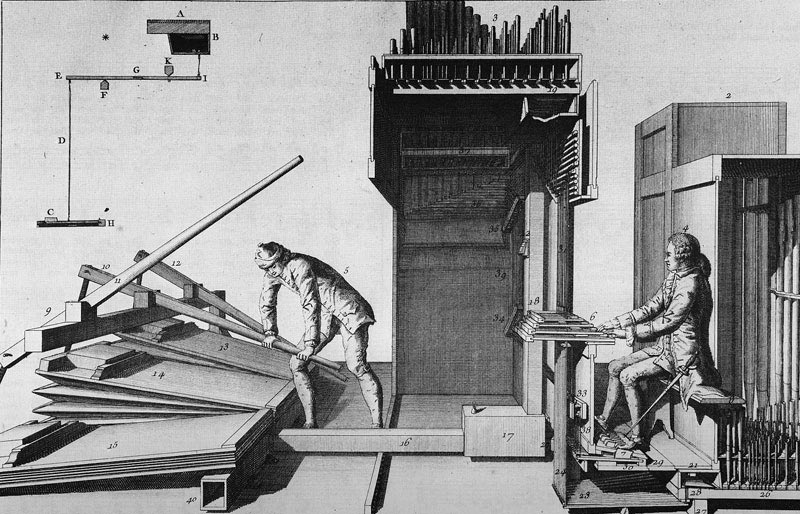
The other option is to have several different bellows operating at once. Each set of bellows is independently weighted, and will feed wind into the organ at a fixed rate. The pumper's job is to top up the bellows, making sure at least one is feeding the instrument at all times. The best visual example of this is the famous "guy with a sword" illustration from Dom Bedos' classic 18th-century organbuilding manuall'Art du Facteur d'Orgues.
The Portative has neither of these. The single bellows makes the long, sustained tones of the organ impossible, and requires the player to breathe the instrument almost as if they were a singer or brass player. Additionally, the portative's short, stubby keys are only suited for melodies or very basic accompaniment: virtuosic runs or polyphony with greater than three voices is impossible. While this is anecdotal, I've played a modern portative from 2014, and found it remarkably difficult to play. One has to press the bellows at a set rate, and figure out when to let the instrument "breathe" in the music.
Changes in taste
Larger organs had acquired modern-style keys by about 1420, which permitted their players to play elaborate polyphony. The portative's limitations when combined with the changing musical tastes of the late medieval and early renaissance period saw it confined to ensembles, then outmoded entirely as organs grew both larger and more versatile in the number of sounds they could produce. If two people could produce music with elaborate polyphony on an instrument the size of a dining room, wouldn't you prefer that than going to see one person with a little box of whistles? Early written organ music like the Buxheimer Orgelbuch would be impossible to play on a portative.
That isn't to say that the small, portable organ died out entirely: the Regal was a popular instrument in wealthier Renaissance households, and a number of aristocratic music fans in 18th-century Europe got really into the idea of having small organs in their houses. The most recent of the small organ is the continuo organ mentioned above, a very small organ built into a box and used in performances of early music since the middle of the 1950s. I'm not sure what you mean by "improving the instrument with modern technology," but I'd maybe push back a little on the idea that modernization of an instrument is an improvement. With technological advances, small, subtle things can be lost, like the flexibility in hand-blown organ wind systems or the subtlety of vacuum tube distortion.
Edit: While it sounds ridiculous, I'd say that the closest modern relation to the portative organ in terms of use, setting, and ease of movement is the keytar. If you're interested in portative organs built by modern people, I'd encourage you to check out the work of Dresdener organbuilder Marcus Stahl.
N.B. most all of the sources on this are very out of print and somewhat difficult to obtain. If you're interested in reading further, your best bet is probably the nearest university library. I'm also currently away from most of my musicology books, but please let me know if you have any questions.
Sources:
Bicknell, Stephen. "King Pippin and the Origins of the Organ". Piporg-l, 1997, Acc. via Stephenbicknell.org . I wouldn't normally include a source with so polemical a tone, but Bicknell really knew what he was talking about as both a musicologist and organbuilder according to multiple people I've talked to who knew him and what I've read of his work.
Bicknell, Stephen. The History of the English Organ. Cambridge: Cambridge University Press, 1996.
Dom Bedos de Celles, The Organ-Builder vol. II tr. Charles Ferguson. Raleigh: Sunbury Press, 1977. Ferguson changed the title from the more literal translation of "The Art of Organ Building" probably due to that title already being occupied by another Anglophone book.
Thistlethwaite, Nicholas and Webber, Geoffrey ed. The Cambridge Companion to the Organ. Cambridge: Cambridge University Press, 1999.
Walcker-Meyer, Werner, The Roman Organ of Aquincum. Ludwigsburg, Musikwissenschaftliche Verlagsgesellschaft, 1972.
Williams, Peter, The Organ in Western Culture 750-1250. Cambridge: Cambridge University Press, 2005.