I am curious to know what the public reaction was, if any, and how different sectors of society responded to the discovery.
The German documentary Our Heavenly Bodies from 1925 (originally titled Wunder der Schöpfung, Wonder of the Creation) was a follow-up to the 1922 smash hit Die Grundlagen der Einsteinschen Relativitäts-Theorie explaining Einstein's theory of relativity. The 1925 film was also a major success and did at least some international touring (a reconstructed copy exists and can be watched on Youtube because part of the film was found in Helsinki and merged with another portion of the film found in Berlin). It is a tour-de-force of 1920s special effects including stop motion animation and forced perspective.
Near the end it features a series where space explorers move further and further away from earth, and because light takes time to travel, the explorers see a series of scenes going progressively back further in time. It isn't quite clear how the explorers are outrunning light, but they seem to be using a fantasy ship much like Carl Sagan's in Cosmos, which is appropriate given the movie is essentially the 1920s version of Cosmos. (The film makers had, of course, just made a science film on relativity, so it is unlikely this was a "mistake".)
What the movie does not include is the idea that leaving the Milky Way leads to other, entirely different galaxies. Even though 1925 is after Hubble's observation (where he found a variable star in a nebulae and was able to reckon the distance, verifying that the "island universe" theory was true) it hadn't quite filtered down yet to mass communication in a general way -- also note that the film took over 2 years to make! This was in the period where the island universe was considered a viable theory and nobody had quite proved it yet. By 1927, though, Popular Science had a glossy article:
These stars, astronomers find, are not sprinkled at random in space, but grouped in countless separate universes. Our universe, the Milky Way, is one of them, and our sun, a huge ball a million miles in diameter is just one of a million stars in the swarm.
Popular Science had 350,000 subscribers in 1928. The German magazine Kosmos was selling 200,000 copies a month through the 1920s. The Science of Life (1929 by H. G. Wells, Julian Huxley and G. P. Wells) sold hundreds of thousands. (For comparison, Time by 1927 was considered influential and had roughly half the subscriber base of Popular Science.) The public in 1920s had a hunger for science -- they had, after all, seen the rise of the automobile, the airplane, and the terrible weapons of WW1, and wanted to know more -- but trying to gauge the public reaction to this specific scientific discovery is still a tough ask, as
a.) in general, historical people haven't collected "reaction quotes" the same way modern people do
b.) historians also generally haven't made it their focus so research on the area is light
c.) this is one of many discoveries at this time, science was fast moving, even if we just focus on astronomy, so it isn't like one particular moment would be thought of as epoch-making at the time
d.) there was enough lag time in the idea being popularized that it would be difficult to mark the moment when a particular person in "the public" knew about it
e.) the idea of island universes had been around for quite a long time already, and it was a subject of recent debate so confirmation of what was already considered in the 18th century doesn't represent a sudden shift in reality that might get a reaction, even from astronomers who were close to the knowledge.
There was a sudden shift in reality from Hubble's discovery, but it wasn't from the confirmation of island universes. Before we get to that, let's step back in our time machine of the mind to the 18th century--
...
Emanuel Swedenborg's ornately titled The Principia Or, The First Principles of Natural Things, Being New Attempts Toward a Philosophical Explanation of the Elementary World from 1734 is perhaps the first attempt at something like a "island universe" theory, although not in those terms.
This very starry heaven, stupendous as it is, forms, perhaps, but a single sphere, of which our solar vortex constitutes only a part; for the universe is finited in the infinite. Possibly there may be other spheres without number similar to those we behold; so many indeed and so mighty, perhaps, that our own may be respectively only a point; for all the heavens, however many, however vast, yet being but finite, and consequently having their bounds, do not amount even to a point in comparison with the infinite.
This was essentially pure philosophizing, imagining the visible heavens as a "single sphere" in the sea of the infinite, akin to medieval cosmologists having arguments about "is it possible for void to exist" based on pure argument. (Nicole Oresme from the 14th century: "...if two worlds existed, one outside the other, there would have to be a vacuum between them ... it is impossible that anything be void...")
Thomas Wright in 1750 independently came up with the same concept, with more reference to evidence: "...is in some Degree made evident by the many cloudy Spots, just perceivable by us, as far without our starry Regions, in which tho' visibly luminous Spaces, no one Star or particular constituent Body can possibly be distinguished; those in all likelihood may be external Creation, bordering upon the known one, too remote for even our Telescopes to reach." He theorized the center to the universe has "the Divine Presence or some corporeal agent full of all virtues".
This was picked up by the philosopher Kant not long after (who directly referred to Wright, and while taking the general idea discarded the "corporeal agent full of all virtues" concept) and then finally the great astronomer Herschel, looking specifically at nebulae. Herschel did eventually (after some attempts to measure distance) settle on nebulae being within the Milky Way.
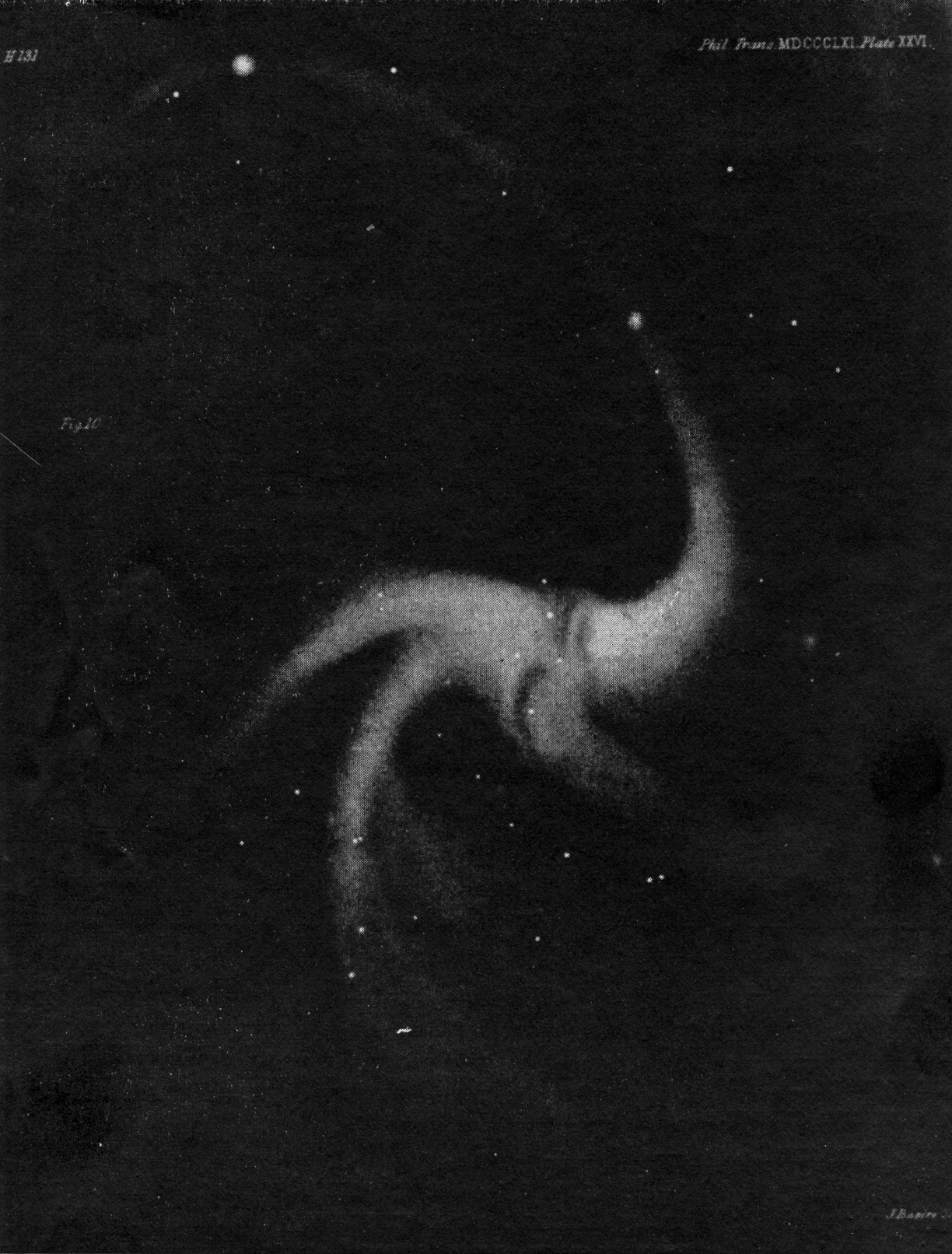
It wasn't until the mid-19th century another attempt at reviving the idea was tried, with a picture from the Earl of Rosse of Messier 33, leading to speculation from Alexander Stephen in a 1852 issue of the Astronomical Journal that the “Milky Way and the stars within it together constitute a spiral with several (it may be four) branches"; this was shot down again with some misunderstandings of size.
More or less simultaneous to this the actual full term "island universe" was coined by astronomy popularizer Ormsby MacKnight Mitchel at Cincinnati College. Mitchel started a "citizen science" group in 1842 by offering for contributing (minimum $25) to building an observatory to be a founding member of the Cincinnati Astronomical Society and be able to use the telescope. Unfortunately, Cincinnati College burned down only a few days after the telescope came, so Mitchel switched gears to become a traveling popular lecturer; he founded an astronomy publication he called The Sidereal Messenger that was, according to the first issue:
...the first popular Astronomical periodical ever attempted (as far as we know) in any language...
He used the specific term "island universe" quite a few times, apparently for the first time (Von Humboldt used the term "Weltinseln" in 1850 which could have been translated that way, but it was translated instead as "world islands".) Even if the concept was restricted more to musings of philosophers in the 1700s, the mid-1800s had the idea brought to the public.
(Mitchel unfortunately did not outlive the Civil War -- he was called up as a Union General and while stationed in South Carolina he died of yellow fever.)
Hello everyone,
If you are a first time visitor, welcome! This thread is trending high right now and getting a lot of attention, but it is important to remember those upvotes represent interest in the question itself, and it can often take time for a good answer to be written. The mission of /r/AskHistorians is to provide users with in-depth and comprehensive responses, and our rules are intended to facilitate that purpose. We remove comments which don't follow them for reasons including unfounded speculation, shallowness, and of course, inaccuracy. Making comments asking about the removed comments simply compounds this issue. So please, before you try your hand at posting, check out the rules, as we don't want to have to warn you further.
Of course, we know that it can be frustrating to come in here from your frontpage or /r/all and see only [removed], but we thank you for your patience. If you want to be reminded to come check back later, or simply find other great content to read while you wait, this thread provides a guide to a number of ways to do so, including the RemindMeBot- Click Here to Subscribe - or our Twitter.
Finally, while we always appreciate feedback, it is unfair to the OP to further derail this thread with META conversation, so if anyone has further questions or concerns, I would ask that they be directed to modmail, or a META thread. Thank you!