This is one of those questions that's hard to narrow down; there was enough variety across the country that everything happened everywhere. I feel like what you're aiming at is a metropolitan area with a preponderance of black-owned clubs, and asking if there was some sort of separation between bootlegging where the black-owned clubs and white-owned clubs were serviced by gangs with similar separation.
Well, kind of.
Certainly there were black bootleggers and club owners. Someone who was both was Gus Greenlee, probably a better known name to baseball fans (I'll get to that in a moment). He was a taxi driver from Pittsburgh who went to fight in WW1; he returned to Pittsburgh to find Prohibition kicked off shortly after (1920) and supplemented his taxi business with liquor transport, getting the nickname "Gasoline Gus". This made him sufficient financial support for him to start his own club -- The Paramount -- where he could supply his own liquor.
The Hill District, aka Little Harlem, had a multitude of mixed-race clubs like the Harlem Casino and aforementioned Paramount Club. It became a particular center for jazz musicians but a police raid caused the Paramount to be closed in 1922, but it was reopened again with 1924. Then it faced allegations of white women "running wild" (a fairly common theme amongst the mixed clubs was fear of white women with black men) and had its dance license revoked, but this lasted only a year.
However, despite all that, bootlegging was not where the black underworld found the majority of its money. They instead found it with "the numbers racket".
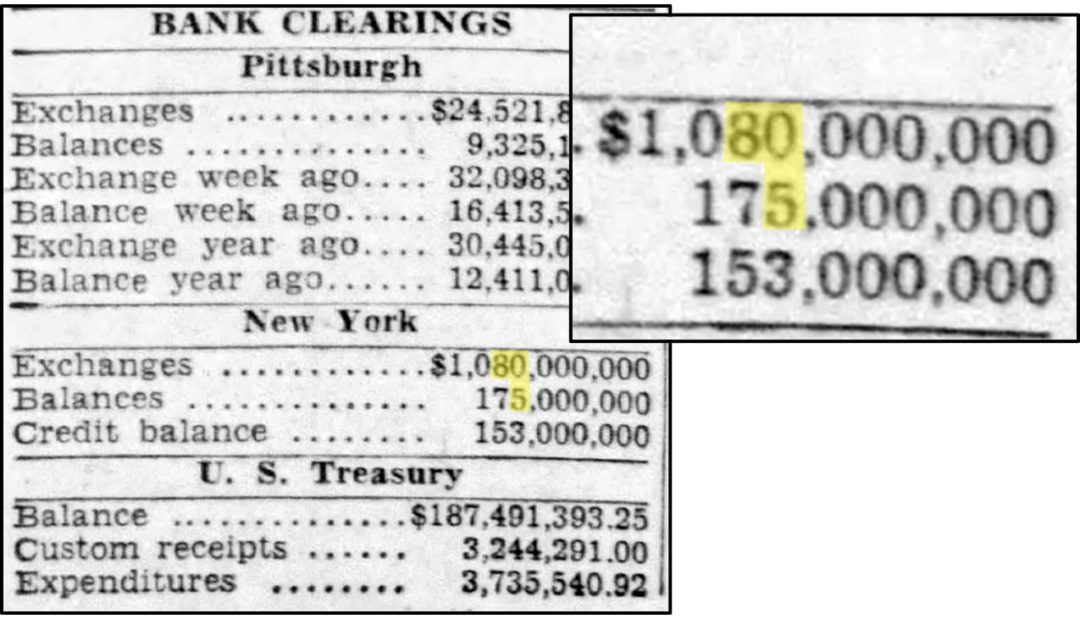
Quite simply, a trio of numbers drawn from the financial papers each morning (here's an example that will come up later) was the "lotto number" for the day that people could gamble on. This was immensely popular and one of the "numbers" mavens, William "Woogie" Harris, became so successful he eventually employed 4000 people.
This was possible in that it was considered "poor man's gambling" in the 1920s; the white gangs were more interested in the financial boon from alcohol, enough so they were willing to cause mayhem and murder to protect their product.
For example, in 1930 Joseph LoBianco (with his wife Josephine, who was pregnant, and his brother Carmen) was at their store stocking when a sedan drove by and opened fire. All three were murdered in what became known as the Braddock massacre. Carmen (with ten bullet holes) made it to the hospital and was asked who the killers were before he died:
He wanted a pound of sausage, then boom, boom, boom...
The police found a five-hundred gallon still and checks to one of the biggest bootleggers in the area. This was clearly a murder related to the bootlegging racket but the crime was never solved.
Another murder in 1931 was Joseph Siragusa, known as the "Yeast Baron", who ran across three men with guns while shaving. He was shot down with five bullets, and police found him dead with his parrot calling "Poor Joe! Poor Joe!" over and over.
So black organized crime making more money from gambling than bootlegging was something of a protective stance (Chicago and New York had similar), but this only lasted while Prohibition did. When Prohibition ended, the white gangs realized they had an opportunity they could muscle in on.
Gus Greenlee at least made it out ok. In addition to being essentially a bank for black club owners (banks, of course, were not keen on giving loans to African-Americans) he even survived the infamous day of August 5, 1930, where, as the link I posted earlier shows, the magic number was 805. Betting based on the date was popular enough that losses were over $400,000 for the Pittsburgh area. Gus had to mortgage houses and sell cars in order to pay off debt.
He eventually became legendary for his sports patronage, being the primary founder of the second Negro League and sponsoring the local Crawfords. He eventually got out of baseball but got back in in partnership with Branch Rickey and the short-lived United States League, who signed up a young Jackie Robinson. The USL folded quickly but Robinson went on to break the color barrier as Rickey owned another team: the Brooklyn Dodgers.
...
There could be black gangsters in mostly-white gangs; I wrote earlier this year about the case of Al Capone.
Conner, L. (2007). Pittsburgh in Stages: Two Hundred Years of Theater. United States: University of Pittsburgh Press.
Feldman, L., Ingham, J. N., Feldman, L. B. (1994). African-American Business Leaders: A Biographical Dictionary. United Kingdom: Greenwood Press.
Gazarik, R. (2017). Prohibition Pittsburgh. Arcadia Publishing.
James, W. H., Johnson, S. L. (1996). Doin’ Drugs: Patterns of African American Addiction. United States: University of Texas Press.
Schatzberg, R., Kelly, R. J. (1997). African American Organized Crime: A Social History. United States: Rutgers University Press.