I read an article on “Le Monde” saying around 45% of all comics sold in France are manga, making them the second largest consumer after Japan. According to demographics there doesn’t seem to be a large Japanese population in France nor a large French population in Japan. I was wondering if there was a historical explanation for this beyond French people just really liking manga.
Not an historian by any stretch, but as a French amateur nerd who witnessed this I might shed some clumsy light into your enquiry. Apologizes in advance for my non-native English!
Let me begin by saying that the cultural relationship between France and Japan is not a recent phenomena. In the artistic sphere there are several 2 way roads between them. During the imperial colonial era for instance, Japanese art influenced several French art movements such as fauvism and art nouveau. A few decades before that Japanese emperors already were visiting Paris's World Fairs on a few occasions. French and Japanese cooks also usually share a huge mutual respect. In 1998 Nintendo's Shigeru Miyamoto was made a Chevalier (knight) of the French Ordre des Arts et des Lettres by the French Minister of Culture. To this day there is a tangible mutual fascination and respect between these 2 nations.
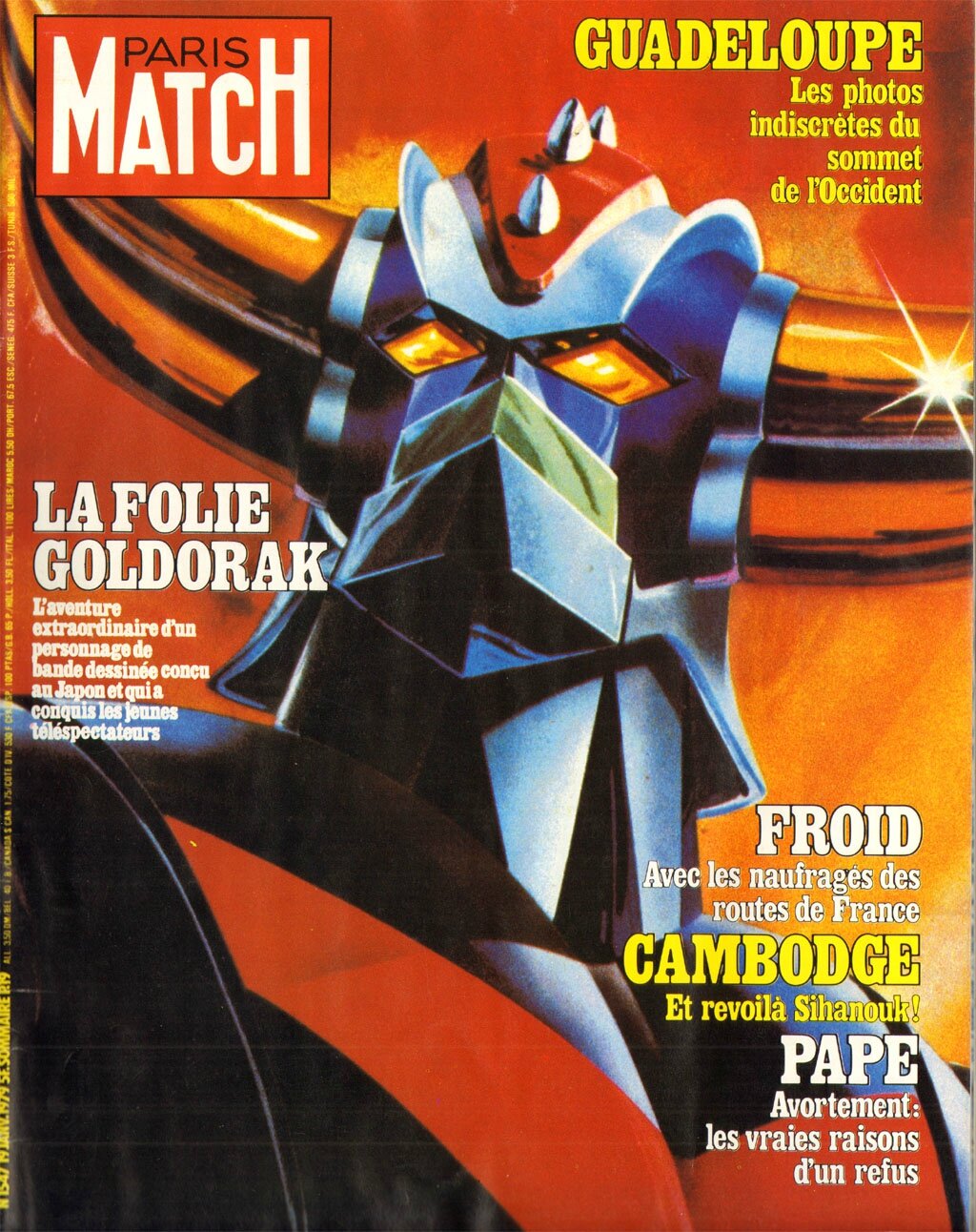
During the late 1970's, French TV networks began to air Japanese animation fully dubbed in French. Who knows why? But they seemed to have been the first second to do so in the western world. One new series from Toei Animation in particular became a national hit when it started to air in 1978: Goldorak UFOロボ グレンダイザー, UFO Robo Grendizer.
It became ridiculously popular in France. Not unlike Marvel Studio level of popularity, probably more popular even. It was one of those "before internet craze" that are so hard to describe in today's all digital world. The entire French youth was glued to their parents TV daily. You could easily find Goldorak merch for more than a decade in France. This even happenned.
It was such a success henceforth a literal flood of Japanese animation exploded on French tv.
A few French animation producers took note early on and went to Japan, they began working on co-producing several animated series to feed the growing appetite for Japanese animation in France and overseas. Their production company name was DIC Audiovisuel. In 1981, DIC established a partnership with the Japanese animation studio Tokyo Movie Shinsha, as one of the overseas animation subcontractors. They helped animate many of TMS's programs, starting with Ulysses 31. They also produced the unaired pilot Lupin VIII. This partnership lasted until 1996. Their first release in 1981 was again a massive success in France: Ulysses 31 . A sombre singular series sadly often forgotten outside of France, inspired by Homer's epics, the first anime to ever have CGI. DIC continued to produce a few hits, later they created a franchise that you are probably familiar with: Inspecteur Gadget.
Parallel to DIC, as the French TV market grew and fresh private networks entered the fray, most of them had to have japanimation as an integral part of their youth program package. TF1 and Antenne 2 had most TSM DIC and Toiei series (saint seya, captain tsubasa, Urusei Yatsura, maison ikoku,and so many many more... ), Canal + aired Chōdenshi Baioman, Silvio's Berlusconi's now defunct La Cinq had Robotech at 8:00 pm on prime time (Macross), and TV6/M6 had the left overs... And I must say, as someone who indeed grew up watching French TV during the 80's, we were ridiculously spoiled with a large choice of animation, all dubbed in French. You had flavours for everybody, lots of sci fi and action, romance, adventure, fairy tales, even French centric historical ones. The offer was vast and the quality was there. It was a golden age for young viewers. (Side note - Daft Punk got into Leiji Matsumoto during this time, his several Captain Harlock series got wildly popular back then, naturally becoming a major influence on the then young French electronic duo, they later collaborated on this little project.
And then, in the early 90's came DBZ and in more discreet fashion Akira. Technically Dragon ball began to air in 88 in France. But it's DBZ that changed the game. Colossal success once again. Meanwhile Akira despite not being a colossal popular success by any stretch, got a lot of critical acclaim in the French comics sphere. French comic publisher Glènat chose to publish it monthly in colour first, it quickly became a sensation. It showed that manga could have mature themes with spectacular style. They soon released it in hard cover format and quickly became a best seller. The Akira movie got released in 92, it aired for a couple weeks only in one single movie theatre way up in the Champs Elysees. One theatre only in the entire capital, probably the entire country if not continent. The queues were insane... and fun. I waited 4 hours surrounded by hundreds to be able to see it on the big screen during a weekday afternoon.
Anyway, with DBZ's vast catalogue and Akira's pretty big length, that's when the French comics publishers took off. Massively publishing manga in print. Series after series. Before that there only were a few magazines or fanzines that you could sometimes find in newspaper shops, but you couldn't really find any translated manga in any French library or market before DBZ and Akira. It used to be a narrow market, the typical underground type. Most mangas were not translated in those days. One had to go to the Japanese neighbourhood near the Opera Garnier in Paris, in specialized Japanese libraries to even be able to hold an original imported one in hands.
DBZ and Akira did for printed mangas what Goldorak did for tv series: it legitimized and opened new markets. By 1995 you could find dozens of mangas in France, translated, page reversed, sometimes even colourized, sometimes in bigger format, without any advertisement and printed on quality paper. Hard-covered even. The French comics bande dessinée way. And they just kept rolling with it ever since really. 2 generations and counting.
TLDR: French tv networks were among the first in the western world to air Japanese animation fully dubbed as far back as the 1970's. French comics publishers were among the first to publish translated mangas in the late 1980's. French youth have been watching and reading manga earlier and longer than mostly anybody else outside of Japan.