They had a population of 300k and only 60k of those people died from the bomb, how did they manage to survive if they had no idea the nuke was coming?
Also Hiroshima doesn’t have that much radiation today and is even better off than it was before the war, why is it less than other places that we nuked like bikini atoll?
So the number of how many died at Hiroshima is actually pretty difficult to know. Reasoned estimates range from 70,000 to 140,000 or so (there are some higher estimates but they are not based on much). I wrote an article all about these estimates and their methodology and history a couple years back. It is complicated by the fact that it isn't clear how many people were actually in the city on the morning of the bombing. It may be higher than either of those estimates. It's just hard — essentially impossible at this point — to know for sure, because the record-keeping in late-WWII Japan was not great to begin with (especially for groups of people who were not considered official citizens, like Korean laborers), and the destruction caused by the bombing made it even harder.
So that's one aspect of it. Secondly, it is easy to overlook how crazy a mortality percentage even just 60,000 is for Hiroshima. Let's say that there were 300,000 people in the city that morning and "only" 60,000 died. That's 20% of the city dead (and another huge percentage injured) — one out of every five people. And if it is the high end of things, that's nearly 50%. To put it into contrast, the March 1945 Tokyo firebombings that killed 83,000 people out of a city of 5 million people, with about 1.5 million were in the targeted areas. So that's 2-5% mortality rate by comparison; the Hiroshima attack was some 10X more deadly when measured this way (there are other ways to calculate attack mortality, including mortality by area affected, where the Hiroshima attack was still many multiples of the Tokyo attacks).
I think a general issue here is that people have been conditioned to imagine that nukes kill everything and everyone, and are somewhat numbed to "statistical" deaths. Nukes are very powerful, but they have limits to their destruction, and 60,000 deaths in a single city, is a huge number. By comparison, NYC COVID deaths right now are "only" 60,000 (spread over 2 years, but most from early in the pandemic) and that was enough to overload the cemeteries and morgues in a city of 8 million. COVID deaths in the US are around 800,000 people out of a 300 million population, and that's enough that everyone is about one degree of separation from someone who died of it (e.g., the father of one of my co-workers, several of the friends of my in-laws). I like to remind people that the term we like to use for the experience of "massive loss of life" is "decimated" which means 10% dead. World War II, the deadliest war in modern history (and included famines and the Holocaust and all that), was about a 3% fatality rate from all causes globally, and nearly everybody knows of a close relative who died in it (e.g., my grandfather's brother). So a 20-50% mortality rate for a single attack against a city made up of 90% civilians is, frankly, horrendous. (When I talk to students about these things, I like to point out how many that would be in a typical class size. If I have 24 students, I would indicate five would be dead at the low-end, and 12 at the high-end. Such "small sizes" make clear how dramatic that would be, socially and psychologically, in a place where even a single student or faculty death has huge and obvious social ramifications.)
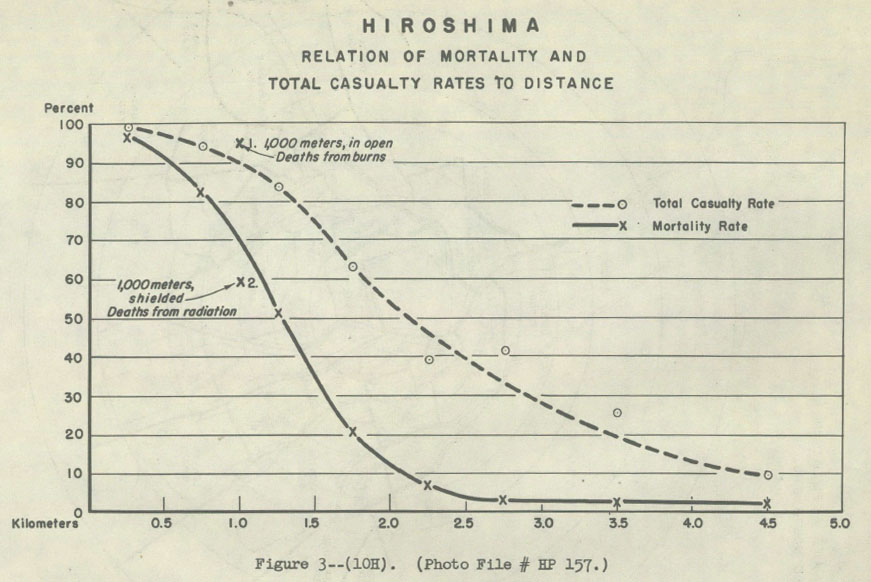
The mortality curve for nuclear weapons, which was mostly calculated from the examples of Hiroshima and Nagasaki, is sharper than what most people imagine it to be. Towards the epicenter, it is essentially 100%. But for a 15 kiloton weapon detonated at that altitude, it drops to about 50% after about a kilometer, and 10% after another kilometer.
So, anyway, that's your answer to the fatalities question — it is just a numbers game about where people were at the time of the bombing, essentially. You can use NUKEMAP's casualty estimator to see similar sorts of numbers for modern cities. I always include the total number of people estimated to be in the area of bomb effect along with the casualties/fatalities so you can get a sense of it; most people would be "survivors," but that doesn't mean that the total number of dead isn't a huge percentage.
As for long-term radioactivity differences between it and the Marshall Islands, there are two reasons. One is the amount of radioactive material created by the detonations. The easiest way to think about this is in terms of fission products — the "half-atoms" created from nuclear fission. Fission products are the most important and intense aspect of radioactive fallout (there are also heavy actinides and neutron-induced materials, but these tend to either be very short lived in the latter case, or extremely long-lived in the former case, whereas fission products occupy the whole spectrum of half-lives, meaning you get things that have half-lives measured in decades, which is the sort of "sweet spot" for "bad for long-term human habitation." Every kilogram of material (uranium or plutonium) that fissions releases about 17 kilotons of TNT equivalent, so you can work backwards from the yields to get the amount of fission products.
At Hiroshima you had a single 15 kiloton nuclear weapon go off which created a little less than 1 kilogram of fission products. By comparison, the Castle Bravo test at Bikini (March 1954) alone was 15 megatons (15,000 kilotons), of which 10 megatons was from fissioning (the other 5 Mt was from fusion, which does not create long-term contamination to the same degree). So that is more like 600 kg of fission products from just one test. The total fission yield from all testing at Bikini Atoll (1946-1958) was over 40 Mt. So you have over 2000X more radioactivity released in the Bikini testing than you did at Hiroshima.
The other thing is that Hiroshima (and Nagasaki) were high airbursts. That means the fireball never gets mixed with heavy soil and debris, and so the radioactive byproducts of the fission reaction stay in the cloud longer before they eventually fall out of the cloud. This means they are far more diluted by the time they come down than a ground burst. By comparison, most of the Marshall Islands tests were surface bursts, and as such a lot of their contamination came right back down again downwind of the explosion, creating areas of intense radioactivity.
If Hiroshima had been a ground burst, it would have had a very different contamination situation, similar to the Trinity Site today, which still has elevated radiation levels compared to baseline. +75 years later, spending a few hours at the Trinity Site is the radioactive equivalent of getting a dental X-ray. Not a big deal for a visit, but you wouldn't want large populations to be living in such an area over a long period of time (esp. ones more vulnerable to radiation hazards, like pregnant women and children), because you'd start to see increases in the cancer and birth defect rate, and in the short term (right after the blast) the residual radiation itself would have been intensely fatal.