TIL that something like 70,000 people died in the Battle of Carthage. In a world without much in the way of technology or machinery, what do you DO with that many corpses? Did they attempt to retrieve (presumably valuable) armor and weapons? Did they bury them in mass graves somewhere?
In the Homeric epics, what happens to a hero after his death in battle is almost as important as what he does in life. When a hero is killed, the enemy will immediately try to strip him of his armour - an important source of wealth as well as glory. For the hero's comrades and dependents, it is a terrible dishonour to let this happen. Many fights between heroes escalate into cycles of violence as one side tries to despoil the fallen and the other side tries to prevent it.
Once the fighting is done, the fallen hero's body is collected for an elaborate burial ceremony. It is a source of eternal shame and dishonour to be denied a proper burial; again, the friends of the fallen are expected to take care of their own. The body is cremated on a funeral pyre alongside precious gifts. Once the fire has burned out, a mound is built over the remains. Games and sacrifices to remember the dead go on for days. Hektor's funeral goes on for 9 days, that of Achilles for 17. Ceremonies like these serve to make sure that heroes are remembered forever, just as much as the heroic deeds they performed in life.
This is how the battlefield was ideally supposed to be cleared of the bodies of wealthy and powerful men. But if you weren't wealthy or powerful... Well, the opening lines of the Iliad note that the wrath of Achilles sent many strong souls of heroes to Hades, while their bodies were left to feed the dogs and birds.
The poem makes clear that after years of warfare around Troy there were decomposing bodies strewn about everywhere. In a few passages describing meetings, it is specified that the Greeks or Trojans picked a clean spot that was free of corpses. Solitary enemies caught at night could be accused of stalking the battlefield looking for bodies to plunder. In one scene, Odysseus and Diomedes lie down in a field of corpses and play dead to surprise a wandering Trojan scout. These scenes imply that most of the dead would actually be completely unattended, unburied and left to rot. The great fear of heroes was to be left as food for stray dogs, but for most of the warriors in these stories, that was all they could expect. Only on one exceptional occasion do the Greeks and Trojans agree to a truce to burn and bury the men who had died that day.
The weapons, armour and clothing of the dead could be reused, resold or taken as treasure, which made stripping the dead a higher priority than burying them. As I said earlier, on many occasions a victorious warrior would try to take his opponent's armour the moment he fell. Sometimes warriors have to be expressly told not to strip the dead just yet, because the battle is still going on: "let us kill the men now, and afterwards at your leisure all along the plain you can plunder the perished corpses" (Iliad 6.68-71). Assuming that there would be plenty of men who ignored such admonitions, we should probably imagine most of these dead bodies stripped of all their posessions and festering in the heat. A comedy by Menander, written centuries later, spins its plot out of this: an enslaved servant is misled into thinking his enslaver has died in battle, because the bodies have been left unattended for 2 days and have swollen beyond recognition (of course we find out later that the enslaver is still alive). We can only imagine the state of the bodies recovered by the Athenians 17 days after their defeat at the battle of Delion (424 BC).
But by this time, customs had changed. It was no longer normal for the bodies of common troops to be left unburied, as it had been in Homeric times. By the Classical period (ca. 500-323 BC), there was no longer a distinction between the treatment of the rich and that of the poor. Instead, the Greeks had developed a tradition of gathering all the bodies, either to be buried in mass graves on the battlefield or to be cremated and brought back home. This was essential to keep men in the fight: later authors remark on the importance for all soldiers of knowing that your remains will receive proper treatment if you die.
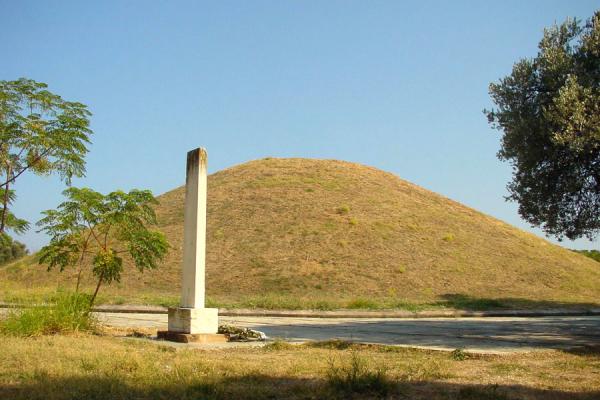
We're not sure exactly when this shift to collective burial happened, but we know that burial in mass graves on the battlefield was normal by the time of the Persian Wars - for both Greeks and Persians. The Athenians built a burial mound for the fallen at Marathon, which is still visible today. Meanwhile the Persians buried the 4,000 Greek dead at Thermopylai in a mass grave alongside the grave containing their own dead. Herodotos tells us of the various grave mounds built at the decisive battle of Plataia to distinguish different groups who had played their part in the fighting.
In each case, we should assume that the buried dead were already stripped of their armour by the victors, either before they were gathered, or in the process of gathering them. Mass graves of warriors in Ancient Greece practically never contain weapons or armour; if the men are buried with any grave gifts at all, it is usually strigils, the mark of athletes and thus of an (idealised) elite lifestyle. Stripping the enemy dead, in particular, counted as a claim to victory; in the Classical period, some of this armour would be set up on the battlefield as a trophy to memorialise the victory, while a tithe of the spoils would be dedicated to one deity or another in gratitude. Some temples in the Greek world appeared to be entirely covered in bronze from all the captured shields hung up on the exterior walls (the most likely origin of the name of the Spartan temple to "Athena of the Bronze House"). In another mark of the gradual collectivisation of warfare, the rest would not be divided up as private spoils, but would be sold by the state to generate cash.
The desire to give all fallen warriors a proper burial, however, creates a problem: what if you lose? What if the enemy holds the battlefield, and your own dead are beyond your reach? To solve this problem, the Greeks developed a custom in which the losing side would send a herald to the winners to ask for a truce to collect the dead. This request was tantamount to an admission of defeat. If the beaten side felt that it had not truly lost, it could skip the request for a truce and fight a second battle for the bodies instead; but it was understood that their duty was to recover the dead, one way or another. The request for the truce might be humiliating, but it was normally granted and honoured. Only very rarely, in very extreme cases, would the victor refuse to allow the defeated to give their dead a proper burial.
The result was that the battlefields of Classical Greece (unlike those of Homeric Greece) were usually pretty comprehensively cleaned by the combatants themselves. First, the victor would strip the dead of any valuables and bury or cremate their own fallen. Then the defeated would be granted access to clear away their own dead. The process was reasonably rigorous, because leaving even a single corpse behind could cause an outrage at home. Abandoning the dead was a very serious form of neglect of a general's duties and a violation of the custom that all the fallen would receive burial. And so, for the most part, anything that could be used or sold was gathered, and any bodies were disposed of according to the customs of each state.
This is why Greek battlefield archaeology usually doesn't yield much at all...
A similar question was posted a while back, with detailed answers in the comments : https://reddit.com/r/AskHistorians/comments/isac2i/so_were_watching_the_return_of_the_king_and_i/