Tl;dr: We don't exactly know, but probably taller than 5 ells in Old Norse-Icelandic or 7 feet in the 13th century English measure (about 210-230 centimeters tall?)
1: How tall was actually (?) Göngu-Hrólfr, as narrated in his saga and other text?
First of all, we have a problem of his identification. While the legendary hero of the protagonist of the saga, Göngu-Hrólfrs saga (linked to the original Old Norse text), that we'll see below, has been usually identified with Rollo of Rouen since the late 12th century, at least the extant saga text shows almost no connection with the alleged career of the "real" Rollo who would settle in now Normandy.
Alternatively, we can perhaps regard Hrólfr-Rollo as two distinct legendary figures who share the same moniker. In that case, we can also suppose that the heights of alleged two Hrólfr-Rollo must have been about the same (enough to get the same moniker).
Anyway, the saga author narrates that:
"Hrólfr, son of Sturlaug, was the very distinguished man both in his girth and height, and he was so heavy that no horse can bear him all the day, and also that he was always on foot." (My clumsy translation from the passages in question of Göngu-Hrólfs saga, Kap. 4).
You might be aware of the subtle nuance here - the text itself does in fact not state that no horse could not stand his weight on time - but in longer duration (all the day), certainly no. This might complicate the question, but the older annotation of the moniker in the (late) 12th century Latin text suggests I might think too much.
"In this company was a certain Hrólfr, called Göngu-Hrólfr by his comrades because he always travelled on foot, his immense size making it impossible for him to ride. With a few men and by means of a marvellous stratagem he took Rouen, a city in Normandy......." (Historia Norvegie, Chap. 9. English translation is taken from: [Kunin trans. 2001:14]).
This History of Norway (Historia Norvegie) is AFAIK the oldest text from Old Norse world (though the text itself is written in Latin) that alludes to this famous moniker of Hrólfr-Rollo, and gives this moniker to the historical Rollo.
2: 5 ells in Old Norse-Icelandic and 7 feet in English: King Haraldr harðráði of Norway falling off from his horse
Then, what these two figures (of height) mean in Old Norse world?
These two are alleged heights of famous King Haraldr harðráði (Harald hardrada), narrated by Snorri Sturluson in Heimskringla:
- "Now if I accept this offer, what will he [King Harold Godwinsson] offer King Haraldr Sigurðarson for his trouble then?’ Then spoke the horseman: ‘He has said something about that, what he will grant him of England: a space seven foot long, or so much longer as he is taller than other men." (Haralds saga Sigurðarsonar, Kap. 91, in: Heimskringla. The translation is taken from: [Finlay & Faulkes trans. 2015: 113])
- "King Haraldr was a handsome man and noble-looking, fair-haired and with a fair beard and long moustache, one eyebrow a little higher than the other, large hands and feet and both well shaped. His height measured five ells." (Haralds saga Sigurðarsonar, Kap. 99, in: Heimskringla. The translation is taken from: [Finlay & Faulkes trans. 2015: 120])
I'm not really good at calculating historical units, but it is generally said (both by the editor of Old Norse original edition in ÍF, Bjarni Aðalbjarnarson, and the translator of the cited English edition) that the "ell" in Viking Age roughly corresponded with about 46 centimeters (Finlay & Faulkes trans. 2015, 120, note 271). Thus, 5 ells here would amount to about 230 centimeters (tall) in modern measurement.
On the other hand, it is not so easy to determine how long was actually this "feet" meant here. Even only for Anglo-Saxon feet, there seems to be two hypothesis, ca. 30.5 centimeters per a feet or ca. 33 centimeters, and we don't know whether Snorri's description in chapter 91 of Harald's saga is based on Anglo-Saxon feet or later, 13th century feet). If we take the shorter version (about 30.5 cm/ feet), "7 feet" would amount to about 213 centimeters.
I don't mean to argue here that how tall historical King Haraldr harðráði really was. The main reason to calculate his alleged height here is that the majority of later traditions (since the late 12th century) allude to one famous episode just before the main battle of Stamford bridge where he was killed. While he went to the frontline of the army, he was falling off from the stumbling horse - as a sign of either his arrogance or a bad omen.
The following passages (in English) are cited from Theodoricus Monachus (Monk Þórir), the oldest author mentioning this episode before 1188:
"And as King Haraldr himself, mounted on horseback, endeavoured to draw up his battle line, his horse stumbled and he was thrown to the ground; whereupon he is reported to have said: ‘Seldom is a sign of this sort an omen of victory.’ Nor was he mistaken in this unlucky omen, for he fell in that same battle." (Theodoricus Monachus, Ancient History of the Norwegian Kings, Chap. 27. The translation is taken from: [McDougall & McDougall trans. 1998: 45])
You can also find the corresponding scene easily in major kings' sagas from later times like Heimskringla and Fagrskinna, though Snorri alters a nuance of Harald's alleged comment on this event (Cf. Haralds saga Sigurðarsonar, Kap. 90. [Finlay and Faulkes trans. 2015: 112]).
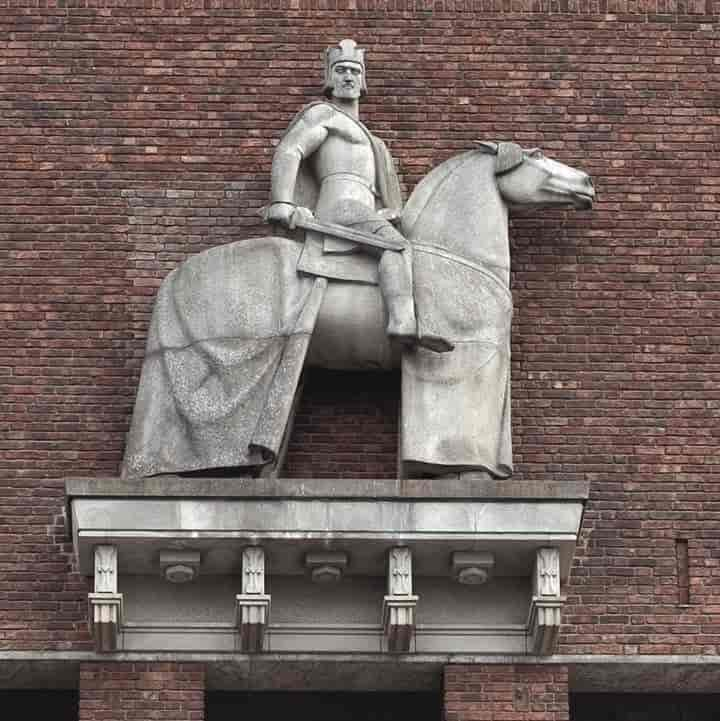
Again, I don't want to mean to discuss the historicity of this event here. The point is that later Scandinavian-Icelandic authors have apparently found no difficulty in narrating King Haraldr harðráði of Norway, an allegedly very tall and imposing (more than 210 centimeters high) figure, on his horseback. Modern artists also follow this tradition, and portrait him on horse back, like this horseback statue of Harald on the wall of Oslo City Hall by Anne Grimdalen.
[Added]: In other words, even legendary Harald's height, "5 ells/ 7 feet" (including exaggerations) was probably not enough to be regarded as too tall/ heavy for the horse.
Consequently, only if Göngu-Hrólfr (either alleged historical or saga's) was recognized as taller and heavier than this Haraldr, the saga author and audiences would find it appropriate to describe him "so heavy to be forced always on foot" as narrated in relevant texts. While it is likely that the height of King Haraldr harðráði itself, as narrated in Heimskringla, was exaggerated to some (or great?) extent, Göngu-Hrólfr in legends was probably regarded as much taller than historical Haraldr (who himself was regarded as very tall) enough to earn this moniker in traditions. This is essentially my answer to OP's question.
3: Can experimental archaeology/ animal science contribute to this question?
If we take these estimated figure (>either 210 or 230 centimeters height and corresponding weight) into consideration, neither of them looks so promising.
The closest academic research (or scientific news of its summary) is AFAIK: Icelandic horses carry heavy burdens (Sep. 23, 2015) (Original press release in Swedish is found in here)
The press release in question is based on the doctoral dissertation of the physiological reaction of modern Icelandic horses , alleged descendant of the horses that the Norse settlers brought to Iceland, with 140 cm tall and 350 kg in average, against the heavy weight like riders.
The scholar tested with max. 35% of the horse's own weight (that would amount to more than 120 kg), and well-trained one can bear this weight of rider, albeit in short time.
So, if Haraldr harðráði was really so tall as later traditions narrate, he (at least in the min. calculation, about 210 cm) might in fact have been able to ride the best kind of such horses at least in limited amount time and light gears.
References: