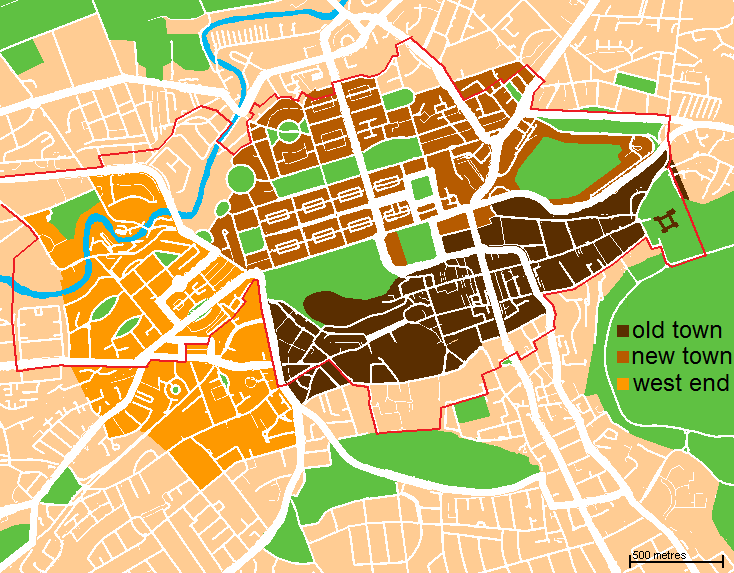
Cllickbait title, maybe. This really concerns Edinburgh specifically, but I'd be interested in similar examples.
I've read that the development of Edinburgh's New Town in the late 18th Century was designed for higher income people - mostly in preparation for the impending boom of the industrial revolution, but also the due to the affordances that came with the ideals of enlightened living. Architecturally, they wanted to break away from the traditional, "uncivilised", weaving clusters of buildings, and designed a strict grid-like arrangement which would better represent the values of the British Empire's Enlightenment - Reason, Liberty, Happiness and Order.
Determined spaciousness allowed for future urban development, sizable public buildings, and less spreading of disease or mould. New Town was not only aesthetically unfamiliar, but migration was also too expensive for Edinburgh's many existing working-class city inhabitants, who stayed in the slowly dilapidating Old Town. Intentionally or not, city planners created a clear residential divide of classes.
As an aside here, England were obviously very concerned with "naturalising" the Scottish people to industrial sensibilities using Economic and Political motions (maybe too many examples to mention, but this was around the same time as the Jacobite rebellion).
Were there any ways in-particular that British city planners managed to use architecture to alienate the Edinburgh working classes, or dissuade Scottish identity at this time? If they did so deliberately, how did they benefit from this? Were any "tricks" employed, such as with Robert Moses notorious bridges (disputed, I know.), or were class divisions purely coincidental? Are there other ways that architecture or urban development was used to the same effect around other parts of the British Empire?
This is a great question, and while I'd like to attempt to answer it, I'm really not knowledgeable enough about architectural or urban history, despite having lived in Edinburgh for a good number of years. Having gotten the kind permission of the mods, however, I'd like to recommend a few very good, recent books that might give you some leads on which to follow up.
• Aaron Allen, Building Early Modern Edinburgh: A Social History of Craftwork and Incorporation (Edinburgh, 2018).
• Murray Pittock, Enlightenment in a Smart City: Edinburgh's Civic Development 1660-1750 (Edinburgh, 2019).
• E. Patricia Dennison, The Evolution of Scotland's Towns: Creation, Growth and Fragmentation (Edinburgh, 2018).
In addition to these, I've found Andy Arthur's Twitter account to be an incredible font of architectural and civic Edinburgh history, and he's eminently approachable if you'd like to contact him directly with some particular questions. I'm confident he'd enjoy the interaction.
Apologies for not being able to help more, but I hope you find some of these resources useful.
With best wishes,
Dr Darren S. Layne
Creator and Curator, The Jacobite Database of 1745