Is it theoretically possible for a New World ship reaching the Old?
Full disclosure: I started writing this answer up, got distracted, forgot about it, rediscovered it, wrote some more, got distracted, forgot about it, rinse repeat. Anyways, this may have gotten a bit away from me.
You really have two questions here that tie together, the first being what Indigenous watercraft were like in the Americas, and the other about the sea-worthiness of those vessels. I’m going to be sticking to the areas I know best (Mesoamerica, the Caribbean, and the coast of Ecuador/Peru) and beg off pontificating on areas like the Pacific Northwest or the Arctic, about which I know basically nothing.
With as broad a region as North and South America to cover, there is going to be variation, but the basic watercraft in multiple regions was the dugout canoe. These could be crafted differently, have differing designs depending on the region and need to adapt to local conditions, and use different materials, but the canoe was the standard boat of the Pre-Columbian Americas. At least as far as we know from the archeological record, which is quite poor.
Maya
Up until recently, for instance, only fragments of boats had been excavated from the Maya region, though recently a small intact canoe was found in a cenote. The leading theory is that it was used for offerings cast into the waters of the cenote, and thus obviously not an ocean-going craft and therefore pretty far outside the scope of your question here. As a result of the poor material record, a lot of what is known about watercraft in the Peri-Contact era comes from European accounts, which necessarily misses a lot of important details since they were outsiders ignorant of things like building techniques and navigational practices. As many of the Europeans were, by the necessity of needing to cross and ocean to get to the Americas, experienced seaman (or at least familiar with ships), their descriptions can still be quite detailed and useful, such as with Ruiz de Estrada’s account of craft captured by the Spanish off the Ecuadorian coast in 1526.
Sticking to the Maya region for now though, what is known about their maritime activities and vessels? There’s actually some good research on Circum-Yucatan trade by the Maya. There’s very good evidence of extensive trade up and down the coast stretching from what is now southern Veracruz to the coast of Honduras. Coastal Maya polities also maintained links to inland groups as evidenced by goods found at these sites. For instance, Glover et al. (2011) notes how one site in Quintana Roo, Vista Alegre, was tied into the political and mercantile network of Chichen Itza which extended across Mesoamerica. The site has artifacts from down the coast into Belize, as well as Pachuca obsidian, mined in the Valley of Mexico. McKillop (2010) likewise found a wide array of artifacts at a site in southern Belize, Wild Cane Cay, with gold foil indicative of trade with southern Central America as well as artifacts from the Pacific Coast of Guatemala that must have traveled overland. Biological remains at the site shows the people of Wild Cane Cay were venturing out to exploit oceanic and reef fish.
Maya trade networks are fascinating, but they don’t tell us too much about the actual craft used in maritime trade, only that they were sturdy enough to maintain a bustling system of exchange up and down the coast. Again, the archeological record is astonishingly terrible, with a single paddle recovered from a salt works the only non-fragmentary evidence of the canoe trade (McKillop 2010). We do, however, have a fascinating description from Columbus’ 4th Voyage of a vessel encountered off the coast of Honduras. That boat was described as
eight feet wide, and as long as a galley, though formed of the trunk of a single tree. In the centre was a kind of awning or cabin of palm-leaves, after the manner of those in the gondolas of Venice, and sufficiently close to exclude both sun and rain. Under this sat a cacique with his wives and children. Twenty-five Indians rowed the canoe, and it was filled with all kinds of articles of the manufacture and natural production of the adjacent countries. (Irving 1892, p. 127)
A canoe made from a single tree, yes, but a damn big tree. The description of the items later on in the text is also fascinating. Among cotton items, foodstuffs, maize beer, and macuahuitls, there were also copper axes and bells, which shows this trade network extended out to the metallurgical centers in West Mexico, though probably through indirect trade. Despite being told by the Maya they were traveling from the west, Columbus continued east along the coast down to what is now Panama before returning to more familiar Caribbean waters. Had the Europeans elected to turn their ships in the opposite direction, they would have reached the Yucatan and perhaps even encountered the Aztecs more than a decade prior to the Cordoba and Grijalva expeditions.
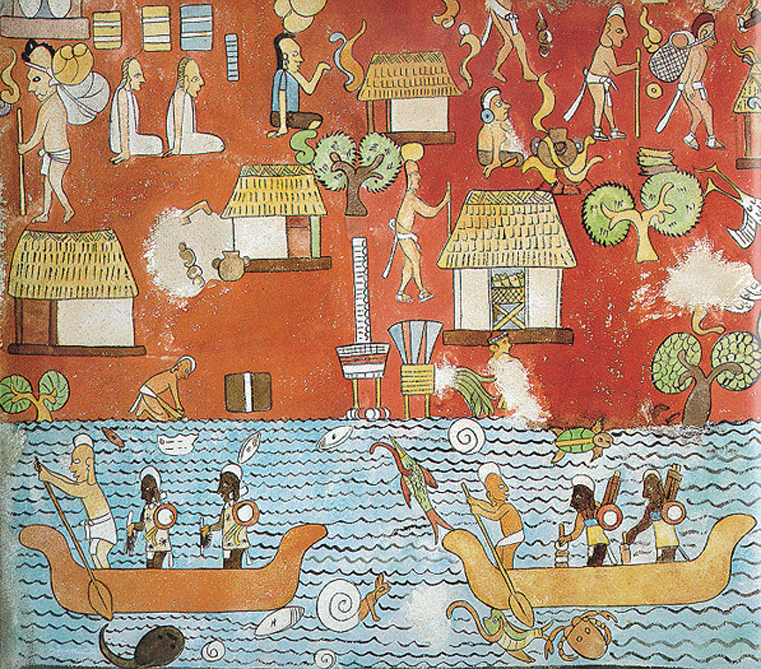
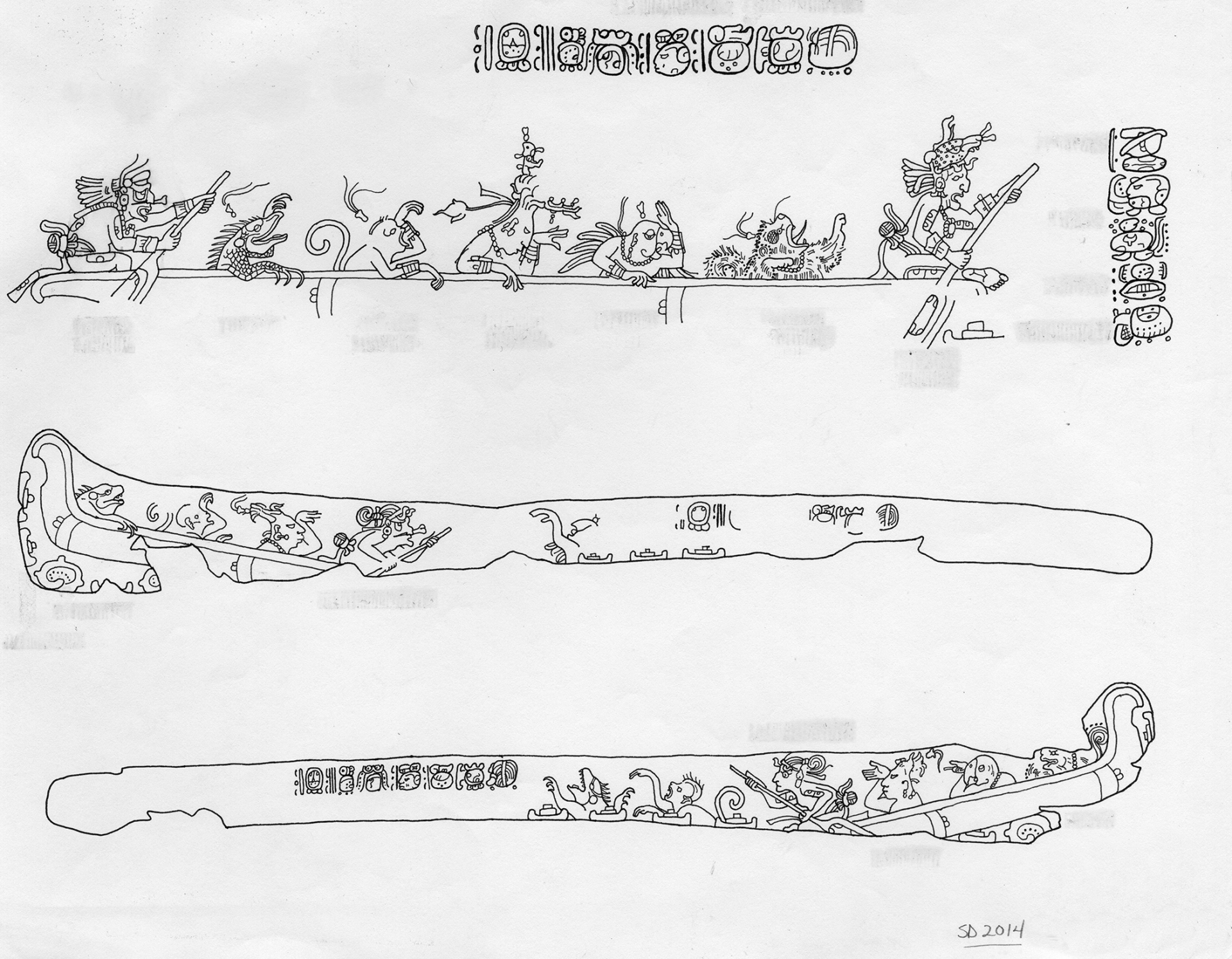
Along with scant first-hand accounts and the dearth of archaeological evidence, the pictorial record is also uncooperative with regards to Maya watercraft. Such depictions as do exist are often not painted in such a way as to be actually representative of real craft. The half-dozen or less people shown on such canoes may actually represent common use of smaller watercraft, but may also be an artistic convention stressing the importance of the persons, rather than their means of conveyance (for example, murals at Chichen Itza). In the case of a scene found on an incised bone at Tikal (Burial 116, the setting is clearly metaphysical, as the paddlers depicted are Maya deities ferrying the deceased ruler to the underworld. If realistically proportioned though, the main canoe shown could be anywhere from 8-30m, with about 40-50cm of freeboard (Hammond 1981).
Carved model canoes recovered from sites in Belize are thought to be toys, but may realistically show the basic shape of watercraft in the Classic era. The cultures of that area certainly had a high familiarity with seacraft, with buildings that utilized coral and abundant marine fish bones found in middens. The figurines, carved from manatee ribs, are flat-bottomed craft with a projecting prow and stern, and a length-to-beam ratio of about 10:1, which matches the general shape and proportion of more contemporary canoes (ibid). The extended prow and/or stern is a design found throughout Mesoamerica (and in the Caribbean), and may have aided both in keeping water out as well as acting as a platform for rowing, fishing, and even warfare (Thompson 1949).