It's absolutely true - at least in case of Nicholas II. Here's a photo of Nicholas II showing off his dragon tattoo on his forearm some years later.
Some background: in 1891, while his father Alexander III ruled, the future Nicholas II and heir to the throne was on the committee (as a somewhat nominal member) of construction of the the Trans-Siberian railroad, a infrastructural mega-project of geopolitical importance to this day.
Essentially, as the name implies, the Trans-Siberian railroad linked European Russia with its Asian far east - which before the railroad was an extremely remote, hard-to-access region.
This railroad construction coincided with Japan's modernising Meiji Restoration. Russia's diplomatic presence would naturally increase along with the railroad. To mark the start of the construction of the railroad, Nicholas visited Japan, where as a high-level official he was given a warm welcome.
Lengthy trip
To get to Japan, in the absence of the as-yet-unbuilt railroad, Nicholas sailed across around the world from Europe - a trip that, after adding in several stops to visit relatives and dignitaries, would take around six months. EDIT: On the way back, Nicholas II did make an overland journey across Siberia back home. It was doubtless less comfortable.
During his forward trip, Nicholas II stopped over, in addition to other places, Ceylon, modern-day Sri Lanka, then a British colony.
He met up with his cousin and friend 'Sandro' - Grand Duke Alexander Mikhailovich - complaining of the formal, stuffy nature of his Grand Tour.
"My trip is senseless," Nicholas II told Sandro. "Palaces and generals are the same all the world over, and that's all I am permitted to see. I could just as well have stayed at home."
Then in Japan, Nicholas II was accompanied by his cousin, Prince George of Greece (who was, incidentally, the husband of Marie Bonaparte, a great-grandniece of the French Emperor Napoleon, and also an uncle of the late Prince Philip, husband of the current Queen Elizabeth II of England).
The heir with the dragon tattoo
While on the Japan trip, Nicholas II had the tattoo in question, a dragon on his right arm. The exotic inking was inspired by the fascination in the orient at the time - and the imitation of novelist Pierre Loti, author of Madame Chrysanthème, an account of his temporary marriage to a Japanese woman while stationed in Japan as a naval officer (a common arrangement in this time frame.) Getting the tattoo was a painful overnight operation - and took 7 hours.
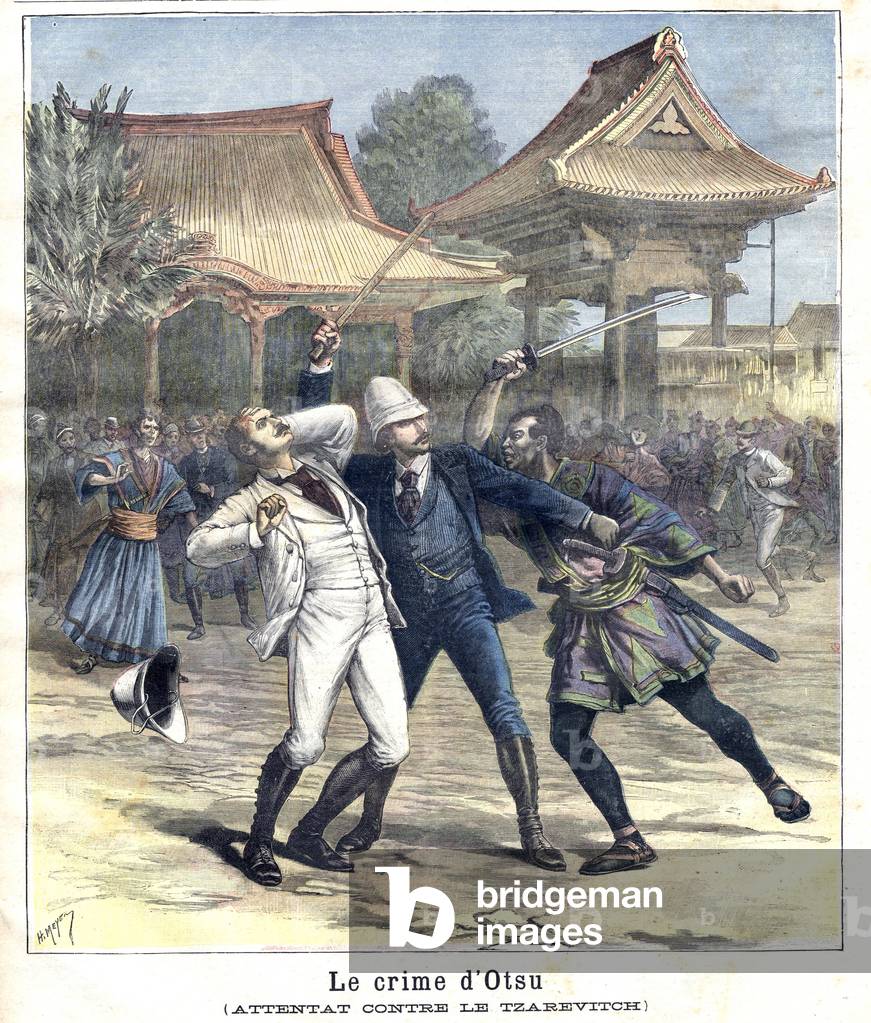
A week later, an event would take place that would have likely overshadowed any controversy regarding a tattoo. While returning to Kyoto, a crazed Japanese policeman who was in the royal protection pulled out his sword and swung at Nicholas II. The quick-acting Prince George parried the policeman and deflected the attack with his cane, probably saving the heir's life. Nicholas II was left with a 9cm scar on his forehead.
Here's an artistic depiction of the attack from a French publication at the time. I'd hazard a guess that the artist has applied some hefty creative license to the image.
Instead of the trip boosting Russo-Japanese relations, as hoped by the the Japanese government, the lapse of security - which caused the resignation of two senior ministers - may have soured Nicholas II's opinion of the Japanese as a whole.
False inferiority
Nicholas II would in his reign be known to refer to the Japanese as 'yellow-faced monkeys' - an assumed racial inferiority which the humiliation to Russia in the 1905 Russo-Japanese war would prove vastly false.
Lastly, even if Nicholas II's tattoo had somehow been controversial, it's unlikely that many of his subjects would have ever seen it.
Although Nicholas II was no stranger to casual dress (and swam naked with courtiers, for example) the average outsider would have seldom seen the tsar in short sleeves -climate and decorum would not have allowed.
Thus, I'd speculate that although clearly not ashamed of the tattoo, as the above photo shows, Nicholas II may simply have seen the inking as being on a place of his body that not many would be privileged to see -similar to how people today may get tattoos on more discreet areas to avoid employment difficulties.
Lastly, a cursory google suggests that as the world shrunk rapidly in the 1800s, tattoos grew in popularity in the Victorian era - and would become not merely the practice of sailors, soldiers, and convicts.