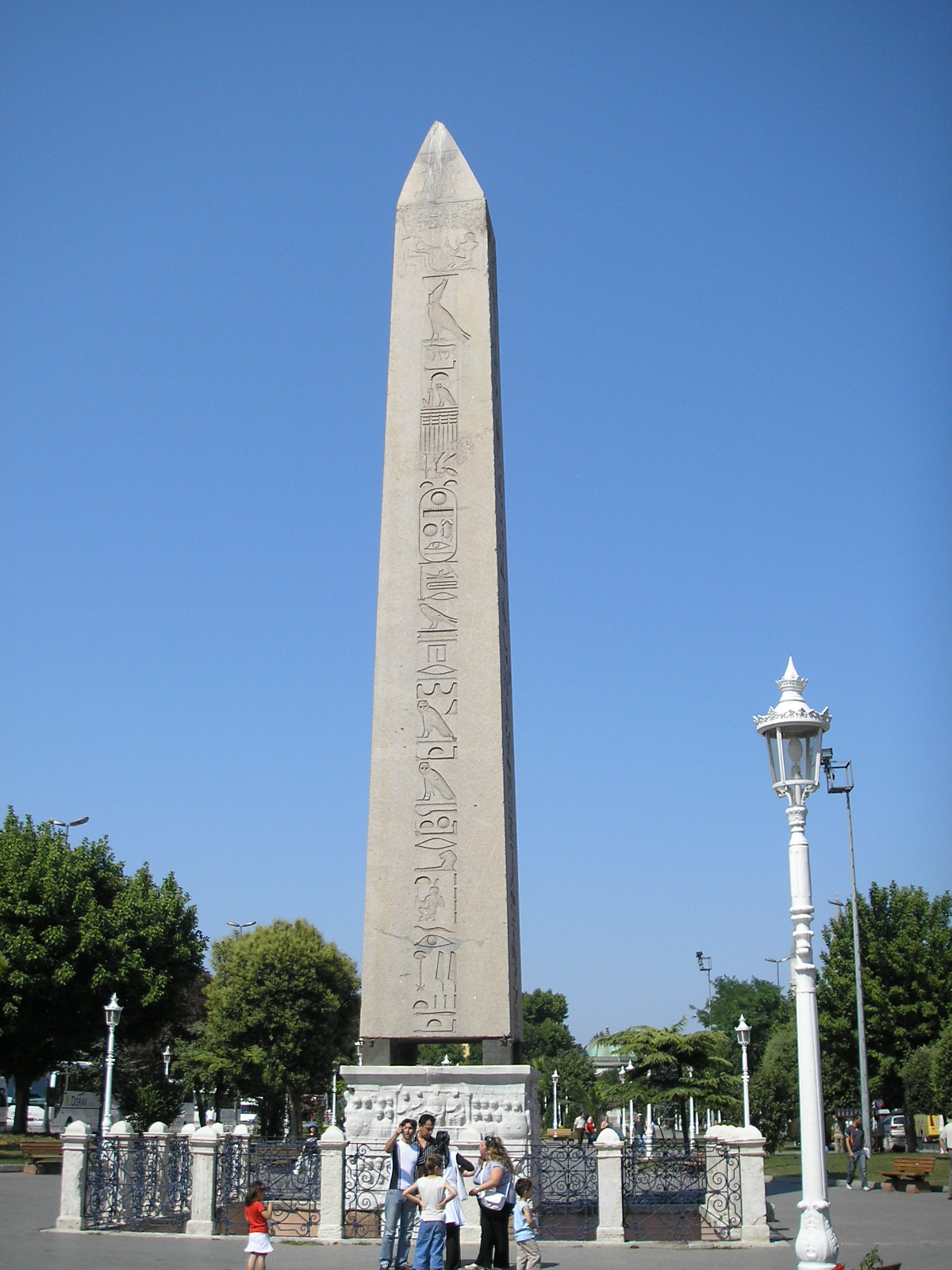
Your question, as it relates to the city's monuments, is perfectly answered by the obelisk of Theodosius (originally the obelisk of Thutmose III taken from Egypt to the capital), placed in the center spine of the Hippodrome in Constantinople. To put it in perspective, here is a digital recreation of what it would have looked like in the Hippodrome. For this answer, I'll be pulling mostly from L. Safran's excellent article Points of View: The Theodosian Obelisk Base in Context.
Note the central position and its height relative to all the other monuments on display. The obelisk was essentially the focal point of the Hippodrome and all eyes would have drifted towards it. Multiple Byzantine authors likewise compared its height and the circular path of the race track to the sun and the cosmos rotating around it.
For the purposes of your question though, we can look at the inscriptions at the base of the obelisk which were added when Theodosius ordered its relocation to the race track. Keep in mind, these were specifically ordered by Theodosius and so were made in line with his agenda. In fact, the base was actually carved while the obelisk was already placed in the Hippodrome, and so its additions were made with full awareness of the monument's surroundings. The sides of the obelisk base that we are concerned with are the east face and the west face. Note this map as well and remember that the east face points to the kathisma or the imperial box while the west face points only to common spectators.
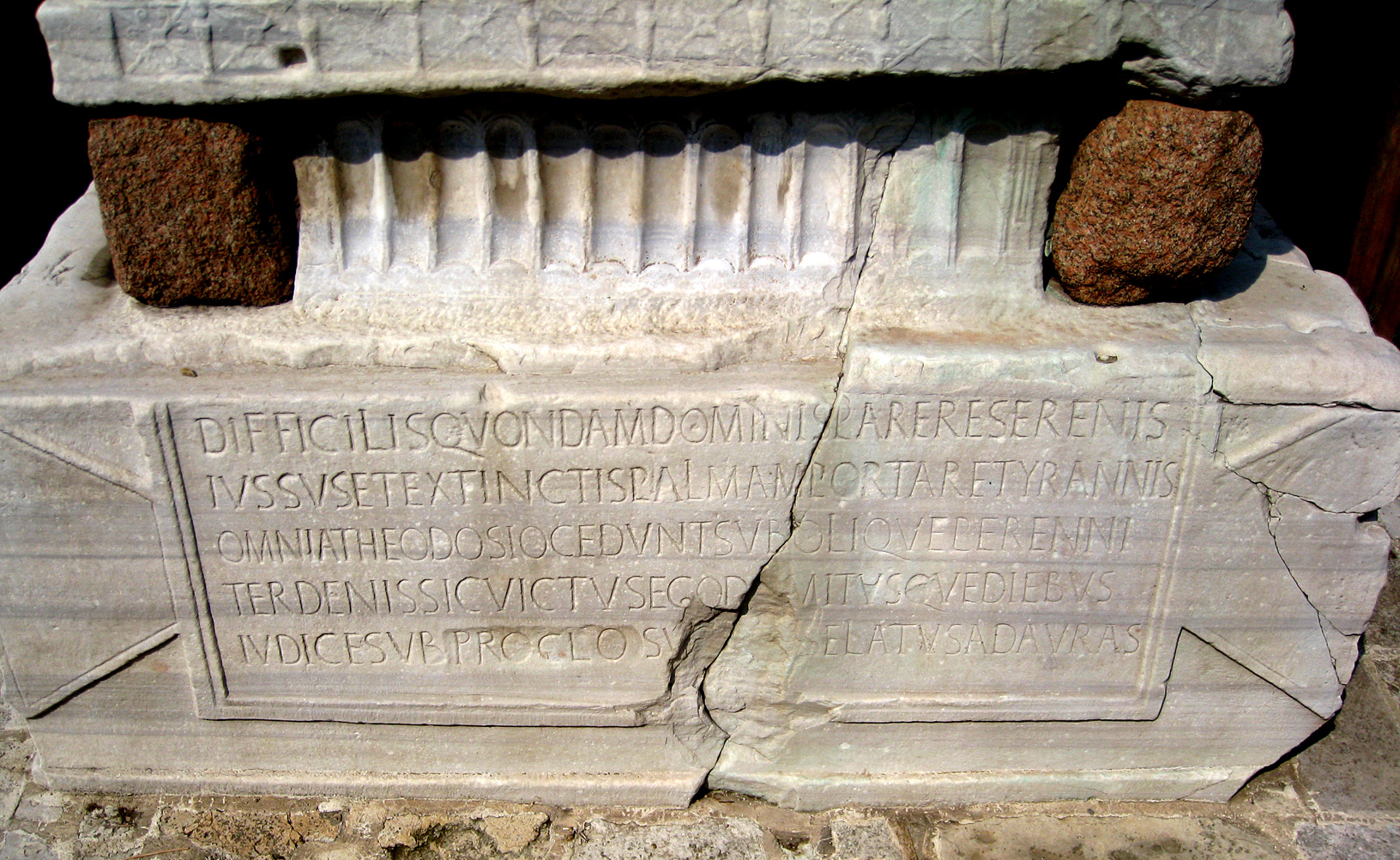
We can start with the east face, again, the one that faced the emperor's box and consequently, the dignitaries of his court. This one features an [inscription in Latin] (https://upload.wikimedia.org/wikipedia/commons/4/4d/Obelisk_of_theodosius_latin_inscription.jpg) and an engraved scene above it featuring Theodosius in his box holding a victory laurel and being surrounded by his court and a group of dancers and musicians at the bottom. Here is the Latin along with a translation:
DIFFICILIS QVONDAM DOMINIS PARERE SERENIS IVSSVS ET EXTINCTIS PALMAM PORTARE TYRANNIS OMNIA THEODOSIO CEDVNT SVBOLIQVE PERENNI TER DENIS SIC VICTVS EGO DOMITVSQVE DIEBVS IVDICE SVB PROCLO SVPERAS ELATVS AD AVRAS
Formerly [I was] reluctant to obey peaceful masters, and ordered to carry the palm [of victory] for tyrants now vanquished and forgotten. [But] all things yield to Theodosius and to his eternal offspring. So too was I prevailed over and tamed in three times ten days, raised towards the skies under governor Proculus
To clarify, Proculus was the urban prefect of Constantinople during the rule of Theodosius, but this has no relevance to the answer.
The west face, with pointed toward rows of spectators had [a Greek inscription] (https://upload.wikimedia.org/wikipedia/commons/5/51/Istanbul.Hippodrome006.jpg) and another imperial scene engraved above it showing the emperor being presented with gifts by a group of Persians on the left (indicated by their hats) and Goths on the right (indicated by their beards, animal skins, and pants). Below is the Greek inscription and a translation:
KIONA TETPAΠΛEYPON AEI XΘONI KEIMENON AXΘOC MOYNOC ANACTHCAI ΘEYΔOCIOC BACIΛEYC TOΛMHCAC ΠPOKΛOC EΠEKEKΛETO KAI TOCOC ECTH KIΩN HEΛIOIC EN TPIAKONTA ΔΥΩ
This column with four sides which lay on the earth, only the emperor Theodosius dared to lift again its burden; Proclos was invited to execute his order; and this great column stood up in 32 days."
While the two inscriptions both pretty much say the same thing, they are quite stylistically different. The Latin version is far more complex, makes more vivid allusions, and even talks in the first person whereas the Greek version is a simple description of the obelisk's erection. Likewise, as Safran notes, the Latin version makes many references to the theme of domination and the idea of the emperor as "dominus" meaning "lord" or "master" in English (the title of a slave-owner and head of a household), with words such as "dominis" (a plural form of dominus) and "domitus" (a related word to dominus, but in the passive form, meaning "dominated"). Additionally, the "vanquished tyrants" (extinctis...tyrannis) alludes to at least the civil war Theodosius fought and won in 387/388 and possibly the 2nd one in 392-394 which ended in the same result.
Similarly, the engraved scenes above the inscriptions have the same difference in quality. The east face's one (toward the imperial box) is more detailed, having more people in varying poses, clothing, and even headware/hairstyles, and is just generally better engraved. The western face contrastingly has less people and those depicted outside the imperial box are engraved in a formulaic fashion, in the same poses, clothing, and faces.
So we have two sides of the same obelisk, one in Greek and one in Latin, but the Latin clearly had more effort put into it. This is because the Latin, east side, faced the imperial box and the emperor's retinue. In addition, this side would have likely been the area in which wealthy Roman politicians, such as the urban prefect and his retinue, along with the city's senators, would be sitting. While many were learned and would have known both Greek and Latin, many senators in the city, and also Theodosius himself, were from Rome or the western side of the empire. This is also why the eastern inscription makes reference to the civil war and the idea of Theodosius as a "dominus," to enforce political stability on other politicians. And of course, Latin was still the administrative language of the whole empire, and so had to be known by most members of the imperial government.
In contrast, we know less about the intended audience of the western, Greek inscription. It would have faced the side without the educated, Latin-speaking, elite, but we don't exactly know what background this group would have been. Of course, these were more common, native Constantinopolitan, and Greek speaking people, but it's possible that they were intended for the enrolled fans of the city's charioteer teams (the greens and blues most prominently) who very likely could've been a local, but privileged class. One reason for this is that the western face has text in itself, and so would have been meant for a literate audience. Some have also argued that the North and south bases, without written inscriptions, may have been viewed by the poorest and illiterate masses who had the least desirable seats on the ends of the race course.
What is clear though, is that the obelisk of Theodosius utilized the social differences between Greek and Latin speakers to great effect, using Latin for the privileged, political, and imperial class, but Greek for the lower ranks and the vast majority of the capital who couldn't read or likely speak Latin. Not to mention, this was the case even before Greek became the sole official language of the empire, and less than a century after Constantinople was originally founded in 330 CE.
Moving beyond Herakleios's institution of Greek as the sole official language of the empire in the 7th century CE, Latin practically disappeared (See Garcea, Rosellini, and Silvano's Latin in Byzantium I: Late Antiquity and Beyond for more.) In some cases, people were even hostile to it, as with the Emperor Michael III who, in a 9th century letter to Pope Nicholas I, called it "barbarian and Scythian." To this, Nicholas replied that titling Michael as "'Roman Emperor' was ridiculous, as he was unable to speak the 'Roman language'." By the 9th century, many who participated in the legal system likely couldn't even understand the Latin technical terminology of the courts, and by the 10th or 11th centuries, the only use of Latin in the empire seems to have been restricted to military terminology and a select few interpreters and diplomats.
So Latin had pretty much disappeared from the vast majority of Constantinople's citizens and was even unknown to the emperors by the time Greek became the official language. But even while Latin was being used, it was mostly restricted to the elites of the city and the imperial administration, in favor of Greek.