Not sure if this breaks the rules because this question references today's culture somewhat. However, there seems to be a common thread of the progressive anti-government and anti-war movement of the 1960s and the limited government movements of the Reagan/Thatcher administrations in the 1980s. I'm wondering if there is a connection between these political eras, and if the brand of conservatism of the 1980s found traction with former anti-establishment youth of the 1960s and 70s. Or is this simply a matter of public perception focusing on singular aspects of a generation when in reality these representations highlight only vocal minorities of this age group?
I've written about this more here. I will save a click by reproducing my answer:
...
The Hippie Trip from 1968 estimated 200,000 hippies, that is, less than 0.2% of the population. So you are right that the situation amplifies a minority. Even more seriously (and being more expansive than just "hippies"): a great deal of the counterculture was not Baby Boomers at all.
Let's suppose the most common definition of Baby Boomers: as being born from 1946 to 1964.
Let's also, for the sake of argument, consider the height-of-counterculture year to be 1969, the year of Woodstock, the year of the Stonewall riots, the year of the trial of the Chicago 8 (later 7 when Bobby Seale's case was severed).
How old would your Baby Boomers be?
For them to even be 18, their cutoff birth year would be 1951, only a quarter into the supposed span of the entire generation of Baby Boomers.
Now, there were certainly young people involved -- and part of the push for the 26th Amendment lowering the voting age from 21 to 18 was involving them -- but centering sole responsibility for the Counterculture Movement on Baby Boomers is very strange.
What about individual influential figures? There's no "scientific" way to make a "most influential" list, so I just grabbed a clickbait article which I figured would be a good approximation, just to check how many were Baby Boomers:
Hunter S. Thompson, gonzo journalist
The Beatles, musicians
Bob Dylan, musician
Muhammad Ali, boxer and noted pacifist
Timothy Leary, LSD advocate
Lenny Bruce, comedian
Gloria Steinem, feminist
Andy Warhol, artist
Jimi Hendrix, musician
Jack Kerouac, writer
We'll keep the Beatles even though they aren't from the US. The birth years of all the people listed? 1937, (1940, 1942, 1943, 1940), 1941, 1942, 1920, 1925, 1934, 1928, 1942, and 1922.
In other words, none of them are Baby Boomers. I can assure you it is equally hard to find Baby Boomers from larger and more expansive lists. The most prominent activist I can think of that falls in that zone, Fred Hampton (famous for dying young) just squeaks into the "Baby Boomer" window at 1948.
The Chicago 8, the ones charged with "conspiring to use interstate commerce with intent to incite a riot" and "teaching demonstrators how to construct incendiary devices that would be used in civil disturbances"? None of them were Baby Boomers either. (The oldest, David Dellinger, was born in 1915: not even of the Silent Generation, but the Greatest Generation.)
Or to take things further, consider Reagan's 1980 group voting group, which did tend to be older; you can check out Roper's voting age breakdown here. 30+ went for Reagan (at 55%) and 18-29 went for Carter (symmetrically at 55%, and this group would be entirely born in the Baby Boomer range).
Again, the "generation" idea doesn't necessarily flow here in a smooth way. (If you're going the "alternating liberal-conservative" theory, both the older generations voted for Reagan.) The concerns with the Iran hostage crisis, inflation, unemployment, etc. tended to concern an older generation more in 1980, just in that innately 20-year-olds might be more worried about college policies and 35-year-olds might be more worried about mortgage rates. If you really want to throw your politics for a loop, check out the 1984 election voting for Reagan:
18-24 61%, 25-29 57%, 30-49 48%, 50-64 61%, 65+ 64%
Ah-ha! you might say. That means the younger group is getting more conservative! But the actual circumstances are more complex: quoting from a NY Times article written at the time:
For many of these new voters, the only American military action they remember is Grenada, a successful venture that posed no threat to their own security. They have never experienced the military draft, and the Vietnam era is something they hear about in history class.
All that many young voters know about Mr. Mondale is that he was Vice President under Mr. Carter, which they see as a burden. The Minnesotan's long record in the Senate is a blur, as are the battles fought by his generation for civil rights and social programs.
They (the younger generation at the time) might not be any more conservative as far as civil rights goes, but the actual personalities involved in the election override other concerns. The fact Reagan was well-liked was part of why Reagan survived the Iran Contra scandal and when his reputation was being hard-hit, a deep in the scandal survey still found 72% approval when people were simply asked if they liked him as a person.
In simpler terms it appeared that: things got worse under Carter, things turned around and got better under Reagan. This isn't just a left-right concern. (The GOP did try to interpret it as snagging the younger generation, but by Clinton vs. Bush, the 18-24 group gave Bush the lowest percent of all age groups -- allegedly, if we think in terms of generations voting as blocs, part of the exact same group as the ones who voted for Reagan's 2nd term.)
Incidentally, one thing I've seen is to split Boomers into two groups, Boomer I and Boomer II, making the first half the more politically counterculture-aligned -- at least some of them were old enough to go to Woodstock -- while the second half missed that wave. I've unfortunately not read enough of the analysis to know if that holds weight on the political end, but it'd make at least slightly more sense than assuming a 20-year voting bloc where it normally gets placed.
...
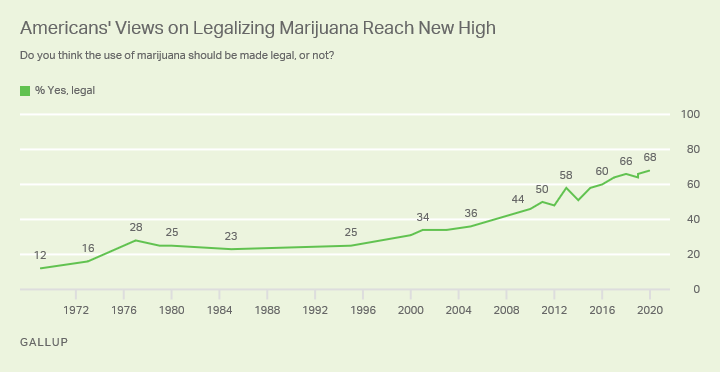
Social change is progressive and not always defined by a "generational" boundary line except in an incidental sense. To take a small example, consider the use of marijuana (a reasonable "hippie-ness" proxy, since the two were considered inseparable in the 60s). Gallup has been asking since 1969 if marijuana should be legalized.
Note a very small initial support (12%) and near-steady increase then. In the supposedly-more-conservative-80s there was a slight slowdown and drop, but hardly a reversal. Support at 2020 is now at 68%. There wasn't a reversal of social norms; things steadily increased, until, in a sense, everyone became hippies.
...
Issitt, M. (2009). Hippies: A Guide to an American Subculture. ABC-CLIO.
Colby, S., & Ortman, J. M. (2014). The baby boom cohort in the United States: 2012 to 2060. US Department of Commerce, Economics and Statistics Administration, US Census Bureau.
What do you think of when considering California in the 60s? The Summer of Love? Hippies in San Fransisco? Innovative, progressive musicians and filmmakers pouring out of Hollywood? Sex, Drugs, and Rock n' Roll?
All of those things were happening in the 60s and early 70s in California, but it would be a mistake to think that these trends represented the majority opinion of Californians, never mind the majority opinion of Americans writ large. Consider that Ronald Reagan, running as a conservative Republican, won decisive victories to win (1966) and hold (1970) the governorship of California. Consider how Reagan achieved these victories - by exploiting the general public's fear of increasingly vocal challenges to the status quo on issues of gender, race, sexuality, and drug use.
A quote from Rick Perlstein's Nixonland about the race for governor and the moral panic surrounding the emerging 60's counterculture and civil rights movement:
"The pundits little noted the Reagan-friendly culture wars roiling beneath the surface of the bourgeois utopia. Only recently, the drug lysergic acid diethylamide had been rhapsodized as a therapeutic miracle; its acolytes included Cary Grant. Now it brought headlines like “Girl, 5, Eats LSD and Goes Wild” and “Thrill Drug Warps Mind, Kills.” Now Time reported in March that it had reached “the dormitories of expensive prep schools” and “has grown into an alarming problem at UCLA and on the UC campus at Berkeley.” Senator Robert F. Kennedy changed a hearing scheduled on mental retardation into an inquiry into LSD instead — one of three going on concurrently.
A group called the California League Enlisting Action Now (CLEAN) pushed an initiative forbidding judges from dismissing any pornography case. Their ads called pornographers masters of “Pavlov’s conditioned response,” responsible for an epidemic of “rape, perversion, and venereal disease.” Other activists went to war on a textbook — Negro historian John Hope Franklin’s Land of the Free, which, their pamphlets insisted, “destroys pride in America’s past, develops a guilt complex, mocks American justice, indoctrinates toward Communism, is hostile to religious concepts, overemphasizes Negro participation in American history, projects negative thought models, criticizes business and free enterprise, plays politics, foments class hatred, slants and distorts facts,” and “promotes propaganda and poppycock.” The L.A. County Board of Supervisors voted “to uphold high moral standards” by censoring an exhibition by an artist named Ed Keinholz, who said he displayed his dioramas of consumer products and mannequins in sexual congress and babies without heads to comment on America’s “sick society.”
In the Golden State, it was a season of moral panic; and as so often, California led a national trend."
It is critically important to remember that the counter-culture of the 1960s was just that: a countercurrent to the predominance of social conservatism in American society in the 60s. The backlash to the radicalism of the 60's counterculture had just as, if not more important implications for the politics of the late 20th century as the counterculture itself did. Not only is there no contradiction between the conservatism of Baby Boomers and the youth radicalism of the 60s - there is a direct link between them. Consider another excerpt from "Nixonland":
"Then there were campuses like Berkeley — where, late in 1964, a police car rolled onto campus to dismantle a recruitment table for Mississippi voter registration that fell afoul of campus rules about where political advocacy was permitted. The squad car was promptly trapped on the main campus plaza by hundreds of students, who started climbing up on its roof and delivering inspiring speeches about the right to free speech, the necessity of defying illegitimate authority, the soul-crushing blindness of the bureaucrats. Then thousands occupied the administration building. For them the “Free Speech Movement” was a moment of moral transcendence. To the man on the street — especially the man on the street never afforded the privilege of a college education — it was petulant brattishness. Then came the “filthy speech movement.” That started when a couple of angry kids sat on the Student Union steps with curses scrawled on placards. A few score kids rallied to their support. But by 1966, these few score kids had become Middle America’s synecdoche for “Berkeley.” “All the most vociferous of them could produce was four- letter words,” Illinois’s Republican Senate candidate, Charles Percy, told eighteen hundred students at the University of Illinois in a speech on the New Left’s “general uncleanliness.” The students gave him a standing ovation.
The outrages, all of them, felt linked: the filth, the crime, “the kids,” the Communists, the imprecations against revealed religion. It all had something to do with “liberalism.” Pat Brown was a “liberal.” And it arrived that liberalism’s enemy, Ronald Reagan, wasn’t doing too poorly at all. He was providing a political outlet for all the outrages — outrages that, until he came along, hadn’t seemed like political issues at all."
The majority of students on American college campuses in the 60s did not riot, did not protest, and were in many cases, as seen in the example of the University of Illinois, alienated and disgusted by the behavior and beliefs of their more radical classmates. And in the 60s, the vast majority of young people did not even go to college in the first place - Perlstein anthropomorphizes the "man on the street" perhaps a little more than I'd like but it is very much the case that the American public at large, including most Baby Boomers, were not fans of student radicalism. After the Kent State shootings in 1971, "[a] Gallup poll found 58 percent blamed the Kent students for their own deaths. Only 11 percent blamed the National Guard."
To come back to the question you asked, it is not the case that the conservatism of the Reagan and Thatcher administrations was enabled by former anti-establishment youth. Instead, the conservative wave of the late 70s-mid 90s in the United States was powered by people who had always been conservative, and indeed who had their formative political experiences in the 60s as people opposed to or afraid/hesitant of the social changes wrought by the 60s counterculture. None of this is to say that the 60s counterculture was unimportant or did not achieve long-term successes, but rather to demonstrate that the Boomers who voted for Reagan in the 1980s were already willing to vote for him in the 1960s, in large part because he was a crusader against the counter-culture.
Looks there was a relevant post & response (e: from /u/jbdyer) about 6 months ago: