Culture,food or even art
(Excluding the north-eastern part of India bordering tibet)
While the influence of India on China in the form of Buddhism and other cultural exports is known, less is known about the other way around, but thats because China really couldn't influence India to the same extent. The reason was likely centralization. China has historically been strongly centralized under one dynasty, so when a new idea, like Buddhism, came to the land, it flourished because the emperor patronized it, and so all of China was accessible to Buddhists. However, a reciprocal wouldn't have been possible. For example, if a Chinese Emperor decided that he wanted to spread Confucianism in India, and sent Confucian scholars to one of the many kingdoms of the Gangetic plains, even if the Confucians got a hold in that kingdom, the kingdom itself could be conquered at any moment, and the Confucian ethics would have been discarded.
So, I'll give two primary examples of Chinese influence on India, although they are primarily political influences.
The first one relates to the Kingdom of Kochi in the southwest coast of India. In the 14th century, central and Southern Kerala was a mess of warring principalities and states, while North Kerala (Malabar), was relatively stable under the rule of the Samoothiri rulers at Kozhikode. The Kingdom of Kochi, and further south, Kingdom of Kollam, were relatively stable and unified, but weaker than Kozhikode. As a result, the kingdoms were under a rivalry.
This was the situation when the Yongle Emperor of Ming sent out Zheng He on the famous 'treasure voyages', where the admiral visited lands all around the Indian ocean. In around 1410, Zheng He reached the coasts of Kerala, where he found Kochi and Kozhikode in a rivalry. After his return to China and his report to the emperor, the emperor himself had a stone tablet carved with a proclamation, and Zheng He delivered it on the next voyage. The proclamation declared Kochi to be under the protection of the Son of Heaven, so that Kozhikode wouldn't attack Kochi and trigger a war that could have interrupted trade. However, this backfired, since the Ming voyages ceased in 1433, during the Xuande Emperor's reign. Without Ming to protect it, Kozhikode immediately occupied Kochi and made it a puppet.
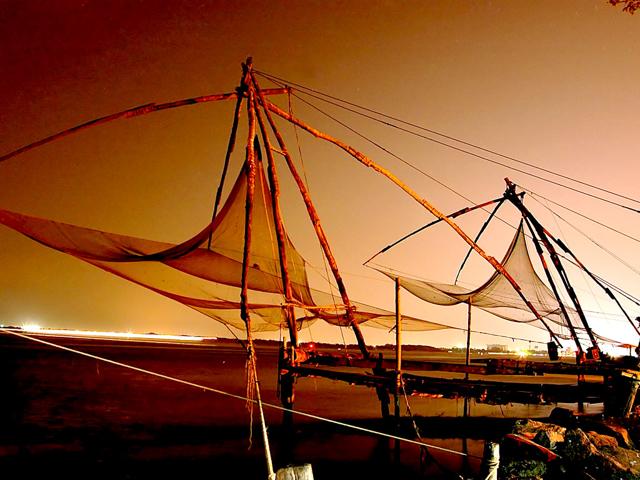
In a cultural sense, today the coasts of Kerala between Kochi and Kollam are dotted with a special type of fishing net called the 'Chinese fishing net', which was supposedly introduced by Zheng He's men. These nets are unique to this area in India, but are widespread in China and Vietnam.
The next incident occured in 648 AD. Prior to this time, the Northern part of Indian subcontinent was under the rule of a capable ruler named Harsha for over half a century. He sent out envoys to different neighbouring places, including Tang China, then under the rule of Taizong. Taizong sent an envoy, named Wang Xuance, to India in response. However, when Wang reached India, he found that Harsha had died a few months prior, and that his place was usurped by an unworthy ruler, named A-luo-na-shun (probably Sinified version of Arunasva) in Chinese records. This new king tried to attack Wang and his subordinates, but Wang managed to escape. He fled to the North, secured the armies of the Licchavis (of modern Nepal) and Tibet, then marched down and in 3 days, defeated A-luo-na-shun. An apocryphal story says that Wang had him brought to China, where he was made to attend upon Taizong till his death. This is a very rare incident of Chinese interference in India.
One more thing that Chinese were known for in India, was studies of the scriptures. Several Chinese travellers, such as Xuanzang and Faxien, travelled to India to bring back Buddhist scriptures to their home. As a result, several Buddhist scriptures are only known from their versions which were copied and taken back to China. Also, the written records of the travellers provide to us a picture of those eras in India. However, this is less of cultural influence, and more of cultural preservation.
Of course, in modern-day India, Chinese influence in the form of food, Jackie Chan films, Feng Shui and so on are more common.
SOURCES:
The Ivory Throne by Pillai, Manu S.
A Survey of Kerala History, by Menon, A. Sreedhara
A History of India: Volume One, by Thapar, Romila