Not really, standardized uniforms certainly did not exist at this time, and the existence of identifying colors and national flags and the like are a much later imposition that has more to do with the needs of film (and TV and video games etc) as a medium than with historical reality.
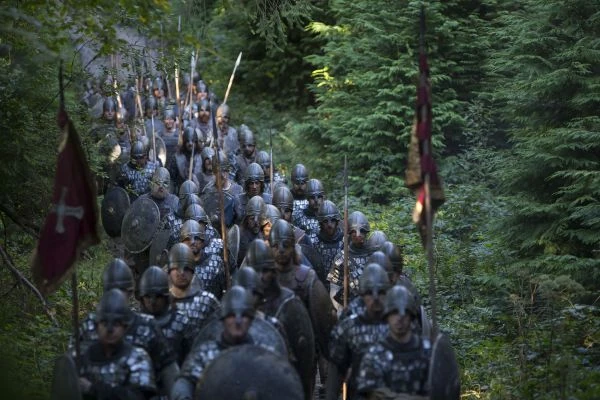
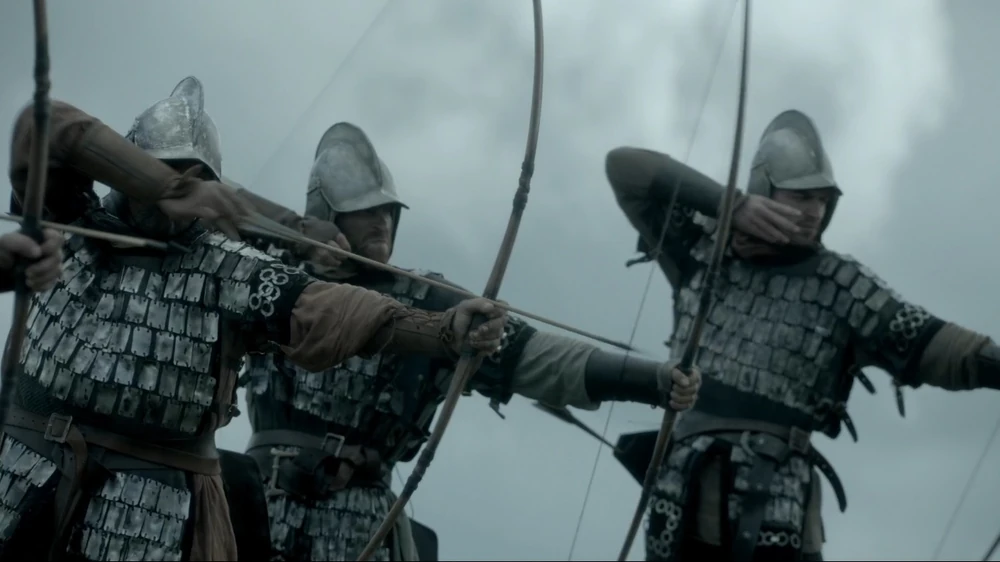
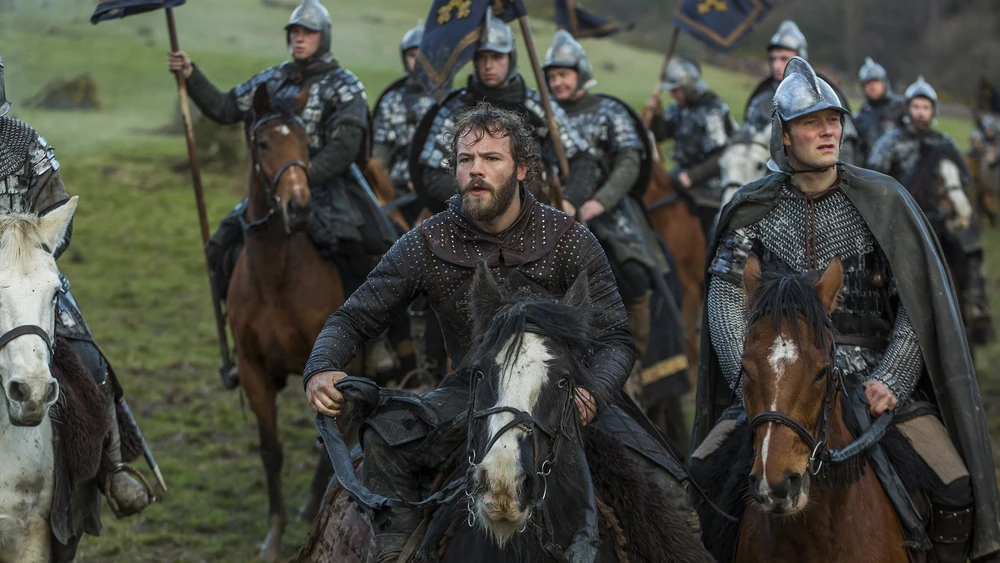
Today there are certain color associations that have stuck to the various kingdoms of the Heptarchy in England. You point out that Wessex and Mercia are color coded in Vikings, and this extends to other media depicting the same time period, such as the Total War game Thrones of Britannia which often uses similar iconography and colors as the show Vikings.
Here are some examples
The Army of Northumbria in Vikings
More soldiers of Wessex in Vikings
Wessex soldiers in Creative Assembly's Thrones of Britannia
These images are visual shorthand for the benefit of audiences. On a tv screen of a computer monitor, and especially for the audience's benefit, more period accurate costuming would be.... difficult for many viewers to differentiate. This is because there were no standardized uniforms for these societies. This is for a variety of reasons, but there are some major ones.
Lack of standardization because of poor state control
Early Medieval states did not have standardized armories that hewed to approved schematics and designs for their military equipment. Even the limited standardized equipment of the Roman empire was not universal, and following the collapse of Roman authority in Western Europe the states that formed in its wake lacked even the basic rudiments of standard equipment. Warriors and levies alike were responsible for providing their own equipment. Their weapons, clothing, armor, were not supplied to them (outside of individualized gifts to people as a part of the traditions of gift giving in the Medieval world) and individuals or their communities had to provide their own equipment. This naturally means that there was no standard equipment, nor the chance to enforce particular uniforms or color coordination among the constituent members of armies.
Indeed, modern style uniforms only become a thing in the time of industrialization when uniforms were able to be mass produced by the state, or through contracts that the state had with private business. Before that time, standardization was almost impossible, and even after the adoption of proper uniforms as we imagine them, a tremendous amount of variety remained even in modern armies (to say nothing of the variety seen in armies that were not modeled on western ones)
Similar equipment
Another issue that this time period faces in visual media is the, ironic given the above passage, uniformity of equipment. Almost all elite warriors of the time period would have been armed with similar, but not standardized, equipment. Shields were of similar construction regardless of the region, usually a simple shield boss covering a handle and glued planks of wood. Conical helmets provided protection for the head, and mail (that is chain-mail to be specific) was the armor of choice, and availability, for those who could afford it. Weapons would have been spears predominantly, but the wealthier in society would also have swords, axes, and many levies likely had improvised weapons such as hand axes, bows, and other make shift weapons. This all would have been the same if you were located in Francia, Scandinavia, or England.
So when the soldiers of one side are armed similarly to the other side, it becomes necessary in a visual medium to have differentiation in other regards, hence the color coding that we see in movies, tv shows, and video games that was not actually reflective of practices of the time, but is needed for modern audiences to more carefully delineate who is who. In historical times this was achieved through other means. Some of this would have been through the use of symbols and flags, but these were likewise not standardized.