There's an old signboard on King Street in Newcastle-upon-Tyne, UK, that once advertised passenger steam ship sailings from Newcastle to a bunch of places – including, first on the list, London.
The Tyne Tees Steam Shipping Company was founded in the 1800s and continued operating into the 1940s, carrying cargo as well as passengers. The cargo from Newcastle was mostly coal - and a lot of it. I guess carrying passengers was a nice way for companies like this to make some extra cash. They also had some ships that were mainly passenger-focussed (carrying in the region of 75 first-class and 100 standard-class passengers).
But what's not clear is why, in the late 1930s, given that railway travel was affordable and fast, someone would have chosen to make the journey from Newcastle to London by sea, given that it would presumably (a) take a long time, and (b) not be that pleasant given the notoriety of the North Sea for rough sailing conditions.
Well one reason would be that it was hugely, hugely cheaper. I would _seriously_ question your claim that long-haul rail travel was "affordable" in the 1930s.
Conext: through the 1930s, the typical wage for an agricultural or factory labourer was barely 1s/hour This is a reasonable secondary source [1] "In 1930 the average wage for a timework labourer in the engineering field was just under a shilling per hour; it dipped in 1933-4, then climbed again to around 1s 2d by 1938. In some cases, wage cuts were more severe." Agricultural wages were regulated, and in early 1930 it was £1 11/8 for a week of 50 hours. My secondary source reports that as "a shilling an hour" but is optimistic: it's less than 8d per hour (for American readers or young Britons: £1 11/8 is one pound of twenty shillings, 11 shillings and eightpence, with 12 pence per shilling).
Getting a snapshot of train ticket prices is surprisingly hard, but let's take future Prime Minister James Callaghan speaking in Parliament in January 1949 looking back to 1928 [2]:
The fare for the journey between London and Edinburgh (Waverley) was 99s. in 1928. That is the three-monthly return fare. The monthly return fare today is 107s. 6d. The fare from London to Norwich (Thorpe) was 29s. in 1928; it is 31s. 9d. today. From London to Brighton the fare was 12s. 10d. in 1928; it is 14s. 3d. today. From London to Birmingham the fare 889 was 27s. 10d. in 1928; it is 30s. 6d. today. I have a whole list here. All the fares are roughly 10 per cent. higher today on the comparison that I was making on the previous occasion than they were in 1928.
This doesn't give us a fare London to Newcastle (247 miles). However, we have London to Edinburgh (99/-, 393 miles), and London to Birmingham (27/10, 101 miles). In the 1930s rail fares were almost entirely done by distance. Scaling down Edinburgh gives us 62 shillings, scaling up Birmingham gives us 68s and the route taken in the 1930s was a bit longer than it is today (Paddington to Snow Hill via Banbury, as opposed to Euston to New St via Rugby which I have quoted). So let us agree on, perhaps, 65s London to Newcastle, one months return, second class.
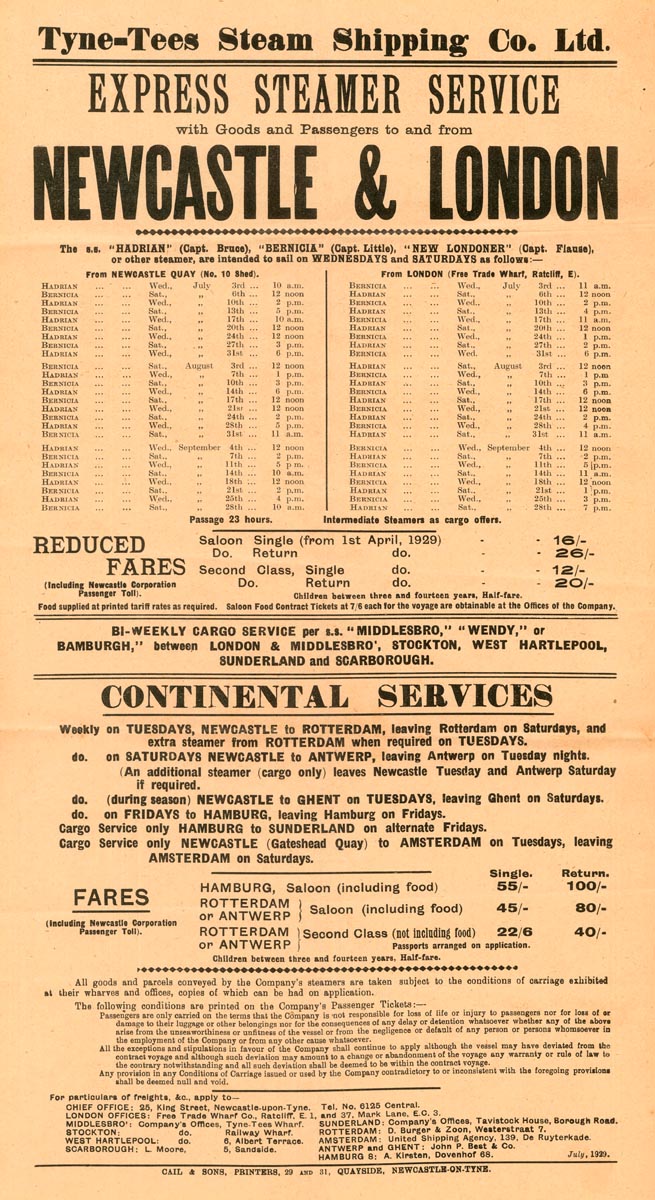
Meanwhile, let us turn to the timetable of Tyne-Tees Shipping Company for July 1929 [3] from which we learn that a second-class return ticket on their boat from Newcastle to London was 20/-.
So one reason people would use the boat is "because it is less than a third the price, the difference being the complete pay for a week's labour by a working class man".
[1] https://www.pocketpence.co.uk/wages-1930s-12269131.html
[2] https://api.parliament.uk/historic-hansard/commons/1949/jan/25/railway-fares
[3] http://www.timetableimages.com/maritime/images/tyne29a.jpg
Just a heads up, [your image link is broken](https://commons.wikimedia.org/wiki/File:Advert_for_Tyne-Tees_Steam_Shipping_Company,King_Street(geograph_2019674).jpg), probably because reddit interprets the closing ) as a reddit closing ). I think you can add \ to make it treat the ) as part of the link.
Edit: yes, that's the correct syntax and the corrected link.
Edit 2: to be clear, \ ) (no space)
.jpg)