I was just reading about the Tsar Bomba (biggest ever atomic bomb tested in 1961 in Siberia), and according to Wikipedia the bomb was developed against the backdrop that the Soviet Union throughout the 50s had suffered under a great geopolitical disadvantage due to the fact that the US nuclear threat towards Russian soil was much greater than the Russian threat in the opposite direction.
Obviously I was previously aware that the Cuba Missile crisis happened because placement of missiles on Cuba would enable Russia to reach the (entire?) US with their missiles – but I guess always thought the problem was that placement at Cuba would increase Russian range across greater parts of the US – and that the Soviet would already have been able to reach, for instance, the far Eastern or Western coasts of the US.
Now, according to Wikipedia again, the US at some point prior to the Cuban missile crisis had missiles installed in Turkey and Italy, which enabled them to reach Moscow.
When did this happen?
So I guess my question is a bit more general than the title suggests – would someone be willing to give a brief overview of what the relative respective atomic nuclear reaches of the Soviet Union and the US looked like in the years following WW2 and up until the 70s/80s?
So the answer to this is tricky, because there is a big gap between "some technical capability" and "credible capability that would be expected to really work." The Soviets did develop a few long-range bombers (like the Myasishchev M-4 and the Tupolev Tu-95, both deployed in 1956) that technically had intercontinental range, but were only deployed in relatively small numbers and would have had a hard time penetrating US airspace (the US set up extensive early warning radar operations in Canada, and had extensive nuclear-armed anti-aircraft defenses, and developed systems like SAGE to track and destroy bombers). One way to try and improve their survivability was the addition of air-launched nuclear cruise missiles (like the Kh-20) in the 1960s, but all of this was pretty unwieldy and the Soviets didn't produce them in bulk, presumably because they had already decided (unlike the US) to put all of their stock in long-range ballistic missiles. By the early 1960s, the Soviets had developed several credible ICBMs, though at the time of the Cuban Missile Crisis only a handful were deployed.
What the Soviets had in spades were medium- and short-range ballistic missiles, and plenty of bomber capability in Europe. So their main deterrence threat was to threaten Western allies, and hope that threatened the US by proxy.
The US had put its MRBMs in Turkey and Italy well before the crisis, and the Turkish ones in particular were part of the spur of the Cuban Missile Crisis — the Soviets were, in a way, just duplicating what the US was doing.
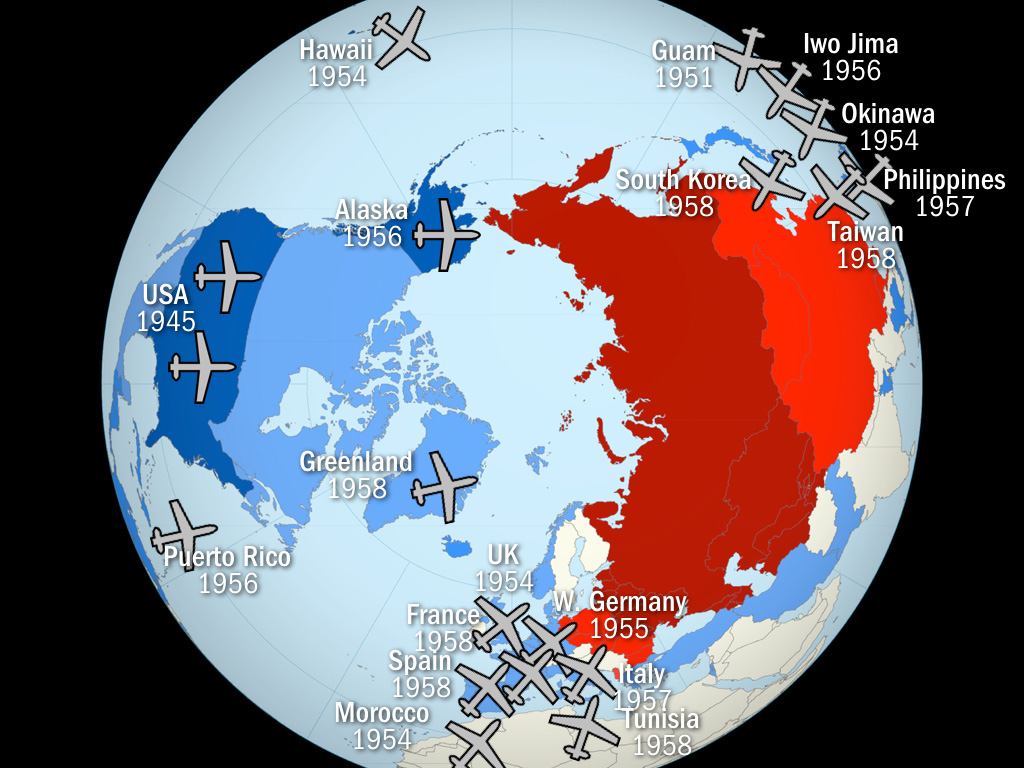
The US, at the time of the crisis, also did not have much by way of ICBMs, but had a vast bomber fleet — much larger than the Soviet one — and considerable medium-range and short-range missile sites (along with tactical nukes, which the Soviets also had). These all depended on the fact that the US had friendly airbases ringed around the USSR. Here are their nuclear bomber deployments abroad through 1958 — it gives you an idea of the strategy. The Soviets had nothing comparable except for Cuba, and you know how that turned out.
Anyway, the long and short of it is that the Soviets had some capability to potentially hit the US mainland by the 1950s, but it was pretty dodgy. They had excellent capabilities for hitting targets in Western Europe. The US, by comparison, had excellent capabilities for hitting the Soviet Union. The US arsenal was also some 20X larger than the Soviet one at the time of the Cuban Missile Crisis. So it was not at all a perfect parity.
Over the course of the 1960s, the Soviets built up a huge ICBM force, and increased their stockpile dramatically. By the 1970s the Soviet and US capabilities were at relative parity.