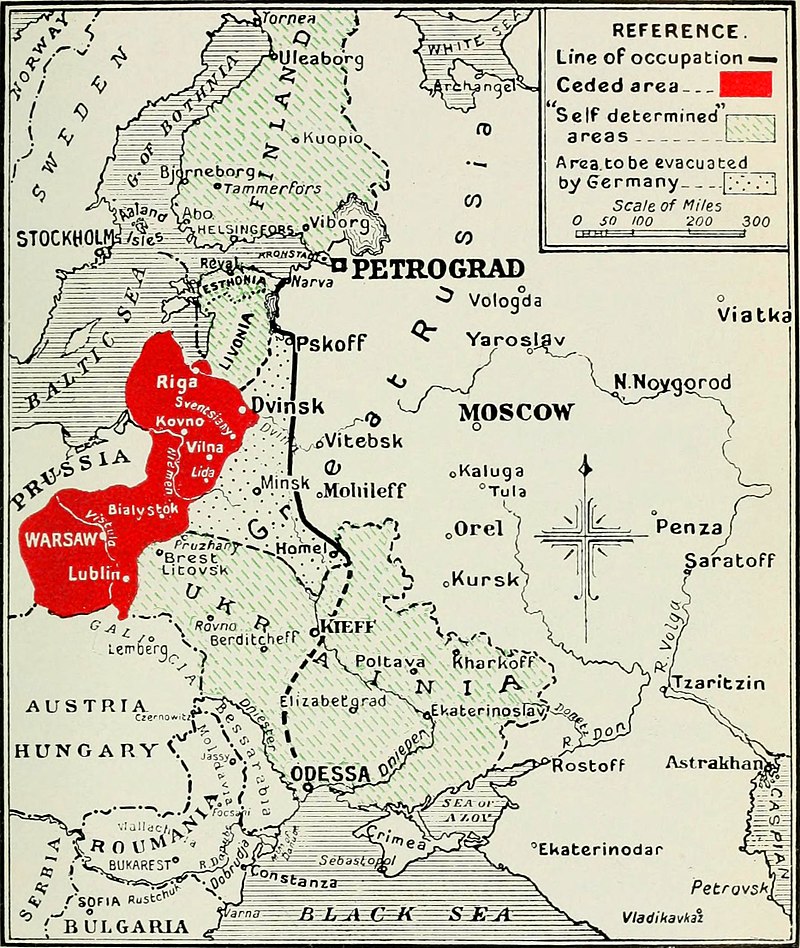
Repost of this earlier answer I wrote.
One thing that I think the framing of the question (and it's a common framing) gets wrong is the idea that British, French, American and Japanese forces intervened in the Russian Civil War after World War I, and this is not entirely accurate.
Most of the Allied nations sending troops to...well, it's a little confusing what to call it, so let's go with the former Russian Empire, sent these troops during World War I, and Allied governments mostly saw these interventions as part of that war effort.
There were two issues at stake - securing large stocks of Allied war materiel that had been shipped to ports like Murmansk and Vladivostok when Russia had been a combatant in the war, and limiting German influence with Bolshevik government. The background there is that, to make a very long story short, the Bolshevik government had asked for an armistice with Germany on December 15, 1917, and after very long, complicated and rancorous negotiations, the Bolsheviks and the Central Powers had signed the Treaty of Brest Litovsk on March 3, 1918 (the Bolshevik government heatedly debated this treaty and narrowly approved it).
These peace terms saw Russia cede Finland, Poland, the Baltics and Ukraine (as well as bits of the Caucasus) . These territories contained maybe half of the population of the former Russian Empire, much of its industry, and most of its resources such as coal mines, oil fields, and crucially Ukrainian wheat. Something like a million Central Powers troops occupied those ceded territories - this somehow almost always gets left out of discussions of Allied/Entente intervention. The Bolshevik government and the German Empire established formal diplomatic relations, and even exchanged ambassadors, and while the Bolshevik government repudiated tsarist-era debts, a financial agreement with Germany in August 1918 saw compensation offered to German bondholders as an attempt to get German industrialists and financiers to invest in Russian reconstruction (the German Foreign Ministry had a standing committee including representatives from Krupp and Deutsche Bank to look into the matter).
So from an Allied perspective, the Bolshevik government, while out of the war, was developing strong links with the German government. And all of this at a time that the Central Powers launched massive spring offensives on the Western Front - the First World War was far from over, let alone showing an obvious, inevitable Entente victory. In the event, Germany even drew up a military contingency plan in September 1918, known as Operation Capstone, which would have seen German and Finnish forces occupy Petrograd at the invitation of Lenin's government (in the event, Lenin understandably wasn't interested, and the reversal of fortunes on the Western Front plus opposition from the German Foreign Ministry saw this plan shelved).
This was the situation which saw the initial intervention, with American and Japanese troops landing in Vladivostok in August 1918. The Japanese sent some 72,000 troops, although hardliners (notably Interior Minister then Foreign Minister Goto Shinpei) in the Cabinet had called for up to a million troops to be sent (it's worth remembering that Japan already had military forces in China at the time, mostly guarding Japanese railway concessions). An entente force landed at Murmansk and Archangelsk around the same time (an additional strategic concern there was also that Germany had sent about 13,000 troops to Finland in March 1918 to decisively intervene in the Finnish Civil War).
In Russia proper, the civil war against the Bolsheviks was largely confined to a rather limited insurgency in the North Caucasus/Kuban region under Kornilov's Volunteer Army, before the war escalated dramatically with hostilities breaking out between the Bolsheviks and the Czechoslovak Legion in May, 1918. When the Legion ended up seizing most of the Trans-Siberian Railway, this is when larger White forces began to control significant parts of the former Russian Empire, with a "Committee of Members of the Constituent Assembly" organizing itself as an alternative government in Samara in June (the Constituent Assembly had been elected in relatively free elections across the former Russian Empire in December 1917. As the Bolsheviks only won about a quarter of the seats, they unceremoniously disbanded the Assembly with force after a single day's meeting).
At the German armistice with the Entente in November 1918, the situation in Russia changed, and strategic goals - already incredibly muddled, became even less clear in more complicated circumstances. December 1918 saw British and French forces land in the Baltic and Black Sea, respectively. Germany was to evacuate all occupied Eastern Territories while renouncing the Brest Litovsk Treaty. The Bolshevik government also renounced the treaty in and moved in February 1919 to re-occupy areas that the Germans were evacuating, bringing it into conflict with nationalist groups in Ukraine, the Baltics and Poland, who appealed to the Entente for assistance (a contingent of the German army also remained in the Baltics to complicate the situation). So the initial reasons for the Entente intervention: securing of military supplies and limiting German influence in Bolshevik Russia, disappeared, and were replaced with a confused and half-hearted opposition to the Bolshevik regime in an intensified civil war. For what it's worth, much of this intervention was sought by non-Russian nationalist groups, such as the Georgians, and in the case of the Estonians, British naval intervention in 1918-1919 was decisive in the establishment of an independent Estonian republic.
The reason I'm stating all this background is that in much of the historiography, World War I and the Russian Revolution/Civil War are treated as completely separate and almost unrelated events, while in fact there was significant overlap and cross-influence in the chronologies of both conflicts. Ironically, this is probably as much because of Soviet historiography as because of Western historiography. In Soviet history, World War I was largely an overlooked event to what was seen as the world-historical importance of the October revolution and Bolshevik victory in the civil war. In opposite terms, for countries participating in the Entente, the First World War was the main event of importance, with invention in Russia in 1918 and after being a confused and relatively insignificant sideshow. The Entente intervention was not big enough to make a real difference, but was prominent enough to be a sore point of contention in Soviet history for decades after.
It's really only in the past couple of decades that the different perspectives and narratives of these two events are being revisited and reintegrated.
I'll note that I'm really abbreviating the situation in the Caucasus in 1918-1921, and this area saw the intervention and involvement of German, Ottoman and British forces (with an additional, very small British incursion into current-day Turkmenistan on the other side of the Caspian). All of these intervention forces, plus many various local groups, had different aims, and the conflicts there were very-multisided (and as much directed against White Russian forces as against the Bolsheviks). The section on the Civil War in Charles King's Ghost of Freedom is probably as succinct an account of what was happening in the Caucasus in those years as any.
Sources
Adam Tooze. The Deluge: The Great War and the Remaking of Global Order 1916-1931
Stephen Kotkin. Stalin: Paradoxes of Power, 1878-1928