In a quite interesting answer written by u/PartyMoses yesterday, I read that "the American military tended to pattern itself pretty closely after the French practice, from its training down to its uniform aesthetics. West Point taught French and officers were encouraged to read and study French manuals and French history, and even apart from bayonet fencing, French fencing manuals were very common in American fencing culture, of which West Point was a part."
Was this due to a connection that traced its way back to the Revolutionary War? Was it an ideological connection due to the French Revolution? Was it just that the U.S. Army looked up to French culture and organization? None of the above?
#1/2
This is a great question!
There is of course a tight relationship between the early United States and the French, thanks to French support during the War for Independence, but the French Revolution introduced some complexities to that relationship, and the United States fought a truncated war, the Quasi-War, against France in 1798, and during its early wars against Great Lakes and Ohio River indigenous alliances, the army totally reformed itself in quite a different flavor than its Revolutionary structure. For the first two decades of independence, the US Army owed much more of its spirit and structure on Friedrich Wilhelm von Steuben, a Prussian, more than any particular French practice.
The French influence manifested as a result of two broad trends of the early US Army: its emphasis on engineering, and its need for a consistent standard of operation when the army mobilized and demobilized in times of crisis.
Steuben and the Blue Book
Most people familiar with the early US Army are likely aware of von Steuben, the Prussian drillmaster who, according to army lore, whipped the amateur Continental Army into shape to face the British toe to toe in the field. This is to a large degree true, and the emphasis on the regular soldiers in Steuben’s drill book certainly made a difference in professionalizing the regulars. The blue book was properly titled Regulations for the Order and Discipline of the Troops of the United States, and was a relatively typical, if simplified, instructional manual for the drill of soldiers. The book formed the basis for all instruction of regular soldiers for the rest of the war.
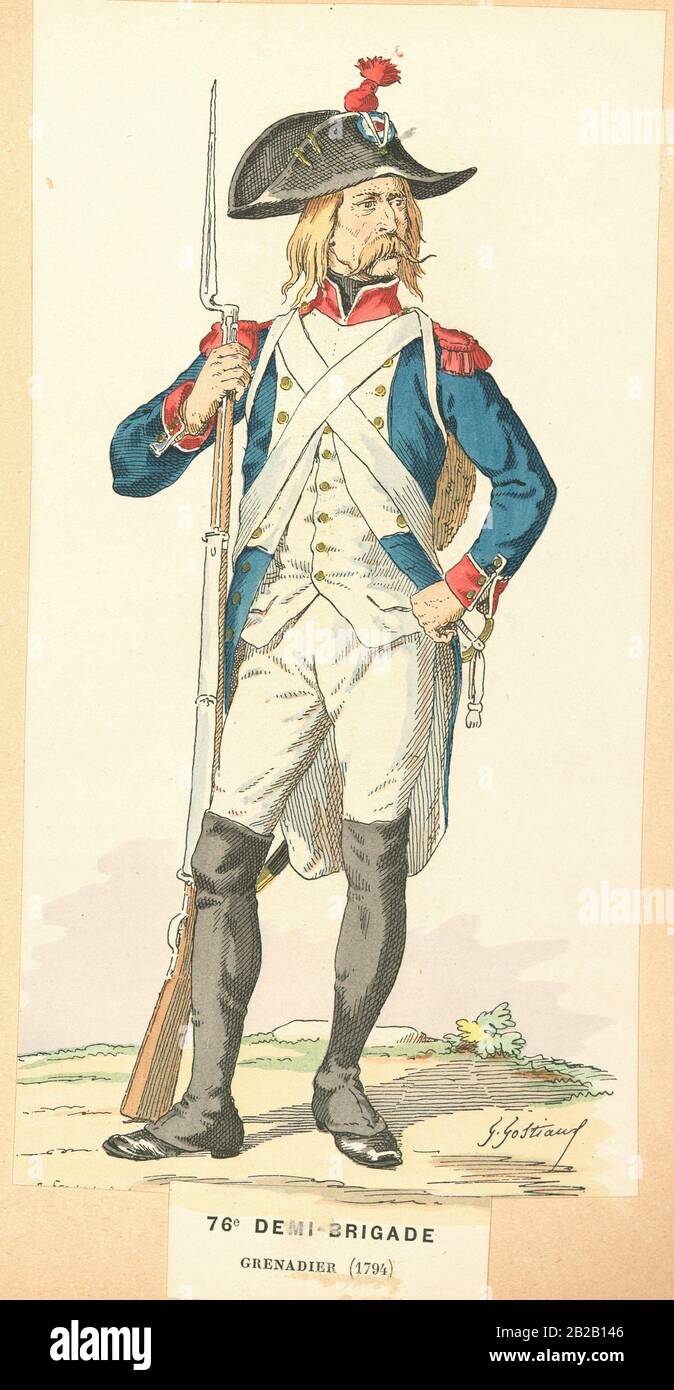
Afterward, of course, things get complicated. It was a matter of political philosophy in the United States that armies were bad, and the Continental Army was rapidly disbanded after the war. Domestic crises in the early republic period - Shays’s Rebellion and the Whiskey Rebellion - were dealt with by embodied militia, while the reformed "Legion of the United States" under Anthony Wayne fought against the Wabash Confederacy in the Ohio country. Wayne’s Legion continued to use the blue book, and instituted a kind of boot camp for training incoming soldiers, whose quality tended toward the dubious and desperate. The Legion’s uniforms, however, showed a significant French influence, from the tightly-fitted coatees to the slim gaitered trousers. Here’s an image of some of the Legion uniforms, and here’s a French grenadier.
Apart from the uniforms, French influence was manifest in the early military academy of the United States, which came to be known as West Point. In 1794, the army formed a permanent Corps of Artillerists and Engineers that were stationed at West Point. Many of the first officers appointed to positions in the new corps were French; Stephen Rochefontaine served as Lieutenant-Colonel, and Lewis de Tousard, and John Rivardi were majors. West Point was just one military post in 1794, however, and it wasn’t until 1802 that it was designated as a military academy.
French influence in the army waned a little bit during the ‘98 crisis, and some of the French officers were discharged as a result, but influence of French leadership and the French art of war remained at West Point and in the American military as a whole. Jonathon Williams, a Harvard graduate and former ambassador to France during the War for Independence, was appointed as the first superintendent of the academy. He had previously translated a French artillery treatise into English for the war department, which was put to use in the curriculum. West Point was, from its inception, primarily interested in teaching engineering, and that emphasis was patterned closely after the French model of higher education, in particular the École Militaire and the École Polytechnique. Williams had visited many of these institutions in his time in France, and their structure and educational methodology was a major influence on the early years of the academy. This is a trend that remained quite strong in the formative years of the academy, as Sylvanus Thayer, a later superintendent and “Father of West Point,” also had direct experience in French institutions.
The emphasis on French in a school primarily interested in artillery and engineering is unsurprising, given that French engineers had a reputation for skill and scientific exactness dating back to Vauban. The French military had supported the American colonists in rebellion, and even if some Americans looked on the French Revolution with horror, by 1800 they had proven their continued mettle on battlefields all around Europe. Even von Steuben encouraged American officers to learn French, both for access to their military manuals and for the study of their history.
We should clarify a few things here, though; the practices of West Point shouldn’t be taken as the practices of the army as a whole. There was no expectation that West Point graduates would even join the army. It was a practical impossibility, as there were often too few officer positions available in the tiny US army for every graduate. The early years of the academy were also much more aspirational than practical. Though structured similarly to the French academies, West Point still lacked a rigorous and consistent curriculum, indifferent discipline, and practically no barriers in terms of age or talent. When Sylvanus Thayer was appointed as a student in 1807, he had recently graduated at the top of his class from Dartmouth College, and took a year to complete the course of study. By 1809 he was a junior instructor for a short time. Thayer was, if anything, an unusually well qualified student, and his passing of the curriculum in a single year was not a universal experience. In the same period, another student, John Lillie, entered the academy at ten and left after several years of study without graduating.
Thayer graduated into a strange army. American politics kept the army deliberately small, rapidly mobilizing and demobilizing in times of crisis and when the crises passed. Thousands of short-term men were dismissed from the army after the ‘98 crisis, which essentially meant that any increase in skill or experience was hard to retain after demobilization. The rapid expansion also meant that, by necessity, the newly raised army lacked any central organizational pattern - some units might drill according to Steuben’s blue book, while others might look to English or French drill manuals, or even those written by local militia officers or aspiring officers. Coordinating small groups with their own local flairs into a larger, cohesive body, was incredibly difficult.
This was immediately recognized as a problem in the War of 1812, and that conflict was likely responsible for not only changing the nature of the US Army, but also the practices of West Point. In terms of the continued French influence on the US Army, we have two men to thank, primarily: Winfield Scott and, as already mentioned, Sylvanus Thayer.
Winfield Scott, Drillmaster
Winfield Scott is likely most well-known to military history buffs as the big brain behind the “Anaconda Plan” during the American Civil War. He had a long military career, and was a veteran of the War of 1812, taking part in some of its earliest battles. By the start of the war, he had some experience as an officer of the Virginia militia, and was one of the many men appointed as part of the 1808 expansion of the US Army following the 1807 Chesapeake Affair. I’ve written more about this crisis here, if you’re interested.. Scott was an energetic, ambitious officer, and it might be unsurprising to find out that his choleric temperament led him to frequent clashes with superiors. His many political disputes are laid out in self-aggrandizing detail in his memoir, which he wrote in 1864.
In any case, his arguably most famous accomplishment in the War of 1812 was his victory at the Battle of the Chippawa, where his regulars, wearing gray round coats due to lack of blue wool, bamboozled the British commander into believing, until it was too late, that the men opposing him were mere militia. We should take the oft-repeated claim that Phineas Riall, the British commander, uttered in astonishment on observing the well-drilled Americans, “why, these are regulars!” (alternatively it is also quoted as those are regulars, by God!) with a pinch of salt, as the story originates in Scott’s own memoir.
Nevertheless, the victory at Chippawa, one of the neatest examples of orderly, set-piece battle in the War of 1812, was accomplished in large part to Scott’s absurdly comprehensive training camp he engaged in during the late winter of 1814. For ten weeks, Scott, then a Brigadier General, drilled his men at a camp outside Buffalo for seven to ten hours a day. Importantly, Scott chose from among his personal collection a French manual of instruction. From his memoir (he wrote it in the third person, so be assured that this is Winfield Scott writing of Winfield Scott):
As Government had provided no text book Brigadier-General Scott adopted, for the army of the Niagara, the French system, of which he had a copy in the original, and there was in camp another, in English a bad translation.
This was due to the impact of Napoleon on European warfare.
In 20 years, Napoleon fought 60 battles and lost only 7; all before 1814. Here's a good explanation https://www.reddit.com/r/AskHistorians/comments/50iaec/napoleon_bonaparte_fought_60_battles_losing_only/
This subreddit had an amazing AMA on the Napoleonic wars: https://www.reddit.com/r/AskHistorians/comments/1u0q7t/ama_on_the_napoleonic_wars/
He was specifically known as an artillerist, and for his use of artillery on the battlefield. u/vonadler covered this https://www.reddit.com/r/AskHistorians/comments/373l1d/napoleon_was_greatly_known_for_his_use_of/
He was generally considered a great general, not because "he did just this one thing which will allow you to take over Europe" (which is what a clickbait link would say today). Rather, Napoleon was successful because of a number of factors: https://www.reddit.com/r/AskHistorians/comments/vx8b2/what_made_napoleon_such_a_great_general/ There are countless good answers in that thread.
European writers in the early 19th century recognized the changes he was making on warfare, and this was picked up in America. Clausewitz later wrote that after Napoleon, "all methods formerly usual were upset." Specifically at West Point, Dennis Hart Mahan graduated first in his class in 1824 (he was already an acting professor, as a third-year cadet) and went to France in 1826-1830 to study artillery and fortifications (and, essentially, Napoleon). He then returned to West Point and taught many of the officers of the Civil War. You could argue that the answer to your precise question is because Mahan spent so much time in France, studied at the artillery school in Metz, and then returned to West Point and taught so many officers for so many years (the entire rest of his career).
The American military leadership of the time became absolutely infatuated with the French system. Russel Weigley wrote in “American Strategy from Its Beginnings through the First World War,” that "So strong was the magnetic attraction of Napoleon to nineteenth century soldiers that American military experience, including the generalship of Washington, was almost ignored in military studies [at West Point].”
By the mid 19th century, even though we were Anglo, our military language was full of French; caisson, corps, campaign, forage, bivouac, echelon, enfilade and defilade, aide-de-camp, abatis, redoubt, chausser, etc. Stonewall Jackson himself was famous for wearing a kepi hat. Dennis Mahan wrote that "the systems of tactics in use in our service are those of the French." Allan Kevins, in 1890, wrote in The War for the Union, that "All the younger generals then fancied themselves embryo Napoleons, and cultivated Napoleonic rescripts; except a few who thought themselves Wellingtons." That's pretty wild if you think about it; in 1840 there were cadets who's grandfathers fought in the Revolution and some literally with George Washington, but they became enamored with Napoleon.
When the officers who would command the Confederacy and the Union during the mid-19th century were matriculating to West Point, it was modeled after Napoleon's Ecole which taught his officers. Library records from West Point indicate that five of the first six books which Robert E. Lee checked out of as a cadet were about Napoleonic wars (and were in French (his grades in French, across 3 years, averaged 98)). Baron Gay de Vernon's Treatise of the Science of War and Fortification was taught at West Point and fundamental to the Army Corps of Engineers (which had a more significant military standing pre-1860 than it does today). By the 1850s, when Lee was the Superintendent of West Point, Mahan led a Napoleon Club for the faculty and leading cadets to meet and discuss Napoleonic battles; Lee designated a specific room for the club's meetings and may have participated in them. Stonewall Jackson carried a copy of Maxims of War, by Napoleon, with him during the war. The list goes on and on.