During this Reagan administration they refit and re-commissioned the Iowa Class Battleship. It was my understanding that at the time, the concept of the big gun battleship was considered obsolete. If this was the case why not spend the money on some other sort of ship, such as building more missile cruisers, or refitting more World War 2 carriers? Surely navy to navy combat couldn't be the reason, as the Soviet Navy was based mostly on its submarine force.
1 Answers 2020-11-09
Nowadays you see trucks moving massive logs on paved roads. It seems impossible to move logs that big without paved roads. How did they do this in the Middle Ages? Wouldn't the wheels get stuck in the mud? This wouldn't work well if you dragged them with horses or oxen either.
1 Answers 2020-11-09
1 Answers 2020-11-09
Priest and children make sense, but why lepers? Was it a personal quirk of Philip? Fear of infection? Or broader medieval attitudes towards them?
1 Answers 2020-11-09
Since there’s such a great divide between the American people lately, I was wondering how fascist nations in the past coped with having a large portion of civilians that believed in their government’s hateful and racist propaganda after the regime ended
1 Answers 2020-11-09
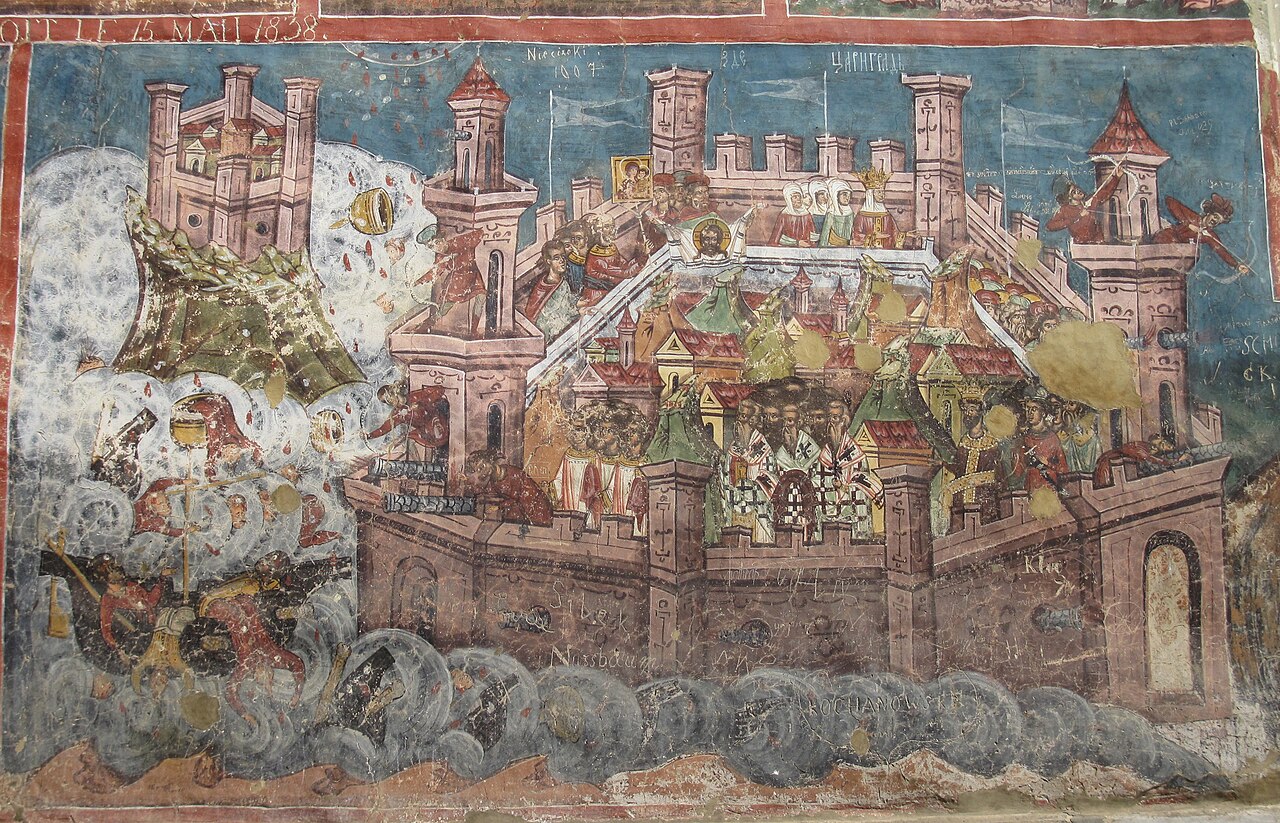
This is a picture I saw of the Sassanian Siege of Constantinople, in 626AD. Its found on the main wiki page of the siege.
Tell me those aren't muzzles of cannons on top of the walls, in the walls, and in the towers?
Is this painting false or were the Byzantines using cannons in 7th century?
Because I've read that the cannon did not arrive to this region until the 14th century.
1 Answers 2020-11-09
Numbers show most people are happy with the current outcome, and it is nice to celebrate. Go rub it into the face of whoever you want in your facebook, or in political subredits. DON'T come here and ask "Was there ever such a fascist government as the one currently being kicked out of the presidency?" This isn't jeopardy. Don't make the poor mods work triple time trying to keep AskHistorians sane. Follow rule 4.
1 Answers 2020-11-09
I’m writing a fantasy fiction novel and wanted some input about the style of clothes and shoes men and women wore during the 1300-1400s The setting is taking place in or near Ireland.
What kind of shoes did a royal woman in Ireland wear in the 1400s
1 Answers 2020-11-09
I’ve been reading as much as I possibly can lately about pre sustained contact Indigenous Australian culture, and there has been something that sticks out to me. In many of the books that I am reading, clans/family groups seem to almost literally be constantly raiding and fighting each other. Usually the dispute is over a woman, who was either promised to a man and not delivered, or literally physically taken from her husband/father. The fights seem relatively minor. A few people from each clan may be speared, hit with a waddy or boomerang, or killed. However, once the dust has settled from the battle, that seems to settle the dispute.
So now to my question. Was this how all warfare was conducted? Small raids on neighboring villages and clans? Did hundreds of clans ever come together and fight a prolonged campaign against another group?
Thank you in advance for any answers, and feel more than free to correct my current understanding of Indigenous Australian warfare or culture in general!
1 Answers 2020-11-09
I am currently reading "The Assassination of Julius Caesar", by Michael Parenti, and I am thoroughly enjoying it. As a Marxist myself, I have a particular interest on looking at both the Roman Republic and Entire from a dialectical-materialist point of view. Are there any other works engaging in this type of analysis that I should read?
2 Answers 2020-11-09
1 Answers 2020-11-09
1 Answers 2020-11-09
For example, would kingdoms have the basics such as a balance sheet, would they give tax breaks or subsidies to local businesses, invest in infrastructure without the expectation of using it for warfare. Some empires had a debased currency to my knowledge. Did they have monetary policies (e.g. Adjusting late payment fees of local banks)?
1 Answers 2020-11-09
AskHistorians Podcast Episode 162 is live!
The AskHistorians Podcast is a project that highlights the users and answers that have helped make r/AskHistorians one of the largest history discussion forums on the internet. You can subscribe to us via Apple Podcasts, Stitcher, or RSS, and now on YouTube and Google Play. If there is another index you'd like the podcast listed on, let us know!
This Episode:
I talked with author Adrian Goldsworthy, whose new book Philip and Alexander explores the lives of the two men who turned ancient Macedonia from a fringe Greek state into a powerful empire. While much of the focus has been on Alexander, Goldsworthy discusses the vital role that Philip played in setting his son up for the successes that earned him the name "Alexander the Great." We also talked about the challenges that come about from viewing history as a narrative, especially the fallacy of believing in the "inevitability" of the events that happened.
Goldsworthy is a fantastic author and has many, many books that anyone interested in history, especially Roman history, should check out. This one is his first foray into Ancient Greece, and it is well worth a read.
2 Answers 2020-11-09
2 Answers 2020-11-09
1 Answers 2020-11-09
In the British parlimentary system, for example, the winning party takes power shortly after the election, why does the US have a two month period to allow for transition? Is there a historical reason for this or is it just convention?
2 Answers 2020-11-09
I'm fairly certain that I saw a post on here going into detail about the life of a Chinese siege engineer a while back but my searching through archived posts has turned up nada so I'm hoping someone might be able to point me to the right thread, or just answer me anew.
Basically as the title says, what was life, (esp. training, equipment, deployment, and compensation) like for a Ming-era siege engineer in the Chinese military? Especially around the late 1500s?
1 Answers 2020-11-09
What was the common feelings toward masturbation in 1700’s America? Was there some sort of porn drawings or something? Was it spoken about amongst friends or completely taboo and not acknowledged at all?
1 Answers 2020-11-09
My understanding is that in the first Presidential election, there were only three states that were relatively equal in size and demographics.
Some opponents of the Electoral College complain that smaller states have undue influence. A Wyoming voter has about 4 times as much "voting power" as a voter in California.
So I was wondering if the writers of the Constitution, when they invented the Electoral College, whether they envisioned the situation we have today? And if not, could that be used as an argument that the Electoral College is outdated?
2 Answers 2020-11-09
So I'm planning on writing an essay about the early modern period and princely courts and have been told to focus it around this book. However, I'm not sure how I'd approach this as for most history essays you look at both sides of an argument, yet with this question, it is simply what can be learnt from a specific text? How should I go about asking a question of this nature?
Or if anyone is familiar with the source and can point me in the direction of some useful extracts would also be greatly appreciated :)
1 Answers 2020-11-09
Welcome to Monday Methods – our regular feature where we discuss methodological and theoretical approaches to history as well as controversies in the field.
Today, we will discuss such a controversy and one that has come up during recent election season to boot: Was Adolf Hitler democratically elected? Or rather was the Nazis' rise to power one that came with the democratic consent of the German people?
These questions are not as easy to answer as one might imagine. In part, this has to do with the trajectory that the Weimar republic took in the years before 1933, meaning the years during which Hitler and his NSDAP rose to popularity and ultimately to power; in other parts, it has to do with the peculiarities of the Weimar democratic system; and finally, it has to do with the understanding of democratic that is applied. Because Hitler did not win the election for president but rather, he became part of the government by forming a coalition after the NSDAP had won a significant part – though not a majority – of the popular vote in parliamentary elections.
But first things first: What is a Weimar and what does he do?
The Weimar Republic as it became known from the 1930s forward is a name for Germany – at this point still officially named the German Reich – during the republic, democratic phase between 1918 and 1929/1933. The Weimar Republic was a political system that functioned as a democratic parliamentary republic but with a strong and directly elected president. Functioning as a democratic republic, governments were formed from parliamentary coalitions that had a majority of representatives in the German Reichstag.
Thew Weimar Republic is most commonly associated with crisis. It started with a revolution that until early 1919 still had to be decided if it was a communist revolution on top of a political, democratic one with this not turning out to be the case. Still, in subsequent years the republic was plagued by a variety of crises: Hyper-inflation, the occupation of the Rhineland by the Allies, and political turmoil such as the first attempted coup by parties like the Nazi party and a variety of political assassination by fascists and right-wingers.
Still, even under these circumstances, the fall of the republic was not pre-ordained like the story is often told. When people emphasize how the Versailles treaty f.ex. is responsible for the Nazi take-over of power, it is thinking the republic from its end and ignoring the relatively quiet and successful and functioning years of the republic that occurred between 1924 and 1929.
Here the Great Depression and economic crisis of 1929 plays an important role for Weimar political culture to change fundamentally. As Richard Evans writes in The Coming of the Third Reich:
The Depression’s first political victim was the Grand Coalition cabinet led by the Social Democrat Hermann Müller, one of the Republic’s most stable and durable governments, in office since the elections of 1928. The Grand Coalition was a rare attempt to compromise between the ideological and social interests of the Social Democrats and the ‘bourgeois’ parties left of the Nationalists. [...] Deprived of the moderating influence of its former leader Gustav Stresemann, who died in October 1929, the People’s Party broke with the coalition over the Social Democrats’ refusal to cut unemployment benefits, and the government was forced to tender its resignation on 27 March 1930.
Indeed, from that point onwards, German governments would not rule with the support of parliamentary majority anymore, namely because they would rule without participation of the Democratic Socialist SPD, which had been throughout the Weimar years and until 1932 the party with the largest part of the vote in parliament. And yet, the German parties to the right of the SPD couldn't agree on a lot in many ways but they could agree that they rejected the SPD and even more so the again burgeoning communist movement in Germany.
From 1930 forward, Weimar governments would not govern by passing laws through parliament but instead by presidential emergency decree. Article 48 of the Weimar constitution famously included a passage that should public security and order be threatened, the Reichspräsident – at that time Paul von Hindenburg – "may take measures necessary for their restoration, intervening if need be with the assistance of the armed forces." However, these measures were to be immediately reported to the Reichstag which then could revoke them with a majority.
The problem that arose here was that because the conservative parties did not have a majority in parliament for they refused to work and compromise at all with the SPD and because the SPD refused to work with the communist KPD, chancellor Brüning and later on Papen argued to Hindenburg that this constituted an emergency and thus began ruling independent of parliament through the use of presidential decree.
Additionally, because they embraced a course of austerity and cutting social spending while at the same time privileging the wealthy, political discontent began spreading in Germany to a great decree. Most notably, both the KPD but even more so the NSDAP began gaining votes. In 1928 the NSDAP garnered 2,6 % of the total votes when in 1930 they were already the second strongest party with 18% and finally in the first election of 1932 the strongest party in parliament with 37%.
Evans explains:
It was above all the Nazis who profited from the increasingly overheated political atmosphere of the early 1930s, as more and more people who had not previously voted began to flock to the polls. Roughly a quarter of those who voted Nazi in 1930 had not voted before. Many of these were young, first-time voters, who belonged to the large birth-cohorts of the pre-1914 years. Yet these electors do not seem to have voted disproportionately for the Nazis; the Party’s appeal, in fact, was particularly strong amongst the older generation, who evidently no longer considered the Nationalists vigorous enough to destroy the hated Republic. Roughly a third of the Nationalist voters of 1928 voted for the Nazis in 1930, a quarter of the Democratic and People’s Party voters, and even a tenth of Social Democratic voters.
Concurrently, political violence escalated in the streets. Nazis fought the communists and social democrats in the streets, in a calculated bid to destabilize German democracy and political culture while using their press organs to instigate a culture war, resulting in what essentially became a parallel reality for adherents to Nazi ideology who would go on to believe that "international Jewry" controlled the government and the international scene and that the baby-slaughtering, blood-drinking evil doers planned to destroy the German "race".
This was hard to curb because those charged with upholding public order did not do a very good job at it. Evans again:
Facing this situation of rapidly mounting disorder was a police force that was distinctly shaky in its allegiance to Weimar democracy. [...] The force was inevitably recruited from the ranks of ex-soldiers, since a high proportion of the relevant age group had been conscripted during the war. The new force found itself run by ex-officers, former professional soldiers and Free Corps fighters. They set a military tone from the outset and were hardly enthusiastic supporters of the new order. [...] they were serving an abstract notion of ‘the state’ or the Reich, rather than the specific democratic institutions of the newly founded Republic.
Within this volatile situation, the year of 1932 saw two parliamentary elections: The July 1932 already took place in the midst of civil war-esque scenes in Germany with the Nazis clashing with the left. During the elections, violence escalated with the police unwilling or unable to act. In Altona – now part of Hamburg – shortly before the election the Nazis marched through traditionally left-wing Altona when shots were fired, and two SA men were wounded. In response, the SA and the local police fired back shooting 16 people. This was then used by the conservative government to de-power the Social Democratic government in Prussia and instead place it under a government commissar, arguing that otherwise the SPD would turn Prussia into an anarchist, lawless place. Shortly after the vote was called, a group of SA men in Potempa in Northern Germany broke into a communist's apartment in the village and beat him to death in front of his elderly mother, which further spurred fears of political violence.
A new government was hard to form and in response German conservatives lead by Franz von Papen und Kurt Schleicher embraced fascism and the Nazis: They tried to form a government involving the Nazis, following the logic that they would rather work with fascists than compromise with leftists and because they felt threatened by communism. At first, the Nazis rejected this advance demanding more power within the government – a strategy that worked out. Following another election in November 1932, a new government was formed in January 1933 with Hitler as chancellor supported by Papen and Schleicher.
This however was not enough and so another vote was called: The Reichstag election of March 1933 would be the last election until 1945 where several parties would take part in. Already, voter suppression methods were in full force. The NSDAP used SA, SS and police to keep social democrats and communists from voting; social democratic and communist rallies and publication were prohibited, and on February 27 the Reichstagsbrand happened.
Following the attempt to set the Reichstag on fire by marinus van der Lubbe, a supporter of the communists from the Netherlands, the Nazi government used emergency powers to start arresting people, prohibiting other parties, the unions, forming concentration camps and start suppressing political opponents. This really marks the beginning of Nazi rule in full force. Still, in the March 1933 elections, the NSDAP managed to garner about 43% of the vote while the SPD with all the suppression and so forth going on became second strongest party with about 18%. But it didn't matter anymore: Embraced and supported by the German conservative political establishment, the Nazis would impose authoritarian rule and brutally suppress other political movements, starting Nazi dictatorship and ultimately even turning on some of the very people who had lifted them to power.
Oftentimes, discussion will revolve around the fact that not a majority of people voted for the Nazis (their best result being just above 40%) or that they rose to power legally because the coalition governments where within what German law allowed. However, the big question to me that brings it back to the initial question of this text and that is a very pertinent one, is: When is the point where a system stops working as intended and therefore democracy becomes hollow resp. it stops being democratic?
The Germany where the Nazi celebrated their electoral successes was a Germany that German conservatives already didn't govern democratically anymore. For at least three years, Germany was governed not by elected parliament but by presidential decree during a time when Nazi violence against political opponents and counter-violence escalated massively and often tolerated in a calculated way or with little pushback.
In July 1932, shortly before the first Reichstag election of that year, the German federal government deposed a democratically elected Social Democratic state government and replaced it by a commissar using occurrences completely elsewhere as a justification for this authoritarian move. Under such circumstances, with the German political system already sliding into authoritarian patterns of behavior, is it justified to still speak of it as a democracy or can it be said that the growth of the Nazi party came about not under democratic circumstance but were cultivated by the authoritarian tendencies of the conservative end of the political spectrum and their refusal to accept social democratic politics addressing an economic and social crisis?
Literature:
Richard Evans: The Coming of the Third Reich
Ian Kershaw: The Nazi Dictatorship. Problems and Perspectives of Interpretation
Ian Kershaw: Hitler
Peter Fritsche: "Did Weimar Fail?" The Journal of Modern History. 68 (3) 1996: 629–656.
13 Answers 2020-11-09