I recently read that for many Europeans, such as Italians, Brazil and Argentina were popular destinations to emigrate to. Some stats say 12% of 19th ce European emigrants moved to South America. What did Europeans believe about South America at this time? Why would it make a good place to move to?
1 Answers 2020-08-01
1 Answers 2020-08-01
So I found that the symbol that is a large P with a cross on top stands for both the western and eastern roman empire. The question is; Who is the real one? The symbol was used in the western or roman empire? thanks for reading
1 Answers 2020-08-01
I recently engaged in a philosophical discussion on whether nuclear retaliation would be justified with a friend of mine. This left me wondering if the non- American world was similarly manic (i.e. bomb bunkers) about Nuclear war.
1 Answers 2020-08-01
The chilli is from the new world but it's a largely predominant flavour in Indian (and other S & SE Asian) cuisine, so what was the cuisine like before it got spicy? Also how did it get there (was it the Brits?) And what other spices in the cruisine aren't endemic to the subcontinent?
3 Answers 2020-07-31
in a middle class distric and in a poor one. and the price of rent?
1 Answers 2020-07-31
This was stated by Paul Hellyer, Canada’s former Defense Minister, in a 2014 interview with RT.
Considering he was the Defense Minister from 1963-1967, it seems like he’d be a relatively authoritative and credible figure on the subject, but for a fantastic claim, I can’t find any records of such an event. Do any exist?/r/
1 Answers 2020-07-31
Hi all,
So I think I first heard this story sometime growing up, very much likely at school, when I realised that literally every (historically) significant city in Portugal that is located at a river mouth is either found on the right bank or its historical centre is on the right bank (with only recent urban sprawl encompassing the left bank). Lisbon, Porto, Setúbal, Portimão - but there are way more examples of this.
Now the theory, as I recall it, is that all these cities had a trading history (as most cities at the mouths of rivers do), and that in the Northern Hemisphere natural harbours tend to emerge on the right bank of river mouths because of the coriolis effect - hence Lisbon and Porto being where they are.
Now for some reason today (actually I think it was because I was watching some new Microsoft Flight Simulator videos and I was thinking I’d enjoy spending my summer Coronacation in August following virtual rivers on a plane) I had a flashback and remembered this whole story - and indeed, a cursory look at Spain, France and the UK on Google Maps suggests that all these river mouth cities do sit on right banks!
Is there some truth to this or am I being a victim of a falsehood and some sort of selection bias?
Edit: *coriolis
1 Answers 2020-07-31
1 Answers 2020-07-31
1 Answers 2020-07-31
1 Answers 2020-07-31
Basically what the title says. Here in the United States, I have received absolutely no education about Tibetan history. As other Chinese-associated territories like Hong Kong and Taiwan make the news more and more due to their movements for increased autonomy, I feel like I am missing some very important information with respect to the people of Tibet.
I am looking for resources to learn primarily about Tibetan history following the Chinese invasion. I would like to learn about the uprising in 1959, about the government in exile, and about recent action for autonomy or international recognition. I want to know how the Tibetan people feel about their nation and their government.
Thank you so much for your help.
1 Answers 2020-07-31
Every time I watch movies like brave heart or The Patriot, it baffles my mind the way battles were fought. Were the traditions of the day , more important than winning the battle by any means necessary? The idea, had to have at least crossed their minds to attack from the side, or a different formation of angle of attack . Or order the soldiers to do up downs, when the other side is firing, to give better chance of survival
1 Answers 2020-07-31
Watching Greyhound (Tom Hanks Apple TV movie) and I can’t take my mind off how much this must’ve fucked up the ocean life. What was the damage?
2 Answers 2020-07-31
Hi, i have watched tons of videos on this subject now on Youtube and they all mostly tell the same story. But they never say how we even know today that this is what happen, who wrote the story down and what is the source of it? If the Library of Alexandria burned down then how did the book survive where Era told hes work? I find myself asking myself more questions when hearing about hes work! I am not doubting hes work, i just wanna know how WE know today about the work he did! Is it a book that the Vatican took care of in their library?
1 Answers 2020-07-31
After going through many census records from 1880s-1950s (NY) it seems many people were only educated until about the 8th grade. What would they have learned in that time, and how in depth? Did kids learn the same things we do now? Would it have been more home care/ trade skill centered?
1 Answers 2020-07-31
So from my understanding, the French and Prussians didn't get along too well, so I am confused as to why Frederick the Great named his palace in French rather than his mother tongue.
1 Answers 2020-07-31
It's really common for the wars between the Aztec/Inca/Mesoamerican tribes and the Spanish to be shown as the Spanish absolutely outclassing them in warfare. I know that this is largely due to the difference of the Spanish having metal weaponry, guns, and horses, but was the disparity between them really as massive as modern media depicts it? Do we have historical evidence or recorded events that support this? I am asking this entirely from a military perspective, not a civil one. I know that in reality, the fact that many Mesoamerican empires were already in decline, infighting, and plague were as big if not bigger factors in them being destroyed than a military advantage. I am just curious about how well a troop of conquistadors actually faired when they got into an altercation with a group of Aztec warriors.
3 Answers 2020-07-31
Hitler was known to promote 'Aryanism' - the Blonde, Blue Eyed, Fair Skinned German. In fact his scientists conducted tests for Aryanism - which separated the pure Aryans from the Jews and others.
Yet I have always thought there was a certain 'Jewish-ness' or 'Asiatic-ness' about Hitler himself. The dark eyes, the thick dark hair, the large nose. Seriously in some photos he looks very very Jewish, and I don't know if this is proven fact but some quarters assert he did have some Jewish ancestry.
But didn't any critics in Nazi Germany or outside it ever remark on the irony of a dark haired Hitler promoting a pure blue eyed and blonde haired Aryan race when he himself might have failed his own 'Racial Purity Test' simply on his appearance alone?
1 Answers 2020-07-31
After binging a number of Westerns, I noticed that they always show individuals drinking whiskey and occasionally beer. Only very rarely are drinks such as sherry and port shown and liquors like vodka and gin virtually nonexistent. Is this a true depiction of the drinks available out West in the 1800s? If so, were drinks only produced locally, thus limiting the amount of imported liquor? Or, were there larger distilleries out East shipping their products West?
1 Answers 2020-07-31
World War 1 was likely the first conflict where widespread video recordings exist of scenes of combat and life on the battlefield. Life behind the front, as well as on the home front also show up regularly in post war and modern documentaries.
A subset of these videos, and a common topic within war documentaries, is video footage purported to show the physical and psychological effects of the war. A Youtube or Google search nowadays brings up hundreds of videos of symptoms of "shell shock" or "war neurosis" on soldiers at field hospitals or treatment centers, and the various treatments that are being administered. However, given the highly-propagandized nature of video footage and news at the time, how realistic are these videos in their portrayal of shell shock? Are there instances of modern medical professionals debunking (or at least questioning the validity of) some of these videos?
1 Answers 2020-07-31
Both the Catholic and Orthodox churches have monastic traditions going back centuries. Why is this not the case for protestant churches?
1 Answers 2020-07-31
My question in the title should be mostly self-explanatory, but I figured I'd put in a few more details about what I already know, so that anybody who responds won't have to explain literally EVERYTHING to me.
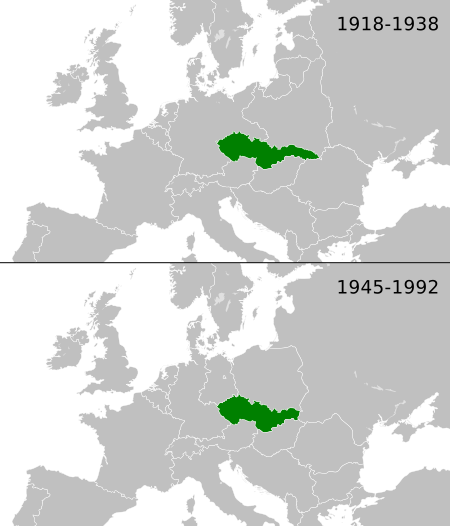
Carpathian Ruthenia is an area that was part of Czechoslovakia until 1945, after which it was integrated into the Ukrainian SSR.
I'm not an expert on Slavic groups, but from what I can tell that area was and still is inhabited by people who are most ethnically and culturally similar to what we would today call "Ukrainians" (I'm aware that there is some difference between the term "Ukrainian" and "Ruthenian", but I'd rather not get into that in this question if necessary). However, these peoples (the Rusyn) appear to be somewhat distinct from other Ukrainians, although I don't know the exact details. Regardless, the inhabits of Carpathian Ruthenia at the end of WWI were significantly more similar to Ukrainians than they were to Slovaks.
Galicia-Lodomeria had a substantial Ukrainian population, and this area became part of Poland after WW1. So why didn't this region also become part of Poland? That option makes a lot more sense to me. Put the Ukrainians with the other Ukrainians. Besides, Czechoslovakia already had enough ethnic divisions before WW2. Surely the last thing they would have needed was ANOTHER ethnic minority.
However, I do understand why that region didn't become part of the Ukrainian SSR. Firstly, due to whole communism thing that would rightly make people wary of joining them, and due to the fact that the region would be completely cut off from the Ukrainian SSR thanks to Poland's annexation of Galicia-Lodomeria.
Thus, my title question could be phrased like this:
"Given the fact that Poland already had a substantial Ukrainian population due to the integration of Galicia-Lodomeria, what caused the ethnically-Ukrainian region of Carpathian Ruthenia to become part of Czechoslovakia rather than Poland? What factors caused this decision, who were the people who ultimately made this decision, and how did this decision come to be?"
1 Answers 2020-07-31
I’m a 20 year old with an enormous passion for history. But I’m hesitant to funnel tens of thousands of dollars into formal college education. I know that’s what most employers are looking for, formal degrees. I went to college for a semester for European History and International Affairs, but I don’t learn well in classroom environments at all, independent study is right up my alley and the way I learn best. I wanted to know if it was possible at all that employers in the tour guide industry or even maybe high school history would consider applicants or individuals that understand and can teach course work (or history in general in tour guide case), even without a formal degree. Have read a great chunk of classic novels and have kept my textbooks from college and studied them independently cover to cover. There’s so much more I need to learn, I realize, and it’s going to be a few years before I’ll even be considered for a job in the field, but that gives me much time to well round and refine my knowledge. But I’m just wondering if this is possible if I demonstrate a very comprehensive knowledge of the field, requirements, and curriculum? It’s wishful thinking, but it’s better to ask than not know if it’s an option or not. (And when I speak of tour guides, think of the kind that lead groups in European cities)
1 Answers 2020-07-31
It seems there's sort of an unwritten code among the elite to treat each other with dignity. So unless someone gets straight up executed, they seem to usually just be imprisoned and eventually released or ransomed.
I imagine it's also rare for a leader to be captured. Not talking about any senior person on the enemy side, like a captain or archduke or whatever. I'm talking about when you capture the general of the entire enemy army, or their king or president or whatever they have.
Were captured enemy leaders ever terribly mistreated (humiliated/tortured) during the Middle Ages?
1 Answers 2020-07-31