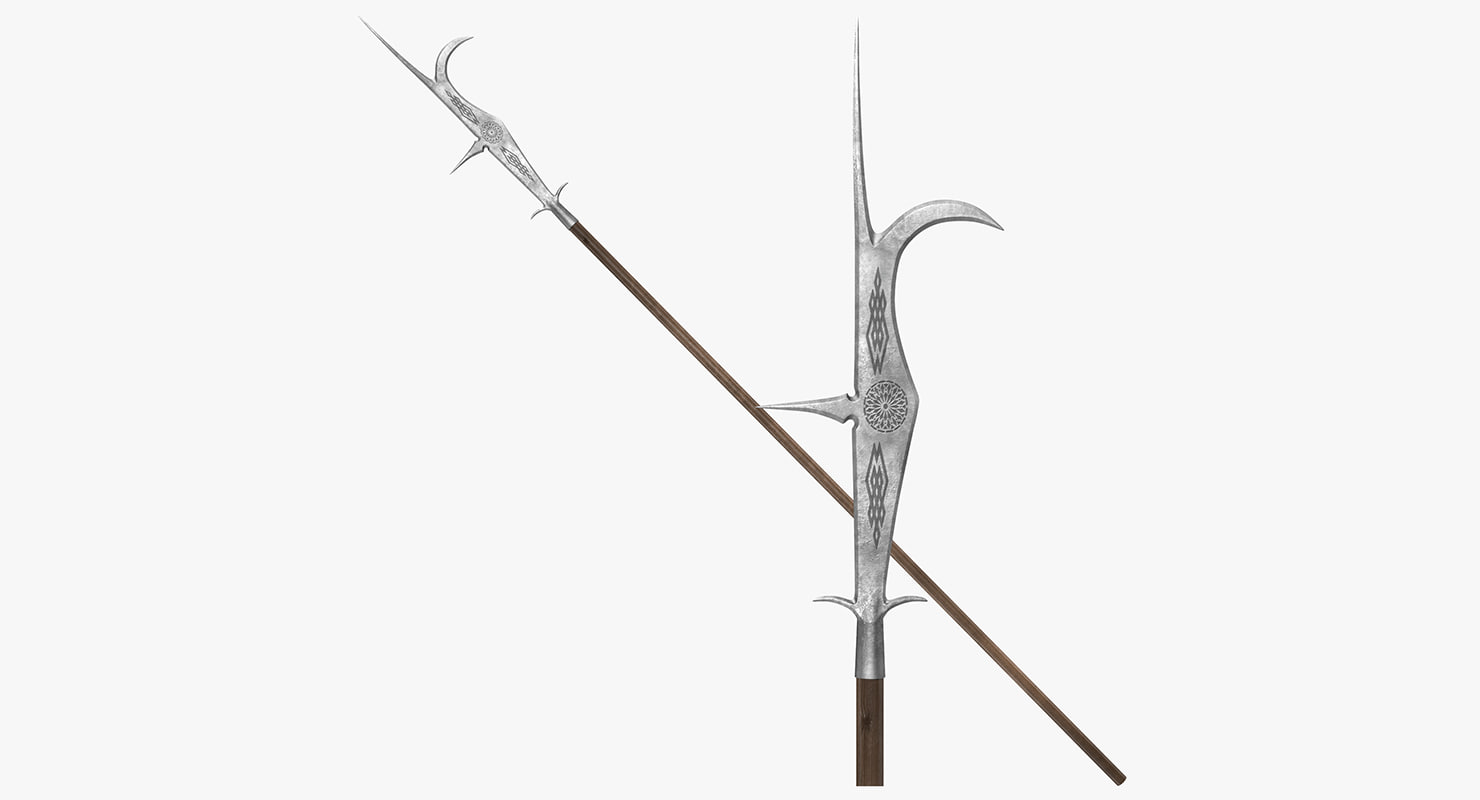
I could not find further references that would support Sir Guy Francis Laking's claim (in his A record of European armour and arms through seven centuries), so I decided to turn to the wonderful people in this subreddit who are more knowledgeable than I am.
I am basically curious about the following aspects regarding the guisarme:
How effective and widespread was it as a weapon and what was its purpose on the battlefield? In his book, Sir Guy Francis Laking says it came second only to the spear, so this makes me think it was a weapon in fairly common use.
What lead to the several shapes and forms of the various weapons that fall under "guisarme"? I know not a lot of people agree on what a guisarme actually is, so I'm lumping guisarmes/fauchard/glaive-guisarme under the same label for the purpose of this question. Why were there so many designs? Were they actually this intricate because such shapes were useful in combat, or was it more of a "ceremonial" look?
Were people in the ⅩⅢth century really advocating for a ban on guisarmes? During a discussion with another person, it came up that this could make sense if taking a knight off of his horse was too easy with recourse to such weapons. Did this "call to ban guisarmes" really happen and if so what were the reasons behind it?
Thanks in advance!
1 Answers 2020-06-23
I know it was common for people to address George Washington as "Your Excellency". When did people stop using this for the president, and why?
1 Answers 2020-06-23
To my knowledge there were several presidents which were pro-slavery or at least southern sympathizers and still alive at the time of the US Civil War. To what extent, if any, did these men help the Confederates?
1 Answers 2020-06-23
1 Answers 2020-06-23
1 Answers 2020-06-23
What's the difference between the theories in Ian Morris' Why the west rules for now and Jared Diamond's Guns, germs and steel?
It seems like both authors are proponents of the Geography hypothesis, what I don't understand is why WTWRN doesn't get as much flak as GGS, it's been a while since I read the books so what's the difference between their arguments?
1 Answers 2020-06-23
I know that noble manor-houses and castles would be built by large teams of professional architects and carpenters and other people like that, but what about the houses of rural peasant villages? Would it be more common for a peasant to hire a professional carpenter to build him a house, or would it be more likely that the whole village would pitch in to build each others houses, with every villager having some basic knowledge of construction?
1 Answers 2020-06-23
I am not necessarily looking for information on Yasuke specifically, but more of what sort of position he actually held in court. Is there cultural context that goes deeper than the literal translation of his title?
1 Answers 2020-06-23
I was doing some research on coups in Turkey and noticed that there were failed coup d'tats in 1962 and 1963 perpetrated by a certain Talat Aydemir, but I can't find any more information on it. What happened?
1 Answers 2020-06-23
There are many references in literature and the like to the Articles of War, but what actually were these articles? What were the consequences for breaking them?
1 Answers 2020-06-23
1 Answers 2020-06-23
1 Answers 2020-06-23
When Hanninal crossed the Alps, he brought with him several elephants. If I remember correctly, he lost most of them along the way. Were the skeletons of these elephants ever found? What happened to their remains? I'm picturing Italian farmers hundreds of years later finding skeletons of elephants in the Alps and being very confused, or Gaulic tribes finding them and the discovery of these monstrous creatures bones having a big affect on them. Did anything like this happen?
1 Answers 2020-06-23
How much damage could a single battleship (or a task force of one battleship and one heavy cruiser) do to convoys of 30+ ships? Or was the value more about proving that the threat existed and requiring additional resources for convoy protection?
1 Answers 2020-06-23
I recently watched the Death of Stalin. I know that it’s a comedy, but I’ve heard that it portrays the events surrounding his death pretty well. In it, General Zhukov was brusque but seemed to have a good sense of humor. How realistic was this portrayal? If it wasn’t realistic, what was he really like? And finally, how good of a General was Zhukov? I understand that he had a hand in defeating the Nazis on the eastern front, but was that from his own skill or was it from the Nazis blundering?
1 Answers 2020-06-23
My dad started watching the Russian series about the WW2 PQ-17 convoy incident. He asked me what PQ stands for since I'm using the computer. I looked it up, but couldn't find the answer on any English-language site. However the Russian wiki-page for the arctic convoys claims that PQ stands (or stood) for the initials of P. Q. Edwards, a British officer in charge of the convoys. Neither my dad, nor I believe it to be so.
Could anyone shed some light on this?
Thank you.
1 Answers 2020-06-23
During the years of slavery in America were there groups/organizations that openly opposed slavery and were fighting for the rights of black people in America?
Were there protests? What sort of feelings did the average American have towards slavery?
2 Answers 2020-06-23
1 Answers 2020-06-23
1 Answers 2020-06-23
Hi I just watched a video made by olly from philosophy tube about antisemitism, at one point he said that jewish community being greedy bankers due to bible laws that prohibits charging interest to fellow christians in money lending in return, the lord of the land taxed them heavily but did these stereotype about jewish people exists in middle ages islamic world as I read that islamic world at that time is more tolerant at the jews compared to christians in the same time period
1 Answers 2020-06-23
2 Answers 2020-06-23
Was it equivalent to horse theft or carriage theft? Was there even a black market for stolen bicycles?
1 Answers 2020-06-23
Rostovtzeff was a giant in his field, especially in his innovative use of archaeology to support his arguments. Now, apart from his very misleading summary of the late Roman economy towards the end of the book (a "terror" state, which suppressed the self-governing city) and his anachronistic usage of the terms "bourgeoisie" and "class struggle", does his use of archaeology and the description of the provinces still hold up well?
1 Answers 2020-06-23
So I just listened to Dan Carlin’s Supernova in the East pt.4 and in it he describes the battle of Midway. As he was describing it he mentioned that carriers had CAP(Combat Air Patrol) to defend their airspace and ships from being attacked. In addition he mentioned that anti aircraft fire was also employed. Also with the reality of how torpedo planes worked, basically coming level with the ship, did CAP not follow them to avoid the ships defenses? Basically I want to know how the fleet that was being attacked avoided shooting their own down. If they didn’t try to avoid that, that begs the question, how did that weigh psychologically on the sailors?
1 Answers 2020-06-23