Today:
Welcome to this week's instalment of /r/AskHistorians' Sunday Digest (formerly the Day of Reflection). Nobody can read all the questions and answers that are posted here, so in this thread we invite you to share anything you'd like to highlight from the last week - an interesting discussion, an informative answer, an insightful question that was overlooked, or anything else.
3 Answers 2020-04-19
1 Answers 2020-04-19
In an earlier Roundtable, we discussed one of the key philosophies of the subreddit, namely that there is no such thing as a stupid question. But none of that is to say that all questions are created equal, and putting in a small amount of time and effort to improve your question can go a long way in helping to get the answer that you are seeking!
###Why Bother?
Not every question gets answered on the subreddit, and there are many reasons why one may be left without response. But one of the most important factors to keep in mind is that answers take time and effort, and everyone writing responses is doing this for free, simply because they are passionate about their topic of study! That means that just how appealing a question looks can have a big impact on whether it gets answered. Appeal can mean many things of course, which we will go over, but the end result is that two questions might be competing for one flair's attention; or similarly a single question may be competing with something else to be done off reddit. If you want your question answered, you want it to seem more interesting than the alternative!
####Curb Appeal
Anyone who has dipped their toe into the real-estate market - or just watches too much HGTV - knows that simple cosmetics can make a big impact! And that is no different for an online space. The most basic step in writing a question is to check simple things like grammar, spelling, and punctuation. We know that not everyone is the next Shakespeare, but putting a few extra seconds to ensure that your question is well written can help a lot. If it looks like you don't care enough to even spell-check your question, perhaps I don't really feel like it is worth putting in the time to answer it.
It is also worth remembering that many Flaired Users have keyword alerts set-up, and misspellings of those terms could very well mean they end of missing your question because of it. And of course, asking about big shifts over time and leaving out that 'f' might result in a very different answer than you were looking for!
####Be Clear, Be Specific!
Consider the time and place that your question applies. To be sure, some questions are necessarily more broad than others, and we are also understanding that the simple lack of foreknowledge can limit just how specific a question can get, but ensuring that your title is as clear and specific as you can reasonably make it helps tell a potential respondent just what you are asking about. The more of the 'Ws' (Who, What, When, Where), generally, the better!
Don't stick too much information in the title though. Too little might be vague, but too much can be jarring too. If you have extra stuff to ask about, put that in the body of the question.
####Self-Criticism is Key
When noting there are no dumb questions, Carl Sagan did nevertheless note that "There are naive questions, tedious questions, ill-phrased questions, questions put after inadequate self-criticism." Think about what you are asking, and think about how you are asking it. The way a question is phrased can matter greatly!
For instance, are you asking a question, or are you posing a theory? Try to keep as many assumptions out as possible, as a wrong premise may keep people away. "Because people only drank beer due to the bad water, didn't everyone suffer from fetal alcohol syndrome?" for instance is a popular question we see, but one chock full of misconceptions! To be sure, asking that question would, ideally, get them addressed, but a question that questions assumptions may get a warmer reception, such as "Is it true that people drank more beer because of poor water quality, and if so, what impact did high consumption have?"
Also consider how an historian might approach a question. Questions about how people felt, or why someone did something are hugely dependent on the sources that exist. Likewise, for many things pre-modern, quantities are at best going to be estimates.
Try and consider what information might have survived, and what an answer might look like, and use that to shape how you ask the question. "How many latifundia existed in the Roman Empire?" is probably impossible to answer. Where would we ever get precise enough numbers? But we can almost certainly discuss about how powerful Roman plantation owners were as a political class, or the role they played in Roman agriculture.
For pre-modern questions, think try to think qualitatively, not quantitatively! What is the underlying theme or trend that you are asking about? Focus there! Similarly questions in the vein of "Why didn't they do X to solve Y?" are driven by modern hindsight far too often, and less likely to get a response than the open ended question simply asking about "What solutions were attempted to solve Y?"
Likewise, asking "Why aren't we taught about X?" often is a less interesting answer than you might suspect; instead of a conspiracy to hide the truth, instead the answer is probably either:
####Do a Little Research
All of the above can be helped out by just a few quick minutes of research. Sites like Google and Wikipedia have their obvious faults - hence why they aren't good sources here - but they can at least get you in roughly the right direction in many cases. A quick check of a relevant Wikipedia page, for instance, can help you narrow down just what you are asking. Google might help point you to the best terms to use in the title.
####We Put in Effort for Those Who Put in Effort
Showing that you have put in the effort to ask a good question makes us want to help you out. Following all of the above helps that a lot. Writing a little bit in the body of your question can go even further. We don't need a long essay about why you have been thinking on this topic, and what you think the answer might be - this often makes us suspect you mostly want a place to confirm your assumptions rather than an answer which might upend them, and so why bother answering? However, laying out a few sub-questions that show how you have been thinking over the theme and the implications of it make us more eager to answer. In fact, it can also help us write a better answer to what you really want to know, as it provides direction as to exactly what things you are trying to learn about.
2 Answers 2020-04-19
I know the US got their hands on a MiG 15 that defected in Korea and a MiG 25 that flew to Japan, and then there was the Hind they got out of North Africa, but are there similar stories for the Soviets?
1 Answers 2020-04-19
On the one hand, there is no shortage of events that can be interpreted as evidence of Stalin seeing himself (and acting) as Hitler's ally - for example, supplying the Nazi war machine with food and raw materials, instructing Communist parties worldwide to denounce the Allies' war efforts as "imperialism", promoting isolationism in the United States, and dismissing the warnings of the planned invasion as a ploy to undermine the Soviet-Nazi alliance.
On the other hand, I am currently watching Indy Neidell's World War 2 series, which depicts Stalin's extensive defensive preparations along the Western borders.
My question is, what do we know about Stalin's state of mind? Did he
a) expect a long-term strategic partnership with the Third Reich?
b) buy time to fight a war against Germany at a later time?
c) hedge his bets, hoping for an alliance and preparing for the war if it happens?
None of these make sense to me. Option A requires Stalin to be naive and gullible, which he was not, AFAIK. If he intended to fight a war, did he look at the experience of Finnish and Polish campaigns and think "yeah, we can totally win this without any help from the Allied powers"? Finally, if he realized that a there is a risk of a war breaking out, why were the preparations so half-baked? (Planes with no airfields to operate from, bunkers without artillery, etc)
Do we have a good insight into Stalin's thinking on this?
Thank you!
1 Answers 2020-04-19
Today is the 77th anniversary of the "Attack on the Twentieth Convoy" and it seems that, in of itself, it is a rare case of targeting a Holocaust train specifically rather than sabotage of the railway lines in general. Are there more cases of sabotage of the journeys of these trains that we know about, was there apathy to the treatment of Jews at these times, or is there another explanation?
1 Answers 2020-04-19
1 Answers 2020-04-19
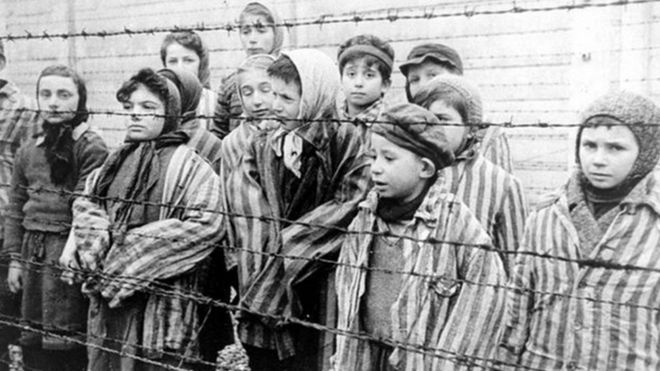
A major difference I am finding is that people in concentration camps usually wore vertically striped shirts, whereas most often the kid will draw the stripes horizontally.
Examples:
1 Answers 2020-04-19
1 Answers 2020-04-19
I keep seeing conflicting answers, and I'm not sure which answer is objectively true or just someone pushing an agenda.
1 Answers 2020-04-19
2 Answers 2020-04-19
The watch is a Soviet brand so I’m assuming it’s a Soviet figure but I’m unsure. The photo is linked here . Any input is appreciated.
1 Answers 2020-04-19
On many web sites I saw big lists of all countries they conquered and this countries were on list.
I am from Serbia and I never heard about any hostility between coutries.
1 Answers 2020-04-19
Firstly, I'm new here and I read the rules, so I think my questions is appropriate. If not, I apologize. Secondly, I'm sorry if my source isn't better, but I couldn't find information about this anywhere.
Ok, so, a few days ago, I was watching Youtube videos, and I came upon the acceptance speech of Kyra Sedgwick during the 2010 Primetime Emmy Awards. I was watching it and, as she walked up the stairs to receive her award, the announce said the following: On her father's side, Golden Globe winner Kyra Sedgwick is descendant from William Ellery, signer of the Declaration of Independence. I believe that means that every July 4th, Ms. Sedgwick gets a residual check'. I found the information very... strange... so, I was wondering if anyone knew whether this is true. Do the descendants from the founding fathers actually get money every 4th of July? Since when? Is it in perpetuity? Do the descendants of, say, the signers of the Constitution also get residual money? I find this all very intriguing.
1 Answers 2020-04-19
So in dual monarchy systems leaders have 2 titles, like Kaiser Karl the 1st of Hungary and 4th of Austria. Is there a particular way to order the names? Does it go highest to low or vice versa (like above)? Also if a leader was overthrown but returned to the throne before their death would they still have their previous number? For example, if Queen Elizabeth the Second was forced to abdicate today, and then through some strange set of circumstances in a couple years she reclaimed the throne would she still be called Queen Elizabeth the 2nd? Is there any situation where she wouldn't be called such or any she would? This is probably a stupid question and I'm most likely overthinking things, but i was just curious
2 Answers 2020-04-19
Edward III's whole argument was that even though Salic law prevented a king's daughters from becoming the monarch, the son of one of those daughters could still become king. So Edward's claim is that he was the closest using that definition.
But he wasn't. Philip V had a daughter called Joan who married the duke of Burgundy, and had a son called Philip. Philip was born in 1323 so would have been alive and the first in line using Edward's definition of Salic law when the Capet line died out in 1328. Edward III would even go further down the line in subsequent years, by the time the actual war broke out in 1337, Louis X's daughter Joan of Navarre now had 2 sons, and Philip V's other daughter Margaret of Burgundy had 1 son.
Did the French ever take notice of this in order to discredit Edward's claim at all? (because it seems like something that would instantly make the English claim fall apart, yet I had never heard of this before at all) Louis X's grandsons even fought for the English at times during the war, I wonder if they realised that they were fighting for a definition of Salic Law that meant they were the true heirs to the throne?
1 Answers 2020-04-19
Hello, I have been reading a bit of James Holland's work and really enjoy his throuoghness and writing style. My primary interest lie in the Eastern Front concerning Germany's war with the Soviet Union. I was wondering if anyone knew of authors that go into similar all encompassing detail and approach as Holland. I really appreciate everyones time, thanks!
1 Answers 2020-04-19
1 Answers 2020-04-19
Bonus question - once accepted into training how were recruits allocated to fighter pilot vs bomber pilot?
1 Answers 2020-04-19
I was reading up on the Royal Navy in the Second World War and saw that many of the famous capital ships ended up being scrapped after the war and were not preserved (BC renown, BB warspite etc.).
Surely these ships which such historical importance should've been preserved, at least one of them, why were so many scrapped?
1 Answers 2020-04-19
So I recently heard that the idea of Roman cities filled with white marble statues and busts was infact wrong, but that they were all painted over, and Renaissance artists attempting to replicate greek and roman art just never realized it. Did this also apply to the buildings and structures, was there just a large paint industry in Roman society that nobody ever talks about anymore?
1 Answers 2020-04-19
I’m also interested in the Ticket of Leave system and how much it promised (as well as actually delivered) on a better life.
Fast forward four years and I’ve received my Ticket of Leave, what does my new life look like now?
1 Answers 2020-04-19
Until recently I thought that the decision to execute Nicholas II and his family was made in the spur of the moment, due to rapid advance of the White forces. But it turns out that it was planned for several months in advance. Why though? Why getting rid of such an asset and bargaining chip, let alone losing reputation worldwide?
1 Answers 2020-04-19
Been learning recently about Ancient Greece and have become absolutely obsessed with Alcibiades.
He was obviously charming, physically attractive and very scandalous, but when I started my research, I was surprised to learn he was also an accomplished military general.
Now my question is this, do we have any sources which specifically say that he was a good fighter, say like in a one on one scenario? Or was he just a good commander?
(Fun facts also welcome, I'm loving learning all I can about this guy!)
1 Answers 2020-04-18