In the last few days I read a pretty old book called 'Indien und das Christentum' [India and Christendom] from a German scholar called Garbe which was written in 1914. He paints a fascinating picture which mostly concerns influences regarding way of worship and a few christian legends (St. Eustachius, St. Christopherus and Satan as a seducers) as well as some smaller but still interesting stories regarding the distribution of bread by Jesus (Feeding the multitude).
I am no expert and not even reasonably well read in that field of study, so I would love if someone could give me a modern take on this subject or at least point me to some good sources. Obviously a scholar who wrote during the Kaiserreich in Germany had some different views and, maybe most importantly, very different sources.
2 Answers 2018-08-10
Operation Barbarossa began within days of the exhumation of Tamerlane’s remains by a Soviet archaeologist, and the Soviet victory at Stalingrad occurred days after their reinterment.
The story goes that Tamerlane’s tomb was inscribed with a curse to the effect that disturbing the remains would “unleash the demons of war”. Other versions merely state that the curse was a common belief among the people of Samarkand at the time that the remains were exhumed.
Was there a curse, or was this element of the story invented after the event?
1 Answers 2018-08-10
Specifically NYC, but also Chicago and any other major cities. I keep realizing I don’t know much at all about it, so I’m looking for some books on like the Italian mob and all the different families in it. I don’t even really know how to phrase the questions since I just don’t know as much as I thought, so if you know any books that are interesting to read and give info on such things, it would be greatly appreciated!
1 Answers 2018-08-10
I'm a theology student, reading a book from Stanley Hauerwas. He keeps saying that the Enlightenment caused a different morality that made it possible to use the bombs and not feeling any guilt about it. I disagree, but I don't know where to find reliable information. Can anyone tell me more about this, or recommend reliable sources that I can consult?
2 Answers 2018-08-10
1 Answers 2018-08-10
3 Answers 2018-08-10
reading the bible was of great importance . but what part was most popular regarding Day to Day guidance. which "stories "were most heared and preached ? and how were they heared? was there a difference over time . which stories were not told.? what is the great difference between reading m.a. and now. is there some kind of books you can advice?
2 Answers 2018-08-10
Also, were any precautions taken to avoid these kinds of things?
1 Answers 2018-08-10
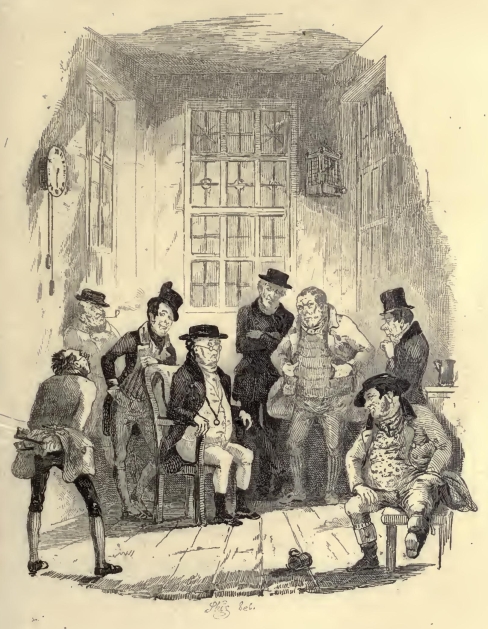
The scene in question is from Dickens’ novel The Pickwick Papers. Here a character is sent to debtors’ prison and the jailers ‘take his portrait’, or memorise his face so they know he is a prisoner.
Here is an illustration of this scene: https://www.gutenberg.org/files/580/580-h/images/20227m.jpg . This is the text in question:
Here they stopped, while the tipstaff delivered his papers; and here Mr. Pickwick was apprised that he would remain, until he had undergone the ceremony, known to the initiated as ‘sitting for your portrait.’
‘Sitting for my portrait?’ said Mr. Pickwick.
‘Having your likeness taken, sir,’ replied the stout turnkey.
‘We’re capital hands at likenesses here. Take ‘em in no time, and always exact. Walk in, sir, and make yourself at home.’
Mr. Pickwick complied with the invitation, and sat himself down; when Mr. Weller, who stationed himself at the back of the chair, whispered that the sitting was merely another term for undergoing an inspection by the different turnkeys, in order that they might know prisoners from visitors.
‘Well, Sam,’ said Mr. Pickwick, ‘then I wish the artists would come. This is rather a public place.’
‘They von’t be long, Sir, I des-say,’ replied Sam. ‘There’s a Dutch clock, sir.’
‘So I see,’ observed Mr. Pickwick.
‘And a bird-cage, sir,’ says Sam. ‘Veels vithin veels, a prison in a prison. Ain’t it, Sir?’
As Mr. Weller made this philosophical remark, Mr. Pickwick was aware that his sitting had commenced. The stout turnkey having been relieved from the lock, sat down, and looked at him carelessly, from time to time, while a long thin man who had relieved him, thrust his hands beneath his coat tails, and planting himself opposite, took a good long view of him. A third rather surly-looking gentleman, who had apparently been disturbed at his tea, for he was disposing of the last remnant of a crust and butter when he came in, stationed himself close to Mr. Pickwick; and, resting his hands on his hips, inspected him narrowly; while two others mixed with the group, and studied his features with most intent and thoughtful faces. Mr. Pickwick winced a good deal under the operation, and appeared to sit very uneasily in his chair; but he made no remark to anybody while it was being performed, not even to Sam, who reclined upon the back of the chair, reflecting, partly on the situation of his master, and partly on the great satisfaction it would have afforded him to make a fierce assault upon all the turnkeys there assembled, one after the other, if it were lawful and peaceable so to do.
At length the likeness was completed, and Mr. Pickwick was informed that he might now proceed into the prison.
1 Answers 2018-08-10
I imagine the Party existed as a legal entity within and among the various Republics. I know it was fully entwined with the state, but it had a separate existence, and wasn't sovereign. So it must have had lots of stuff...real estate, buildings, aircraft, cars, ships, all kinds of stuff. My first question is what happened to the Party, legally? And second, was the transfer of all that property legal and orderly, or was it a wild scramble by different people to simply seize the property and assert ownership on a revolutionary basis?
1 Answers 2018-08-10
Before the first transfer of prisoners to Australia as a penal colony, were there any Natives on the continent or was the first set of prisoners the first to be on the continent?
3 Answers 2018-08-10
How did Robin Hood become such a prolific character in English (and French) folklore?
1 Answers 2018-08-10
I ran across this in a parish record. As a layman I've heard about "master pieces" in medieval apprenticeships, but this would be long after that time. What signify the difference for shoemakers, or other trades? I've run across muellermeisters (miller), schmeidermeisters (tailor) and maurermeister (wallbuilder) as well.
1 Answers 2018-08-10
People knew for centuries there was this sludge underground, but did they know what it really was or did they have any uses for it until the late nineteen century when engines were invented? How historically was crude oil/petroleum viewed as or thought to be?
1 Answers 2018-08-10
Since the Bering Strait only separates the continents by 55 miles, with islands between, was there localized trade/travel between small groups of individuals?
Was there contact but it was simply never realized these were two separate but massive continents?
What did Asian societies believe was to the extreme north east of Asia and what did their maps depict? How long did it even take for word to reach them of the official discovery of north america?
1 Answers 2018-08-10
1 Answers 2018-08-10
I've been really interested in Latin America lately. I don't know why but that's not an issue at all and I'm not about to complain about being fascinated by something and motivated to learn two languages all of a sudden. I started by just reading the Wikipedia page top-to-bottom; this was for a brief overview and an idea of where to look next. However, I'm only 20% through it and already perplexed by the paragraph on the Pre-Columbian history of Latin America. The first three sentences are:
The earliest known settlement was identified at Monte Verde, near Puerto Montt in Southern Chile. Its occupation dates to some 14,000 years ago and there is some disputed evidence of even earlier occupation. Over the course of millennia, people spread to all parts of the continents.
This implies that humans have been settling in the Americas for fourteen millennia. However, a couple of sentences later, we read:
The earliest settlements in the Americas are of the Las Vegas Culture[33] from about 8000 BCE and 4600 BCE, a sedentary group from the coast of Ecuador, the forefathers of the more known Valdivia culture, of the same era.
Forgive me if I am misinterpreting this information entirely. I am not accustomed to the language used in articles about the history of humanity and civilisation; for example, I don't actually know whether 'settlements' count as 'civilisation'. That being said, don't the two extracts above directly contradict each other? The former says settlements occurred fourteen millennia ago, while the latter says the earliest settlements occurred just ten millennia ago. Am I not understanding the flow of time? It's possible, I'm not trying to be facetious. I'm really not a smart cookie, and I was hoping this community could help me out.
Further to this confusion, I was under the impression that humans entered the Americas over the Bering Strait when it was frozen over. If this is the case, why did they go all the way to Southern Chile to settle? If not, how did they get there?
Thanks for reading <3
1 Answers 2018-08-09
1 Answers 2018-08-09
1 Answers 2018-08-09
I am currently watching Ken Burns' Vietnam documentary series, and I am seeing a lot of fantastic footage from the heat of battle. I realize that there were a lot of battles, but still. Were camera-equipped reporters the norm or the exception? How did journalists manage to stay literally in the center of the action? How many of them got killed?
There is a war vignette in Burns' documentary, where a reporter recalls how a U.S. military person instructed him on how to fire, reload and clear jams on an MG, because said military person required all hands he could muster for a battle at hand.
I don't really have a specific question; I'm rather looking for resources on the work journalists did in Vietnam at that time. Preferably first-hand accounts. What kept them from quitting once they'd been involved in a fight for the first time? How did they manage to keep their composure in order to film frankly incredible shots while under fire? Generally speaking: How did they do it?
Thanks!
1 Answers 2018-08-09
Did it persist in Iranian-speaking peripheral areas like Tajikistan and Afghanistan? Is there any evidence that Iranian polytheists were assimilated directly into Buddhism or Hinduism rather than ever going through a Zoroastrian-phase in Afghanistan?
1 Answers 2018-08-09