I'm reading Marcus Aurelius' Meditations and he often mentions God. Given that Romans had thousands of deities and that Marcus Aurelius himself prosecuted Christians, I guess it maybe has nothing to do with the modern concept of God. How was the original text? Was he referring to Jupiter? Was it changed by Christian translators? Was God as a metaphor, like the Supreme Good or something?
I've seen God mentioned by Plato and other philosophers and was also confusing.
2 Answers 2018-05-10
As the question asks, were the Nazis just convinced the Soviets defended the Jewish religion? Did the average German believe the propaganda? Did the Soviets do anything to discredit that propaganda? Thank you for the answers.
2 Answers 2018-05-10
Hi! I need a simple, to-the-point explanation of why soviet factories never went bankrupt. If a Factory has "X" Production but then they sell it at a fixed, subsidized price that didn't match the production costs, then how did enterprises, collective farms and factories remained profitable? (The first soviet factory to go bankrupt was in 1988, when the Federation was no longer Socialist). Was it because the production costs were also fixed or something like that? Thanks!
1 Answers 2018-05-10
Hello!
1 Answers 2018-05-10
3 Answers 2018-05-10
Thursday Reading and Research is intended as an academic free-for-all, for the discussion of all issues historical, or tangentially so. Suggested topics include, but are by no means limited to:
New developments or discoveries in the field
Recent book releases, old book reviews, reading recommendations, or just talking about what you're reading now
Historiographical discussions, debates, and disputes
Your current research interests or projects
The goings on within the academy
...And so on!
Regular participants in the Thursday threads should just keep doing what they've been doing; newcomers should take notice that this thread is meant for open discussion only of matters historical discussion, not just anything you like -- we'll have a thread on Friday for that, as usual.
1 Answers 2018-05-10
1 Answers 2018-05-10
I hope my questions make sense, but basically: why are there so many princes/princesses in Tolstoy, Dostoyevsky, etc etc. and are they what the English would consider to be princes/princesses? Or are these royal titles just the result of translation to English?
1 Answers 2018-05-10
In the late 1950s and early 1960s, despite intentional or unintentional information to the contrary, we know that the United States had a great superiority and reliability in ICBMs and other delivery methods compared to the USSR. Obviously it would be assumed that some damage in the US would occur in a nuclear war at the time, from a couple of destroyed cities to dozens of cities destroyed and tens of millions dead. However, ultimately this would not have been mutually assured destruction, since the US could eliminate virtually 100% of the USSR with high confidence. At what point (month and year or year) would it be considered that America could simply not survive a Soviet attack, and thus the two sides would virtually become equals in this scenario? Furthermore, forgetting the obvious moral reasons, and thinking about this in a strictly rational way, would it not have made the sense for the US, if they knew the stockpiles would grow to endanger the entire human race, potentially forever, to strike the USSR as soon as possible in that early-mid cold war time frame? You would destroy a country, but the threat of doomsday for the entire globe would almost certainly vanish. Again, from a purely strategic point of view, as if robots made the decisions, I'm not suggesting it would have been OK to do that.
1 Answers 2018-05-10
The wikipedia article about the blue division mentions Hitler planning to replace Spain's dictator Francisco Franco with the commander of the Blue Division, Agustín Muñoz y Grandes. I looked for more information on it and, while I did find a couple of pages mentioning it, nowhere was anything said about it.
So how much do we know about this plan? How serious was Hitler about it and why was it desestimated?
1 Answers 2018-05-10
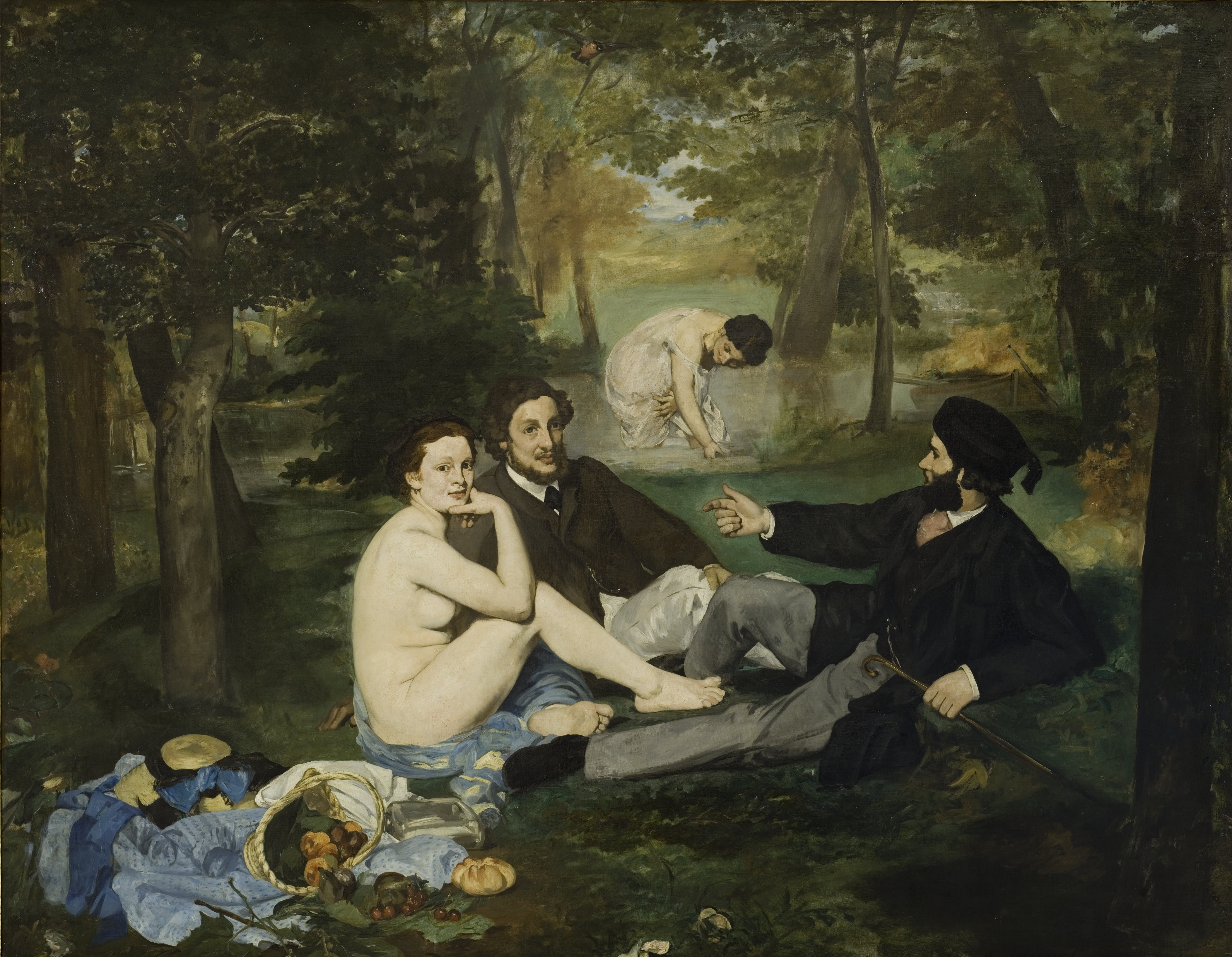
The controversial exhibition of Édouard Manet’s Déjeuner sur l’Herbe at the Salon des Refusés in 1863 is often considered the founding act of modern art. The painting broke away from classical art's insistence on historical or mythological figures, feelings of awe, important themes and noble ideals.
I've also read art historians dating the birth of modern art to earlier works such as Gustave Courbet's 1850 Enterrement à Ornans, which also caused a stir among the conservative public and artistic establishment for being concerned with what some described as "ugliness" and "triviality".
However, an artist like Pieter Bruegel the Elder eschewed bombast as early as the Renaissance and I have never read about him being considered a modern artist. His 1568 Noce Paysanne for instance depicts a rowdy peasant wedding with a somewhat grotesque vibe, the artist's late signature style.
I might simply have missed something. But if that's not the case, then how come artists like Bruegel usually aren't taken into consideration in debates around the birth of modern art when they seemingly broke away from classical conformity centuries before the likes of Courbet or Manet?
.
Links to the mentioned paintings:
Édouard Manet's 1862 Déjeuner sur l'Herbe
Gustave Courbet's 1850 Enterrement à Ornans
Pieter Bruegel the Elder's 1568 Noce Paysanne
1 Answers 2018-05-10
When reading things by pro-Soviet communists I have run into claims that the Hungarian revolution of 1956 was caused by fascist agitators and involved anti-Semitic violence. With some quick searching I can't find any trustworthy sources for this. Is there any truth to either of these?
Additionally, I would be interested in how these things have become a part of the "official" version of history for (at least a part of) pro-Soviet communists.
1 Answers 2018-05-10
1 Answers 2018-05-10
This is always something I have wondered and been fascinated with more so than the discovery itself. It had to have been something that shook the community to it's bones (pun intended).
I imagine it would be similar to discovering life on another planet today.
1 Answers 2018-05-10
1 Answers 2018-05-10
Why was he not summarily executed after his first abdication? Was his execution deemed to risky based on the fact that he was a popular figure in France?
1 Answers 2018-05-10
Is there a clear line between the two? Is it purely a matter of the age of the topic?
1 Answers 2018-05-10
1 Answers 2018-05-10
From Wikipedia: "Andrew Jackson did not listen to the Supreme Court mandate barring Georgia from intruding on Cherokee lands."
Was there a repercussion for this? Or did he find some loophole that gets around our whole system of checks and balances? I thought the power of the supreme court was equal to that of the president, as far as decisions like this go.
Edit: Wow! Thank you so much for the amazing answers! (And the upvotes that got us here) As you have all laid out, this is a MUCH more nuanced situation than I could have imagined, thank you again for your thorough answers!
3 Answers 2018-05-10
Hi everyone, Granted, it was on Wikipedia but I remember reading about the rise of early christianity in the Roman Empire and about the polemics aimed at the figure of Jesus and christianity as a whole. There was a Greek philosopher who basically argued that "there already was a famous Greek man who performed miracles and other feats and we have proof of his existence, why not worship him if there is absolutely no proof of Jesus?". Not a direct quote by any means but that was the crux of it. Who was the author of that claim? Who was he referencing? Who were the biggest outspoken critics of the early christianity? Where can I read more? I am aware of the broad scope of the question so please forgive me but it sits on my mind for two months already and the unfruitful search for answers only ignited my interest further.
2 Answers 2018-05-10
More specifically, would I learn the history of Great Britain, or would it just be world history, or something else?
1 Answers 2018-05-10
1 Answers 2018-05-10
When did people first discuss time travel? Is it a new age concept? Or would have an ancient Greek for example have thought of traveling forward or backwards in time?
1 Answers 2018-05-10
I am American and have only ever been taught history by American professors in English. I've been wondering what it would be like to read a book (or take a class) on American history written by someone who is not American, especially if the book is not in English.
In addition, the global history classes that I have taken tend to look at the past 300 years of history as, "Europe and the United States are proactive, the rest of the world is reactive." How is global history approached in other countries, especially non-Western ones?
1 Answers 2018-05-09