[deleted]
1 Answers 2017-08-03
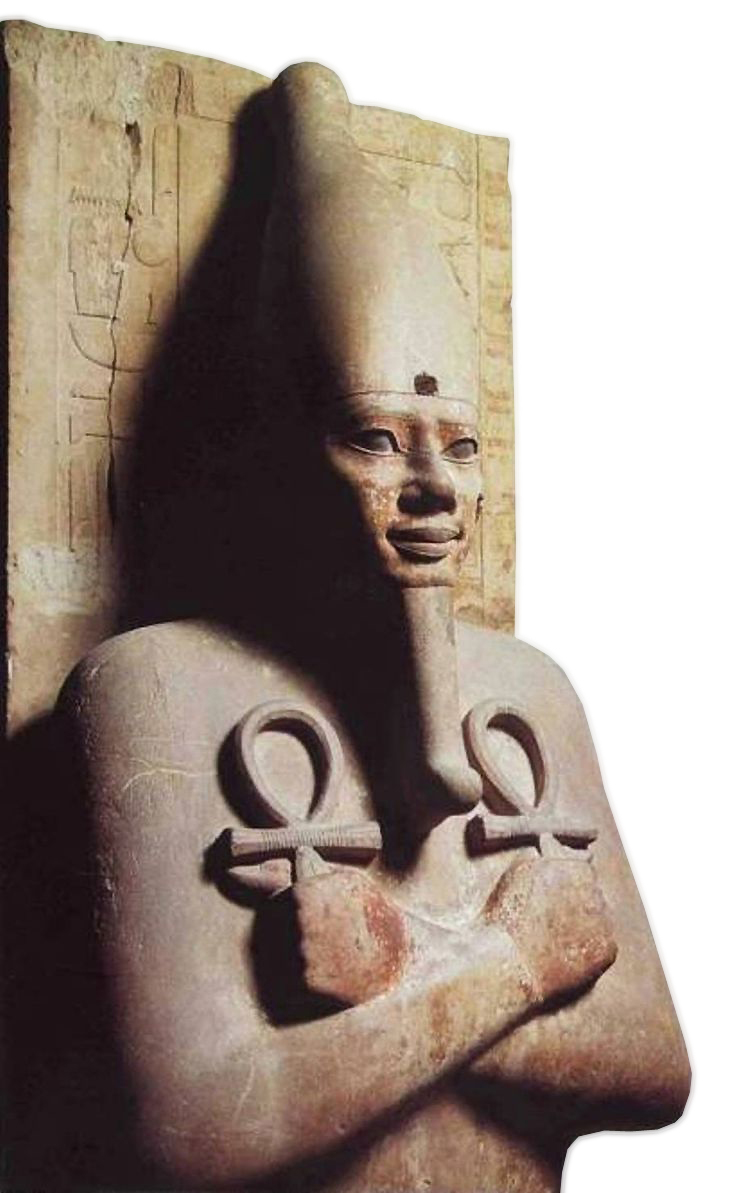
Over the past few months, my fascination with the history of ancient Egypt has grown. I've watched documentaries, read books, gone to museums and looked across the internet (with varying degrees of success). One thing that has always bothered me, though, is the question of their ethnicity. Starting off, I'll admit this is a hard question to answer, and that it is usually politically motivated. I know it is a huge question, as ancient Egyptian civilization spanned thousands of years. I also know this question has been posed here a million times, as I've looked through many of the threads in search for answers to no avail. What bothers me when seeing people discuss this topic is that they always argue over semantics. Questions pertaining to the ethnicity of ancient Egyptians are often met with "define race/ethnicity", "it doesn't matter", "this is a hard question to answer" or something in that direction. People are also very quick to point out how wrong Afrocentrists are (something I agree with) and how even some ancient Egyptians couldn't possibly have been anything close to what we view as black today, something (something I disagree with). Why is it so hard for people to accept that people that looked something like this, existed, while people that looked something like this also existed. r/askhistorians, what is your opinion?
2 Answers 2017-08-03
I saw a tv show which interviewed a professor of Jewish History who talked about his new book about the Bar Kohva Revolt. The professor claimed that the Jewish people have revolted at least 10 times against the Roman Empire and that no other nation under the Roman Empire had managed to revolt more then two times. How true is his claim that no other nations managed to rose against the Roman Empire more then on or two times?
1 Answers 2017-08-03
1 Answers 2017-08-03
I'm reading "The Fall of Carthage" by Adrian Goldsworthy and he is describing ancient source texts he has used. They are almost universally enormous, or at least sound like they are to my modern ears.
Polybius' "History" - 40 books
Livy "History of Rome" - 142 books
Diodorus Siculus "Library of History" - At least 40 books
etc.
Now a 142 book history sounds almost comically large and impossible to read let alone write. Was it really a vast work or did ancient book making simply require that much more space? If they are actually much longer than modern works, was there a reason such as writing style or an element of prestige in length?
2 Answers 2017-08-03
Here's my source for the 200 legislative proposals number: https://www.ncbi.nlm.nih.gov/pmc/articles/PMC1646146/pdf/amjph00277-0020.pdf
2 Answers 2017-08-03
A friend is writing a short story and needs some information. Her request copy/pasted from a text:
Help! I'm writing a murder mystery short story that takes place in and around 1789, and I'm including letters from an investigator to his superior about the case. Anybody who knows anything about that time period, what was the police/investigation structure, what would his title be, and what position would his superior hold??
Any other information is also welcomed. Thank you!
1 Answers 2017-08-03
This week, ending in August 03 2017:
Today's thread is for open discussion of:
History in the academy
Historiographical disputes, debates and rivalries
Implications of historical theory both abstractly and in application
Philosophy of history
And so on
Regular participants in the Thursday threads should just keep doing what they've been doing; newcomers should take notice that this thread is meant for open discussion only of matters like those above, not just anything you like -- we'll have a thread on Friday for that, as usual.
2 Answers 2017-08-03
Shakespeare set his stories in such locales as Italy and Denmark. Was there a reason that he chose to set them there? For example, was he really writing about a situation in England but for which he couldn't write freely?
1 Answers 2017-08-03
From my understanding Hitler was charged with treason but was released after nine months. Why such a short sentence?
1 Answers 2017-08-03
For the battle at Arnhem (Market Garden) there are several War Diaries available. In these there are mentions of coordinates. The style is 697774 for example. These are based on US Army maps available at the time. 69 is from west to east, 77 is from north to south but the last two are unclear to me. Would these be altitude? I cannot place it.. I've uploaded a screenshot of an entry in a war diary and a simple render based on the US Army map. Sorry for the potato quality of the war diary. it was sent to me like this. A picture of a monitor with a screenshot. Album
1 Answers 2017-08-03
I was taught that the Thin Red Line was an important part of the transition from smooth-bore muskets to rifles, as rifles were far more accurate than muskets, could shoot greater distances, and were more lethal. and allowed Campbell's men to stop the cavalry charge sooner. I'm told this paved the way for making the square formation obsolete, and cavalry charges less common. Campbell knew the effectiveness of the rifle and so chose to form up in a line.
How accurate is this? Were the British armed with rifles or muskets, and did this affect Campbell's decision at all?
1 Answers 2017-08-03
Do we have any way of knowing what the population of Italy looked like culturally/ethnically in the time of the Lombard Kingdom (568 - 774)?
I've read that the peninsula was massively depopulated after the Gothic wars, and that there weren't enough soldiers of the Empire to hold the land against the invading Lombards, but do we know anything about how many Gothic people were left, how many Romans (or whatever you'd classify them as) were left, and how many Lombards (and/or their Germanic allies) migrated into Italy?
I've googled, but haven't really been able to find anything. I'm not even sure I know how to properly search for that sort of thing.
1 Answers 2017-08-03
Specifically I'm interested in would the Emperor and his senior military leaders have knowledge of comfort women, medical experiments, massacres, etc?
And if so what opinion did he/they hold on it?
3 Answers 2017-08-03
I mean I found Deutsche Kolonialzeitung (colonial journal of Germany) but I guess Austria-Hungary must have something too, but I can't find it on the internet.
1 Answers 2017-08-03
After seeing a similar question regarding Baldr's death in Norse mythology, I thought this could be a good question for some experts on Mesopotamia.
I just read through a translation of the Epic of Gilgamesh, and it fascinates me because the main character is often described as beautiful, strong, and so on, but isn't exactly a good person by modern standards if we just look at what he does in the story. Did the ancient Mesopotamians view it any differently?
1 Answers 2017-08-03
I've always wondered this. If you are travelling overland from Europe to China in the medieval period, how did you pay for food etc? Could you carry enough money to sustain you over all this time?
2 Answers 2017-08-03
Perhaps I just need help to understand, but from what I see that was textbook genocide, killing civilians even the babies and pregnant women etc. Shouldn't whoever ordered that attack be considered among the greatest villains of history, amount Stalin and Mao?
Sorry if this is a sensitive topic.
1 Answers 2017-08-03
1 Answers 2017-08-03
I've stumbled upon something I find somewhat hard to believe in this AH post:
Highly illuminating to me was his description of the Russian method of attacking through minefields. The German minefields, covered by defensive fire, were tactical obstacles that caused us many casualties and delays. It was out laborious business to break through them, even though our technicians invented every conceivable kind of mechanical appliance to destroy mines safely. Marshal Zhukov gave me a matter-of-fact statement of his practice, which was roughtly 'There are two kinds of mines; one is the personnel mine and the other is the vehicular mine. When we come to a minefield our infantry attacks exactly as if it were not there. The losses we get from personnel mines we consider only equal to those we would have gotten from machine guns and artillery if the Germans had chosen to defend that particular area with strong bodies of troops instead of with minefields. The attacking infantry does not set off the vehicular mines, so after they have penetrated to the far side of the field they form a bridgehead, after which the engineers come up and dig out channels through which our vehicles can go. (Eisenhower; Crusade in Europe, John Hopkins University, 1997)
I've also hear discussions about so called 'mine trampler' battalions, supposedly penal battalions sent to clear mine fields, a concept I find more plausible than presuming that the Soviets did that with every infantry unit.
Can anyone help me figure out what the truth is?
1 Answers 2017-08-03
In my research I've had very conflicting sources, some saying that Ptolemy dynasty tried their hardest to hellenize Egypt, others saying that they simply kept themselves Greek and others further saying that the Ptolemy's did their best to become Egyptian to appease the populace.
Which of these statements are correct, or is it a mix of two?
1 Answers 2017-08-03
a different but interesting question may be seen here -- https://www.reddit.com/r/AskHistorians/comments/5ml4ki/how_true_is_it_that_all_industrialized_nations/
1 Answers 2017-08-03
1 Answers 2017-08-03
Well, the only instance I know is of Pompeius Strabo (father of Gnaeus Pompeius, you know, the Magnus, the Great) having a disease broke up in his camp when he besieged Cinna and others. This must mean that other earlier armies were always good at avoiding it. The Persian, Macedonian, Theban, Spartan, Athenian, none to my memory. So protocols were that wastes and such were thrown far from the camp? Just some help please!
1 Answers 2017-08-03
I am in no way trying to justify the Holocaust-just want to make that clear. I visited the US Holocaust museum today (it was outstanding) and I wondered: Hitler blamed the Jews for all the things wrong with Germany post-WW1 and of course said that by purifying the German state Germany could prosper. So I wondered, did the economy (or anything else) benefit at all from his policies and Final Solution?
5 Answers 2017-08-03