As the title says, I'm looking for sources or authors to trace how ideas about liberty, equality, justice, etc. in the Constitution and Bill of Rights have changed or evolved since their conception. Any help will be greatly appreciated!
1 Answers 2016-07-27
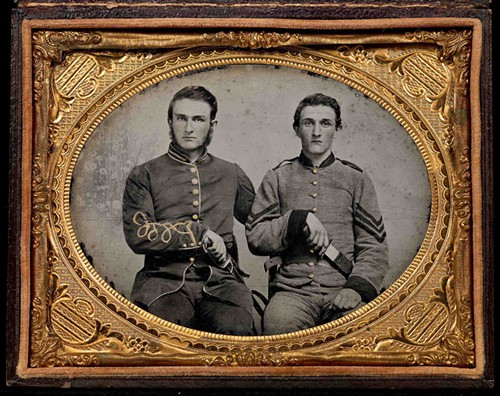
http://lossincivilwar.weebly.com/uploads/5/1/3/0/51303025/1892254_orig.jpg
This comes up in Google when I search "brother against brother" and I wanted to confirm that one of these was a union soldier and one a confederate.
The obvious answer tells me that the guy on the left is Union because of his blue coat, and right is confederate because of the grey, but when I google "Confederate uniform" a lot of blue uniforms looking identical to the guy on the left appear.
Anyone know something about this?
1 Answers 2016-07-27
When you say "angel" most people will probably immediately think of a person in a white robe with white wings and the typical golden ring above the head. Where did that image come from? And how did that original become the angel of today?
1 Answers 2016-07-27
When discussing the Pacific campaign, I find most sources focus on the USMC, US Navy (especially carrier operations), followed occasionally by the disastrous British loss of Singapore, and finally by ANZAC cooperation with US forces.
However, Russia and Japan had an historical enmity including armed clashes in the run-up to the war. Were Soviet forces involved in the campaign against the Japanese Empire, and if so, was it a major or minor campaign for both parties? Thanks!
2 Answers 2016-07-27
I've been reading about the House of Glücksburg, Prince Andrew of Greece and Denmark and Prince Philip (born Prince Philip of Greece and Denmark and baptised Greek Orthodox) and I was wondering how that link came to exist. I understand the link between the Northern countries, but when/why did Greece come to be included? As a follow-up question, why was the House of Glücksburg/the monarchy exiled from Greece in the early 1900s?
1 Answers 2016-07-27
I love ancient history (talking about Greek and Roman 500BC-500AD history) but I was never able to get an understanding of what the ends of a battle line were like. There are always soldiers that are at the absolute flanks, but wouldn't they be continually trying to move a little bit further and outflank the enemy? And isn't this where a lot of the battle would be decided in the end, where the ones that outflank the enemy would be able to rout them? Or were the flanks of the battle line dominated by the cavalry regiments?
1 Answers 2016-07-27
Sorry if this isn't the right place to ask this question. If it's not, I would appreciate someone pointing me in the right direction.
I saw a post a while back about a President or some person that had some sort of power in a country that I can't remember, who seized power during a television broadcast by listing the names of people who were thought to be colluding against him and the government. As he was listing the names, they were being escorted out by guards. The people who thought their name could be on the list began to stand up and scream how great this man was and how much they loved their government. If someone has a link to said post or any more information I would really appreciate it.
Sorry I can't really remember more than that.
1 Answers 2016-07-27
Hello historians!
6th June 1944 was certainly a changing point during the Second World War. There were different beach-heads led by different nationalities, namely the Americans, Canadians and the British. I was wondering if there were any major differences between these beach-heads (Utah, Omaha, Sword, Gold and Juno) other than the nationalities who fought at these places. Were other beachheads more difficult to fight at or did plans materialise better than others? Did the naval + aerial bombardment have more success at some more than others? Also does anyone reccomend any certain historians or works that may be useful. Any help would be great
Many Thanks!
1 Answers 2016-07-27
I can't help but feel that a tragedy on such a monumental scale would have been commemorated in some way or mentioned in some ancient document that would have told of Pompeii's existence to people of that day. It just seems baffling that an empire so meticulous in recording their history would have let the destruction of such a wealthy Roman town be completely forgotten, and wouldn't have left behind SOMETHING that would have informed us.
1 Answers 2016-07-27
1 Answers 2016-07-27
1 Answers 2016-07-27
Could the US and Soviet Union made the advances they did without it?
1 Answers 2016-07-27
Interested in this topic based on some claims made in the media recently. As follow-ups, what were the federal government's (or state governments') practices when it came to the use of slave labor for public projects? Were there publicly-owned slaves, or were there companies who owned slaves who could be contracted?
2 Answers 2016-07-27
Edit - I meant HAVS not HVS i.e. hand-arm vibration syndrome.
1 Answers 2016-07-27
I don't quite get it, it's not like early medieval people didn't have talent or resources. Is it because we didn't focus on art so much as on wars, is it because our minds were simple? What's the reason - if it can be even known.
2 Answers 2016-07-27
1 Answers 2016-07-27
1 Answers 2016-07-27
Yes, I am aware that the middle ages is a large period, and Europe is a big place, please answer with whatever place and period you are best able to.
Since playing the Witcher I have become very interested in the role of folklore traditions and belief in the supernatural in historical Europe. I am really just looking for any interesting bits of information/books/sources that can set me off in asking more questions, so what do we know about the role of the supernatural in historical Europe?
1 Answers 2016-07-27
I hope it's ok to post images here. I restore antique furniture and artwork for my job. I recently was commissioned to repair this antique ivory samurai figure. I have made all the repairs to the body itself, but the warrior's sword and (presumably) bow are missing.
My question is, what kind of sword and bow should he have? I'll need to carve them out of ivory substitute and I need to make sure they are accurate.
Any help would be much appreciated.
2 Answers 2016-07-27
1 Answers 2016-07-27
Was it during his life? If so, at what stage of him conquering... everything... was the title bestowed upon him? Did he come up with it himself? His close hangers-on? The general populace?
1 Answers 2016-07-27
As per our announcement, this week we will be discussing the article submitted by /u/Uhm_yup.
Tell us what you think!
What did you like? What did you dislike?
What did you not understand? What was explained really well?
Did you notice any problems or issues in the premise/methodology/sources/etc?
What would you like to know more about?
Grau, Lester W. "Breaking Contact Without Leaving Chaos: The Soviet Withdrawal from Afghanistan." The Journal of Military Slavic Studies 20, no. 2 (2007): 235-261.
There is a literature and a common perception that the Soviets were defeated and driven from Afghanistan. This is not true. When the Soviets left Afghanistan in 1989, they did so in a coordinated, deliberate, professional manner, leaving behind a functioning government, an improved military and an advisory and economic effort insuring the continued viability of the government. The withdrawal was based on a coordinated diplomatic, economic and military plan permitting Soviet forces to withdraw in good order and the Afghan government to survive. The Democratic Republic of Afghanistan (DRA) managed to hold on despite the collapse of the Soviet Union in 1991. Only then, with the loss of Soviet support and the increased efforts by the Mujahideen (holy warriors) and Pakistan, did the DRA slide toward defeat in April 1992. The Soviet effort to withdraw in good order was well executed and can serve as a model for other disengagements from similar nations. During the Soviet occupation of Afghanistan from 1979–1989, its occupation force, the 40th Army conducted 220 independent operations and over 400 combined operations of various scales. Many of these large-scale operations accomplished little, since this was primarily a tactical commanders' war. Some large-scale operations, such as the initial incursion into Afghanistan, Operation Magistral, which opened the highway to Khowst and the final withdrawal, were effective because the force employed was appropriate to the mission.
2 Answers 2016-07-27
After reading discussions on "realistic prices" in a video game with a medieval setting, where people complained about supply and demand not having an effect in the game, i got thinking about how prices really worked in the middle ages.
There often was only one tailor, barber, blacksmith etc in an area so there was no competition. How did he know what do demand? When you came into a town as a traveling merchant, and you had for example barrels to sell, did the barrel maker guild have a say in the price?
Let's take an iron mine for example. Were there "independent" mining entrepreneurs or did the minerals belong to the local noble? If so how much could he sell his iron ore for? A local blacksmith couldnt really go somewhere else to buy it at a better price.
1 Answers 2016-07-27