1 Answers 2015-03-26
I read that the Nazis supported the nationalists during the civil war , what was the thinking? And why wasn't Spain able to join the war on the axis side?
2 Answers 2015-03-26
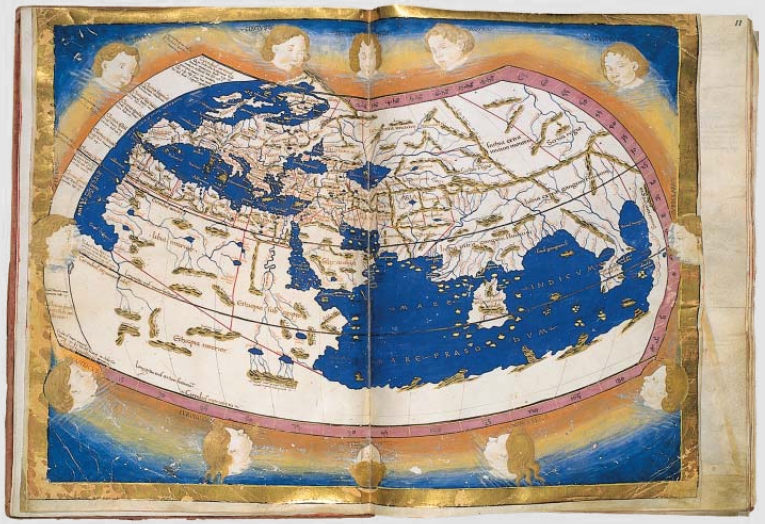
They had limes bordering the Roman Empire and everything else outside the Roman world, but what bordered the provinces inside the Roman world?
This Ptolemiac world map for example. From how it is drawn, the borders seem clear, but...
If, say, a traveler journeys from Antioch to Jerusalem by land, how would've he realized that he has crossed the province of Syria and entered Palestina? Did they have some kind of marker like we do today?
How did the geographers and bureaucrats know the scope of geographical area that belongs under his jurisdiction?
Edit: Given that not all provinces are delimited by natural borders, i.e. provinces in Eastern Mediterranean (CMIIW).
1 Answers 2015-03-26
I'm currently reading The War of the Three Gods by Peter Crawford which details Islam's rise during the seventh century. It seems like before almost every battle, the Muslim commanders would use their specially-trained mubarizun to duel officers of the opposing army to kill as many of them as possible and undermine their enemy's moral. Would these duels be expected by both sides in seventh century battles, or was this a new tactic the Muslims developed?
1 Answers 2015-03-26
I have several Republican friends who pride themselves in being financially conservative; that is, they don't align with the more religious side of the right on social issues, but admire old Republican financial policies. That said, I can't help but find it odd how much attention and praise Reagan gets as the "hero" of modern Republicans (in fact, the level of praise I see him get is nearly on the level of fervor). It is in my limited understanding that Reagan's economic policies cost America far more than Obamacare (e.g. the War on Drugs), and that Reaganomics is a failed economic theory (as evidenced by America's ever-growing super-rich to poverty gap). So why the love and hero worship?
8 Answers 2015-03-26
What tactics and equipment did the early muslims use when they expanded their caliphate?
1 Answers 2015-03-26
In an edition of Mario Puzo's The Godfather, cultural studies professor Robert Thompson, used the above phrase in his forward to the novel.
Of course we know that the Western was the dominant story form of American film and much of it's pop literature for most of the 20th Century. By the 1970's it was quickly overtaken by the "mob story". Not just Italian mobsters (Cosa Nostra), but also street gangs, Yakuza, Triads, Narco-Syndicates, corrupt police, have dominated a sizeable portion of American media since then. Not just in dramatic film, but in comedy. Books, t.v. shows, films, music, and just about every other form of popular media (including video games), all seem to be deeply attached to the theme of "the criminal organization."
What cultural shifts led to this change in popular narrative?
2 Answers 2015-03-26
My History teacher told me that a lot of historians don't agree to the 1947-1991 dates of the Cold War. When do you think the Cold War started and why?
1 Answers 2015-03-26
Medievalists or students of Church history probably know what I'm talking about; for the rest of us, here's some links:
The one useful comment on this from a previous thread last year. There were other threads, even older or even smaller.
Wikipedia article on the so called medieval "same sex unions" that could or could not be romantic in nature.
That's an important debate on whether those ceremonies were fringe or accepted by the Church; and whether or not homosexuality has always been condemned in Christianity or if it was a later development. This may not seem like a biggie for non-Christians, but my layman speculation is that it's going to get relevant as LBGT-supporting churches get more numerous.
Also people just can't agree if Boswell wrote a reliable, academic book or not.
2 Answers 2015-03-26
I'm primarily thinking bout western society
2 Answers 2015-03-26
1 Answers 2015-03-26
Source of Jesus being a relatively common name
Many people shared the name. Christ's given name, commonly Romanized as Yeshua, was quite common in first-century Galilee. (Jesus comes from the transliteration of Yeshua into Greek and then English.) Archaeologists have unearthed the tombs of 71 Yeshuas from the period of Jesus' death. The name also appears 30 times in the Old Testament in reference to four separate characters—including a descendent of Aaron who helped to distribute offerings of grain (2 Chronicles 31:15) and a man who accompanied former captives of Nebuchadnezzar back to Jerusalem (Ezra 2:2).
1 Answers 2015-03-26
As a follow up, I would also like to know how the suit came to be a dominant formal wear in today's society.
1 Answers 2015-03-26
Such as Jorvik. What type of buildings did they have? What was the general appearance of these major town?
1 Answers 2015-03-26
1 Answers 2015-03-26
1 Answers 2015-03-26
What led to the prevalence of diesel engines in personal vehicles in Europe as opposed to the United States where the petrol engine is almost exclusive? Were there any benefits to the use of one or the other and if so, do these still benefits still exist today?
1 Answers 2015-03-26
If I recall correctly, this was a time period when Europeans knew about and used firearms, but when said firearms were not useful enough to replace earlier weapons like bows. So my question is: how big of an investment would this be for an individual? I recognize that these sort of prices would vary from region to region and that it would be far easier for individuals of certain classes of society to buy them, but I'm more looking for a general idea of value, rather than exact numbers. Thanks for your assistance.
3 Answers 2015-03-26
This week, ending in March 26 2015:
Today's thread is for open discussion of:
History in the academy
Historiographical disputes, debates and rivalries
Implications of historical theory both abstractly and in application
Philosophy of history
And so on
Regular participants in the Thursday threads should just keep doing what they've been doing; newcomers should take notice that this thread is meant for open discussion only of matters like those above, not just anything you like -- we'll have a thread on Friday for that, as usual.
2 Answers 2015-03-26
I know Connolly wrote about nationalism but was it stemmed solely from the pursuit of democracy and anti-imperialism or was he just very patriotic / anti-British?
Can it be determined from his and other writings that the Irish independence movement would have been satisfied if an international socialist movement had come about, perhaps including Britain and Ireland under one banner e.g. in the event that a British socialist state had been established that wanted to retain its bonds with Ireland?
1 Answers 2015-03-26
In reading about the Pelopennesian wars I read the account of the athenian defeat in Sicily and the selling of captured soldiers into slavery. If I were a captured soldier sold into slavery would I plan to never see my family again? Was the institution of slavery in ancient Greece different to more modern notions of slavery as seen in the African slave trade to the Americas?
2 Answers 2015-03-26
Is there any historiographical debate regarding the issue or are historians (moderately) unified on the topic of prohibition?
2 Answers 2015-03-26
1 Answers 2015-03-26