1 Answers 2014-12-11
Did any Indian people become involved in politics or business in Britain? Were there cases of Indian people marrying Brits from well-to-do families?
Would a wealthy Indian be seen as better than a poor English or Irish person?
1 Answers 2014-12-11
1 Answers 2014-12-11
Is it as good as studying books primarily about the history of the era or should it be thought of as a supplementary text.
1 Answers 2014-12-11
I constantly read new stories and think pierces about the high levels of corruption in places like Mexico and Russia being the root cause of many of those countries problems. Are there any relatively modern examples of countries with similar problems turning that around and how did they do it?
3 Answers 2014-12-11
One thing I notice is that whenever there are depictions of ancient towns/cities in movies and tv (Athens, Rome, Troy, Alexandria, Babylon, Jerusalem, Sparta, etc), they are depicted as sprawling, sometimes vast cities. How historically accurate is this? I have been trying to find maps of these ancient cities, but the ones that I do find depict much smaller areas of land. Were ancient peoples even capable of building and sustaining cities over a certain number of square miles? What modern day towns and cities are most comparable to an accurate representation of these ancient examples in terms of size?
3 Answers 2014-12-11
Napoleon was defeated in 1813 in the Sixth Coalition War, and he was offered (in 1814) to keep the French throne in exchange for the return of lands conquered by France after 1792. He refused, was sent to exile and the lands were returned anyway (eventually, at least). why did he refuse? Was it pride? Was it not obvious that he couldnt hold on to the lands he conquered after he was defeated anyway? Wouldnt maintaining the throne present more opportunities to re-conquer those lands later? Did the succession of his son play any part in his decision? What was his rationale for refusing this offer?
1 Answers 2014-12-11
I know it's lumped with Christmas to make the "Happy Holidays" more inclusive, but say, there's not a lot of public/commercial promotion of Passover next to the Easter, even though they're around the same time. Likewise hardly anyone knows about Sukkot even though it's another minor holiday. I could go buy some Hanukkah wrapping paper right now at CVS but I'd be hard pressed to find a etrog anywhere in the fall. When did the elevation (and commercialization) of Hanukkah begin?
1 Answers 2014-12-11
A related question. How much slop was there in the process especially as we look further back in time? There must have been some uncertainty in the process.
1 Answers 2014-12-11
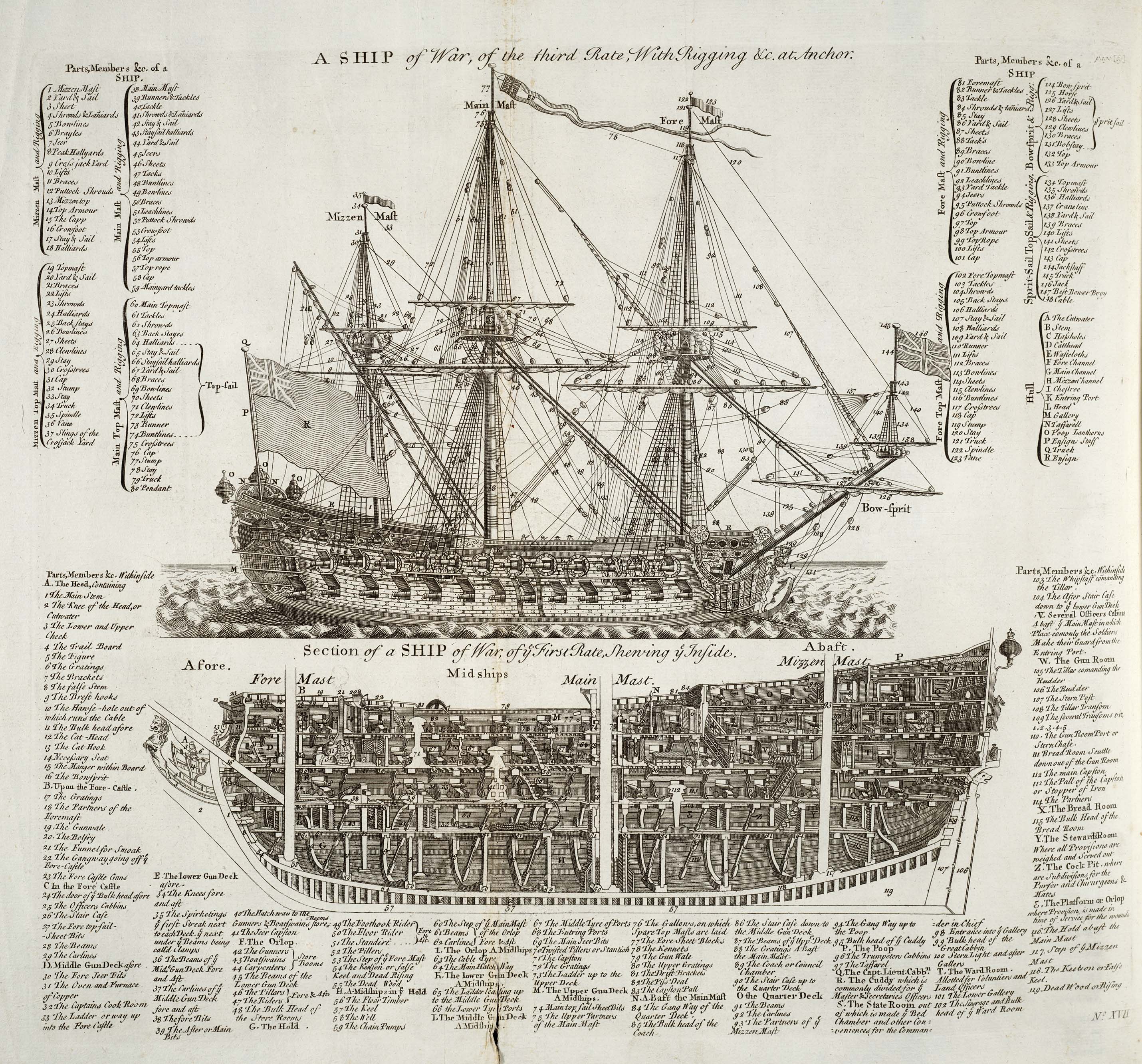
I already own several excellent books that cover the period:
...etc.
The Command of the Ocean gives excellent tables to cover the armament, displacement, and so on. But plans, rigging, and layout are so varied that it's hard to visualize. What I really want is diagrams of rated ships and their armaments. I've found lots of individual plans for ships (designed for wooden ship hobbyists) but they're expensive (in the $90-$120 range apiece). In other words, I want lots of stuff like this -- I don't mind if they are reprints from the era as long as the text is legible.
And other books above give brief snippets from personal logs and accounts from sailors, but they are chopped up and interspersed with explanations. I really want to get my hands on some un-edited first-hand accounts of things like the Battle of the Nile, or random encounters at sea. I want to get a real taste of the language used with no context.
I hope this is all clear, and a reasonable request for /r/AskHistorians
Thanks!
EDIT: AND CHARTS! I forgot charts. If anyone knows where I might get reprints or scans of charts from the era, with soundings, etc., I'd be very grateful.
2 Answers 2014-12-11
A few years ago I came across this article on the CIA's website https://www.cia.gov/library/center-for-the-study-of-intelligence/csi-publications/csi-studies/studies/96unclass/farewell.htm
It is a fascinating read about the Soviets interest in stealing western tech, and how US intelligence sabotaged them by giving the Soviet spies faulty plans.
In the section "A Deception Operation" there is a single fascinating line "The Soviet Space Shuttle was a rejected NASA design". The source is an unspecified "Conversation with James Fletcher, Administrator, NASA".
I cannot find the conversation online. It is common wisdom that Buran was based on stolen plans, but I can't find it anywhere else that the plans were fed to them. It is possible that the information was placed in a poor context, but it clearly implies that this was a calculated US action.
Can anyone help me find out more about this? It's been bothering me for years!
1 Answers 2014-12-11
Any information on why these characters were chosen? The Wolf, the names etc?
2 Answers 2014-12-11
So everyone knows that during world war 2 the American soldiers would search German officers for the prize possession of a German made pistol e.g. The Lugar. What my question is, is the an equivalent to the German Lugar for German soldiers? Like when an American soldier died was a there a "prize" possession that German solders looked for that the soldier carried?
1 Answers 2014-12-11
As I understand Enigma was a symmetric encryption where a single set of settings were used to encrypt and decrypt the messages. Those settings changed every day but were shared among all Enigma messages on that day. Are both of them assumptions true? I'm basically wondering how the Germans avoided the fatal flaw of symmetric cryptography, and leaking keys to spies. It seems a pretty significant number of people would need to be able to decrypt messages (eg at least one on every boat/plane?) - so do we know how close the Allies got to having spies with access to those codes?
2 Answers 2014-12-11
2 Answers 2014-12-11
EDIT: I hadn't really realized the distinction, but I would be interested in both the Norse who went viking (and may have regretted it) and the ones that didn't go.
2 Answers 2014-12-11
Cecil Rhodes in his will calls it the "English Empire," and judging by his history, he's not one to differ from the common opinion on matters of nomenclature. And of course, he'd have more of a right to name it than almost anyone. But I'm still interested in knowing what the general population called it.
1 Answers 2014-12-11
I'm not sure if this is an appropriate/well-worded question but it's something I've been thinking about for a while since I started studying Buddhism. I understand all religions need to be taken into the context of where and when they originated and how different cultures shaped them over time. I was hoping to find some discussions or explanations of how some of this occurred in Buddhism.
I know the Buddha was originally a follower of the ancient Vedic religion in India and as I learned a little bit about Hinduism, I started to see the parallels. I guess what I'm looking for is what were practices and beliefs that carried over into Buddhism and what practices and beliefs unique to Buddhism itself.
2 Answers 2014-12-11
Just as the title says,
How effective has propaganda been in the United States? What about other countries?
Have there been any historians who have written about this? If you have any recommended books or authors let me know/source them in your answer.
Thanks a bunch!
1 Answers 2014-12-11