Very sorry if this isn't quite the appropriate sub, but does anyone have any credible sources, preferably, but not necessarily online, about the origins and expansion off Islam?
1 Answers 2014-10-11
1 Answers 2014-10-11
Aren't Austrians ''Germans'' too? I mean, before the unification of Germany, there were hundreds (?) of small German principalities, kingdoms, etc. The ''German'' (as we know it today) didn't exist, so if Austria was included, the ''Austrian'' wouldn't exist today, they would be ''Germans'' too, right? Just like how ''Prussians'' don't exist anymore.
If von Bismarck united the ''German speaking people / cultures etc.'', why was Austria excluded?
2 Answers 2014-10-11
I found an old map of my area online and down in the lower left corner in very small type one of the harbors on a nearby island is called "Smugglers Cove".
I know the cove well and it is still called smugglers cove. There really isn't anything on the island so I don't think you would be smuggling in and out of the island, but in the 1850's there weren't that many people in this area at all.
Who was smuggling what to where? Would they really have spent time on the backside of this island to avoid law enforcement? Who would have been enforcing the law out here?
1 Answers 2014-10-11
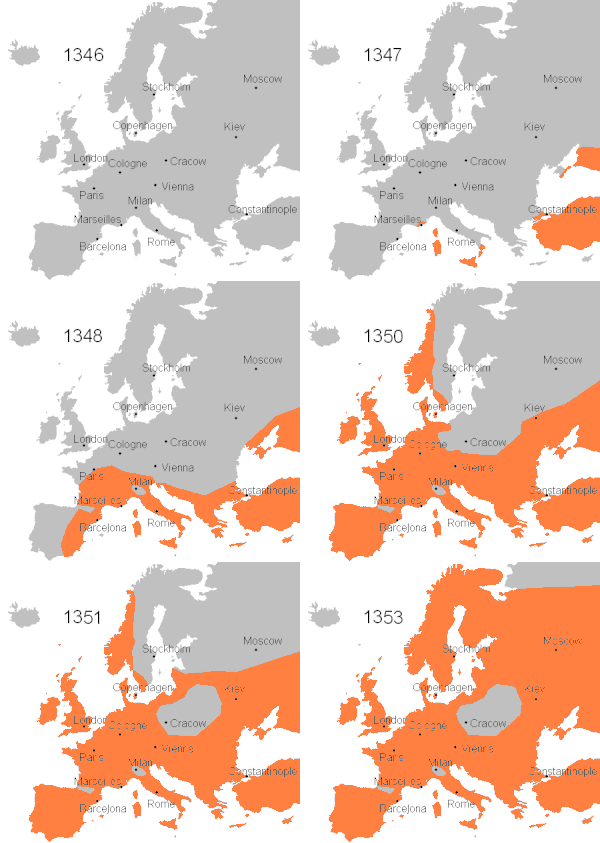
I was checking out the Black Death on wikipedia, and noticed that all images seemed to show that Poland was mostly unaffected by the Bubonic Plague example and i'm highly curious as to why this is the case. thank you!
1 Answers 2014-10-11
1 Answers 2014-10-11
(Before starting, idk if this message has its place in this sub, I went through the "resources" link on the right but didn't find something similar, so forgive me if I did wrong).
Hi, I'm a history student starting my second year at university and I'm looking for a good timeline building tool, there are many of them available on the web and I find myself unable to know which one would fit my needs best.
Ideally, I'm looking for a tool that would allow me to create several timelines in order to compare them (for instance, creating a timeline for each different european country, allowing me to put in perspective the concurrency of different events), and would be easily customisable. Bonus point if it doesn't require internet access.
So far, websites such as TimeRime, TimeGlider or Myhistro seem interesting. What are you thoughts on these ?
1 Answers 2014-10-11
1 Answers 2014-10-11
I'm not sure if this is the right sub-reddit, really sorry if it isn't but I couldn't find any other relevant sub.
We went diving off the coast of Albania, and found these.
http://i.imgur.com/cvrVmKm.jpg
http://i.imgur.com/iyFAuQ9.jpg
There are sunken ships around the area, and these were found embedded in the sea bed. I have no idea how old they may be, what they might be worth, or anything.
If anyone has any idea what they are, I'd be really interested to know.
Edit: someone offered me $500 is it worth it?
7 Answers 2014-10-11
The author depicts them as almost -wanting- to die, constantly. Sure, discipline can make you more corageous, but humans still have the basic primal instinct of survival, and it becomes pretty comic how willing they are to sacrifice themself for almost no reason at all.
2 Answers 2014-10-11
X, do you take Y to be your wedded wife, to live together in marriage? Do you promise to love her, comfort her, honor and keep her for better or worse, for richer or poorer, in sickness and health, and forsaking all others, be faithful only to her, for as long as you both shall live?
I do.
When and where did this vow originate? It sounds poetic, so I assumed this might have originated in Middle Age, but of course this is an uneducated guess.
If it were true, did earlier Christian societies have similar marriage vow?
2 Answers 2014-10-11
1 Answers 2014-10-11
I'm absolutely immersed in a Yale online course at the moment on the American civil war.
I keep running into a few questions where I start to wonder about things like inevitability and contingency.
I'll hang my question on this example. We're told (by this historian) that the civil war absolutely was really about slavery. Then ... in another lecture, we are told that the most random set of coincidences play a part in the coming of the war, in this case, a depression in 1857.
So my question is, in this particular example, was the civil war therefore "inevitable" so long as slavery occurred? Were the contingencies just a timing issue? Is that the right way to understand contingencies?
Similarly with inevitability of the great conflagration in 1914, vs the contingency of Gavrilo Prinzip.
So, I'm not looking for the actual answer for the civil war, more just some kind of framework to think about these things. Any guidance on a framework (and any good lectures online, if you know any) would be very helpful.
EDIT: "Framework" = How historians think about / approach these things.
1 Answers 2014-10-11
For it being self contradictory, Hebrew-centric, not believable, etc?
1 Answers 2014-10-11
Many heroes of ancient mythology don't always behave in ways we'd consider exceptionally heroic today. Hercules, for example, frequently kills people in rages and other episodes who don't seem very deserving of death. Odysseus of course has that whole thing with killing all his wife's suitors after being missing for twenty years.
I understand that the ancient idea of a hero was more of a person who was simply better than other man, and it generally isn't until the advent of Christianity that we find the newer, more modern idea of a hero where moral outlook matters as much (if not moreso) than physical strength or cleverness, with a health dose of self-sacrifice for good measure.
I'm interested in any further insight and analysis anyone could offer on the subject, as well as some reading materials as I might like to write an essay or two on the subject.
3 Answers 2014-10-11
1 Answers 2014-10-11
The US suffered 290,000 combat deaths in WW2. They also suffered 113,000 military deaths marked "Other" adding up to a total of 405,000 total deaths.
What exactly does "Other" mean? What are the causes of death that fall in this category and why weren't they marked as combat deaths? 113,000 dead soldiers isn't something you can just pass off under one miscellaneous category without further explanation in my opinion.
3 Answers 2014-10-11
2 Answers 2014-10-11
In manuscripts of Classical works, capital letters (so Δ instead of δ) are used frequently, yet when modern publishers publish these works, they use lower case letters. Then there all the rules of breathings and accents over the letters which can't have been invented by Alexandrian scholars. When were Greek lower case letters used first, and when did they become common?
2 Answers 2014-10-11
Today:
Saturday Reading and Research will focus on exactly that: the history you have been reading this week and the research you've been working on. It's also the prime thread for requesting books on a particular subject. As with all our weekly features, this thread will be lightly moderated.
So, encountered a recent biography of Stalin that revealed all about his addiction to ragtime piano? Delved into a horrendous piece of presentist and sexist psycho-evolutionary mumbo-jumbo and want to tell us about how bad it was? Need help finding the right book to give the historian in your family? Then this is the thread for you!
7 Answers 2014-10-11
I apologize for both my grammar mistakes, as English isn't my first language and second, for some of the ignorant questions/comments I'm about to make. Please bear with me
Dear Historians of the world,
I am one very confused person: I have been living in China for the past 3 years, and due my job, I get to read a lot about Chinese traditions and culture. I'm sorry I can't produce some of the articles, I work as a translator for a website, I can't really keep track of everything... Sorry. Anyways, Culture or WenHua as they call it, is a word they seem to really like here in China, it seems to me (and not just me) that there is this ingrained idea that Chinese is the only culture in the world. And the only surviving one too.
Ever since I can remember, I've heard that China has 5,000 years of history. On one hand, the love of Chinese for their culture inspired me to start digging on my own country's history and some others too. On the other, because at work I sometimes find some hmm let's just call them facts, that I am not sure I believe and some others that are just seem to reinforce this "only culture idea", I sometimes resort to my limited Internet resources to try to verify some of those facts. I'll give you some examples: one said that in 45 years, China had sent 21,000 doctors abroad and cured 200 million people in 49 countries; another one, China was trying to peacefully explore some gold mines during the Spanish rule over the Philippines, but the Spanish vilified Chinese and as a result, 25,000 of them ended up dead. Given that this is such a great number of deaths, I asked my colleague to produce anything where I could read about such massacre. But not only did she not even know the name of this incident, she couldn't find nothing but a brief mention on some old Chinese book.
This is why, my by now brainwaished brain has started to get suspicious over certain things. And now I'm troubled. Please bear with me once again, I sometimes can't investigate things on my own, due to Google and countless things being censored here.
I have read, and here goes my first question, that China's 5,000 years of history, was a response from Mao Zedong to Korea saying they had a history stretching back 8.000 years, and that the Chinese history was at some points so vague and confusing that it was kind of hard to get the gist of it, or even consider it as 'continuos' . Some website claimed that all in all, you could account Chinese history as going back 3,500 years tops.
Furthermore, I read that Iran was 7,000 old, and that also got me confused. So question number 1: is it true that China has 5,000 years of history? If not, do we just believe it out of sheer repetition?
The second long question of mine, revolves around a comparisson mostly between my home country (Mexico) and China. It's a bit disorganized, so be warned.
It is my understanding that the Chinese territory wasn't the same all through history, but has become bigger. China has, just like Mexico, 56 ethnicities (or indigenous groups as we call them home). I learned that corn domestication was achieved five thousand years ago in old Mexico.
Here are some similarities I find or think I find (and this is just my opinion) between both countries: both produced their own kind of ceramic (Mexico has something called talavera, with 2,000 years of history); while football was supposedly invented in China, there was an ancient ball game in Mexico too (could be the Tajin area); China gave tea to the world, Mexico gave them chocolate; China invented pinatas, while the conquistadors were surprised to find that one of the indigenous groups in Mexico also had something similar. The Olmecs invented some sort of compass, that just didn't catch on I guess. Both countries are family oriented, don't really mind much that whole personal space deal, food is such an obsession, etc.
But I wonder, how come China got more territories, and changed it's own configuration, is predominantly Han but at the same time has all these ethnicities; Mexico is predominantly mestizo but just like China, we have all these indigenous groups, but no official language, just a common one, or putonghua as Mandarin is called in Mandarin; China has had an ovethrown dynasty to become communist to become whatever it is today; while Mexico had emperors, had dictators, kings, presidents and whatever it is that we are today.
So how come China is considered so old, but Mexico seems to be considered old only by us Mexicans? or so is my perception.
While it's true that modern Mexico and it's language are the mix of two worlds, I think some of those indigenous groups survived the Conquista (just like Uigurs and Tibetans are still around under the Han), our language is stuffed with words of Latin/indigenous origin, and these indigenous groups are still around, so are they old or what are they?; our Day of the Dead tradition, has its origins 3,000 years ago, and by the seventies it became what it is today, some sort of pagan indigenous celebration mixed with Catholicism. I'm confused. Confused because China changed territories, I guess at its beginning it began as many tribes under one (maybe not, I don't know), has cultural diversity and some of its food, has ingredients native to other countries, but other countries, including mine, have been inhabited by the same people but migration affected them, just like China, have lost or gained territory, and yet it seems that China gets the credit of being the only continuous one... Why? Why not Iran as I asked before, and...
What exactly am I, as a Mexican, and what exactly is Mexico, as a territory inhabited for a few millennia, part of it destroyed, part of it still around, part of it evolved into a fusion of the old and the new?
Thank you for reading, and apologies for this confusing text, but I'm just so curious to hear some 'outsiders' voice, since I'm a bit biased.
3 Answers 2014-10-11
I see descriptions and images of Caesar where he is said/shown to wear a red cape, and I am curious about the story behind it.
1 Answers 2014-10-11
I encountered someone who claimed that the european colonizers were greeted as gods all over the world, and I'm trying to debunk this notion. This person has given no sources to the claim.
I've found a lot of claims that the incan/northern american white/bearded gods might have been after-constructions. The Skeptic's Magazine claims that the only thing that can be verified, before the conquistador's arrived, was that Quetzelcoatl was described as bearded. The rest of the "white god" myths can be after-constructions by the conquistadors.
However, I haven't found anything on the rest of the world, only specific books about specific people, eg Captain Cook. Do you guys know of anything on the subject? I'm looking for someone claiming or debunking that colonizers were greeted as gods, or made kings just for being wise & enlightened. My theory is that we conquered with weapons...
1 Answers 2014-10-11