Wikipedia entry: http://en.wikipedia.org/wiki/St._Thomas_Christians
2 Answers 2014-07-21
Also, I was curious as to what happened to the Native American's land when Oklahoma reached statehood. Were they compensated at all?
1 Answers 2014-07-21
If so who was the Red Baron of medieval combat?
1 Answers 2014-07-21
4 Answers 2014-07-21
Topic.
I am in the middle of the strangest cat fight..ever.
Two of my friends are having a argument, one study Kendo, the other fencing. The Kendo user is arguing the rapier is the most useless weapon ever invented in history, because it is only used by the wealthy in Europe to settle scores and not a real "Battle tested weapon."
Anyone agree? Disagree?
6 Answers 2014-07-21
Why did they even continue in the cold war during the 60s, 70s, 80s, etc?
Did they really feel like the US might invade them during that time?
2 Answers 2014-07-21
Also related, were were instances of heavy discrimination against Polish people who identified with their Polish heritage?
How were the Polish treated by these nations during the Partition?
Also, my apologies if I'm coming off as being very uninformed on the topic
1 Answers 2014-07-21
The quote is from John Green in his most recent Crash Course: World History episode.
How were ancient slaves acquired? Did they have a different legal or social position? How did the treatment of slaves differ? What tasks were assigned to ancient slaves? Did race or ethnicity play a role in who could become an ancient slave? How were ancient slaves transported? Could free men become ancient slaves? Could ancient slaves be freed? How did ancient slavery gradually evolve into the atlantic slave trade?
7 Answers 2014-07-21
I would like to make my own opinion of the subject without being biased by the media of all sides. So a specific history book or any academical work as neutral and precise as possible would be the best. Thank you in advance.
2 Answers 2014-07-21
I was reading an article about different groups' opinions of religions in America and found one particular part interesting: that Jews were not considered to be white in America until the "postwar years." I know this was the case in Europe and especially Germany, but I was surprised Jews were considered a separate race altogether in America. Also, much of the pre-war anti-Semitism dissipated after the war.
What changed in American society and opinion that spurred Americans to accept Jews and for Jews to self-identify as 'white' (as far as Ashkenazim are concerned).
1 Answers 2014-07-21
I remember reading something about the spanish and their conversion efforts but weren't other countries in Asia Colonized by European Powers as well? Most seemed to have ended up with some form of either Islam, Buddhism or Hinduism why the Philippines holds a Strong Catholic Majority.
2 Answers 2014-07-21
For as long as I can remember I've been interested in martial arts, as in, eastern martial arts like Judo and Karate. Recently I've been getting more and more interested in history (mainly pop history, like viking combat and warfare and stuff like that) and I was wondering about unarmed combat in Europe during the middle ages.
Did it exist? If so, how common was it and why isn't it as well known as eastern martial arts? If not, how come?
I suppose things like armour and crossbows made it hard to sidekick somebody, right? I know wrestling was a big thing in Greece and Rome but was it ever used outside a sport context?
Thanks so much.
1 Answers 2014-07-21
1 Answers 2014-07-21
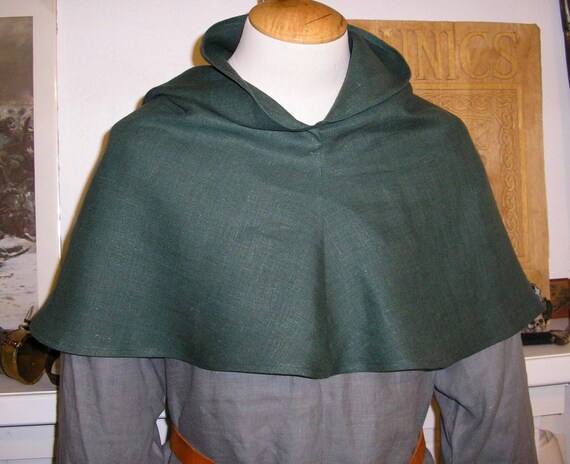
How did people wear these kinds of hoods without them flying off their shoulders when riding or running or even fighting? Were they secured with a leather strap over the shoulder or something?
Here's some other examples:
2 Answers 2014-07-21
So I've been reading about the general history of the Roman Empire lately, and I found it curious that the Romans seemed to try their hardest to expand west (until they hit the sea), north (Britanic and Germanic tribes) and east (Parthian Empire). Yet there seems to be very little information on the expansion south. Do we know why they stopped with only North Africa and not, say, expand down the west or east coast of the African continent?
2 Answers 2014-07-21
Hello!
I am an undergraduate in History at University of York. I have had to take an unplanned gap year and I go back to York next January. After five months out of the loop, I am also convinced that I have fallen way behind on what is current in the Philosophy of History and my knowledge of the historian's craft is probably fifteen years out of date; my most up-to-date back-to-front reading is the great Richard J. Evans' In Defence of History which I lovingly pored over as a sixth former and a first-year undergrad. I've got through The Pursuit of History by John Tosh and Studying History by Jeremy Black. I read and re-read E.H. Carr's classic What Is History back in 2011 many times although it is obviously an "elderly work" as Evans put it and says nothing of modern essentials in History like the diversification of studies, inter-disciplinary collaborations and the role of digital technology in just about everything.
Regardless, these are all kid's stuff in the grand scheme of things - I have grandiose delusions of becoming an academic and feel scandalised that I do not know which texts I should get onto next to gain a proper understanding of History as an academic field. Does 'History' even exist any more in that regard? Can one comprehensive text cover all the divergences, or would I be better off focusing on historiographical texts pertaining to specific areas of study and interest? I'm personally interested in Jewish Studies, British/US political history and memory studies but I'm an open book and could end up going in completely the other direction. York is big on medieval stuff and I've been tempted by doing something on York's Jews and Clifford's Tower.
Philosophy of History and historiography are my main targets. Other relevant philosophy concerning things like 'What is Truth?' or the meaning of 'Truth' is important as I want all my future work to have a sound methodological and epistemological underpinning - I aim to develop a solid criterion for 'historical truth' not contingent on outmoded 'Facts, Facts, Facts' Gradgrindian history, the formerly fashionable piffle of obscurantist postmodernism (not to discount the relevant contributions of postmodernism) or extreme revisionism-for-its-own-sake. I've got AJ Ayer's 'Language, Truth and Logic', though like Carr's work it is a very mature vintage and Ayer himself recanted large parts of it. Your suggestions for material in this area are also prized.
With many thanks,
1 Answers 2014-07-21
Hi everyone,
in this interesting article from the New Statesman, they mention:
In France, the abject failure of the Bourbons to defend French national interests in the Holy Roman empire and eastern Europe precipitated the revolution that destroyed the country’s monarchy.
I wasn't aware the Holy Roman Empire had such an influence on the French Revolution, so, in what extend is this quote true?
Thank you in advance !
1 Answers 2014-07-21
My English teacher said that the language in Shakespeare's plays are over the top and exaggerated, and not how people actually spoke at the time.
1 Answers 2014-07-21
I got to thinking if there ever were any actual DnD-style experiences in the history books, concerning either ancient money/armor/weapon caches with lethal security systems, or expansive tombs with similar seals and dangers, that made a mark in history and spawned tales.
The egyptian pharaohs and south-american native temples are the first two areas that spring to mind, but more rare or esoteric examples are welcome.
5 Answers 2014-07-21
1 Answers 2014-07-21
I have been told that Muhammad was illiterate, but I have also been told that he was relatively well educated after his first marriage. With all of the Pro-Islam/Anti-Islam websites out there it is tough to find a decent source to work this out. Is there just some confusion on my part?
2 Answers 2014-07-21
Let's say that early 19th century South Carolina had 300000 freemen and 200000 slaves, would that mean that people back then would say that South Carolina had a population of 500000?
1 Answers 2014-07-21