1 Answers 2014-06-11
During the Gallic War, Caesar attempted multiple times to take Britain from the native "barbarians" but it was still a hundred years after his last attempt before it was finally conquered. He was unsuccessful both times he tried and it can't have been easy getting all the ships and troops ready so why didn't the Senate stop him (or were they more ruled by Caesar than he was them)? Weren't there more important matters to attend to?
2 Answers 2014-06-11
Hi. As far as i understand thumbs up has always been a positive thing, but do we know this for sure? I remember hearing a theory that thumb down meant you were allowed to stay on earth. Up means you will go to the gods.
1 Answers 2014-06-11
3 Answers 2014-06-11
I know Roman's is a very a sweeping statement, but I thinking along the lines of the rich that own large villas and land etc. that you might see in films.
Compare my generality to: During the slave period in America, I could say that the rich made their money from cotton plantations using the slave labour.
Did they inherit? Did they earn? How did they earn? How much did they earn? What was the demographic like in terms of the gaps between upper, middle and lower class wealth?
Thanks!
4 Answers 2014-06-11
I'm a teacher, and I hear colleagues discussing the need to make teaching a higher status profession in America. Many people examine other countries, like Korea or Finland, to compare them to the US, but I want to examine history. I know that "physician" or "medical doctor" was not always a high status position in American or English society. How did it become that way?
1 Answers 2014-06-11
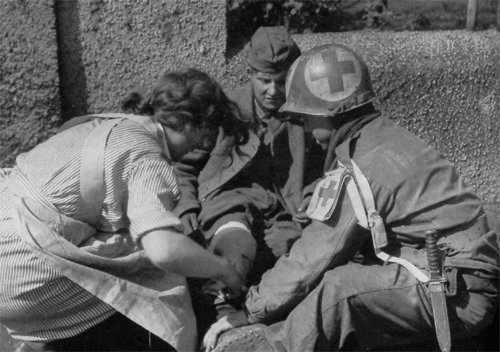
So I was watching the Pacific early today and I saw the medic's symbol and was wondering if anyone knew the origin of the symbol and its use on the battlefield.
2 Answers 2014-06-11
Does anyone with a background in East Asian history have anything to recommend on this. I'm interested in both domestic/geo-political and military aspects of the conflicts.
1 Answers 2014-06-11
So me and my girlfriend, who is Kazakh, have been talking about how similar Nations like the Inuits are to central asians. She has seen videos of the spoken inuit and agrees it sound somewhat similar to kazakh minus the harshness on the throat.
Is any of this founded or is this a classic case of correlation not causation?
2 Answers 2014-06-11
Both of these palaces sit on the same axis (approximately facing ESE and opening to the back toward WNW). The cities that grew up around them use this same axis for major thoroughfares that define the urban space. Did this axis have any significance (such as perhaps the direction of the rising sun on a particular date) that attracted builders and the king? Was the Louvre simply sited along the Seine and then Versailles later built to mimic the Louvre's alignment? Or is there some other explanation or meaning to these sitings?
1 Answers 2014-06-11
While I'm mostly talking about people, I could also use some info on the value of non-human things lost. This is for an argument with a friend that claims that the Western Allies could of won WW2 on their own.
1 Answers 2014-06-11
So I'm the family history buff and enjoy all things regarding both world wars. A few years back I was given a large collection of letters home written by a relative that served with the US Expeditionary force during the First World War. The letters span from 1916-1919. As much as I absolutely love reading through them; I admit that I am lacking the best methods to properly and effectively preserve them. I was wondering where might I begin to inquire about donating these letters and if indeed they are something deemed worth accepting by a museum or university. Thanks!
1 Answers 2014-06-11
As far as my understanding, Hindi is an Indo-European language. I am not too sure of Urdu's language family, but I would assume that it is the same. The languages are identical in their vernacular, but are extremely distinct outside of vernacular usage.
1 Answers 2014-06-11
3 Answers 2014-06-11
Or where do you know it is taught best, especially to younger demographics (teens and young adult)
5 Answers 2014-06-11
Preferably, in their own tongue. Kinda like how Asatru was the mythology/religion of the Norse, and how Judaism was the religion of Judea and Jews called the religion Yehudah.
1 Answers 2014-06-11
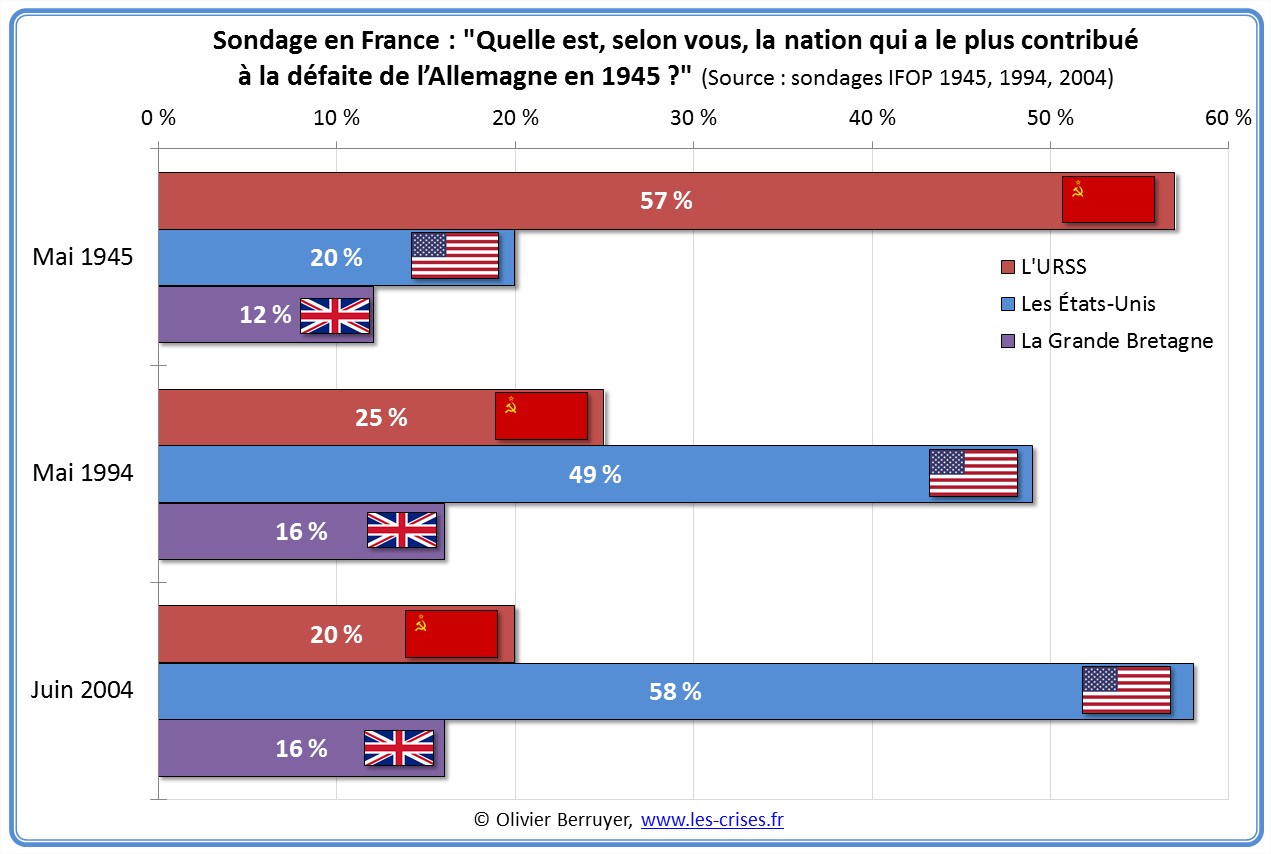
This poll has been posted a few times on Reddit today. It shows French people's opinions on national contributions to victory changing over the 20th century and into the 21st.
Why did this happen? Why did the United States of America end up with this reputation?
1 Answers 2014-06-11
Saw a front page post about Julius Caesar and have spent the last several hours absorbing everything I could find on the guy.
I think it would be a good use of my time to dive into a full book on his life and/or particular events. I keep coming upon many myths about him and I am aware that history is written by the victors but I would still like to know what truth is behind such an insane life and mind.
Keep in mind I am approaching this from completely square one. Soooo not trying to make excuses but was educated in a strict home school/church environment that took a narcissistic approach towards history. Example: Only education about Africa I received was through stories about missionaries. Learned about China through being told about Gladys Aylward http://en.wikipedia.org/wiki/Gladys_Aylward
I once read the book "The Young Carthaginian: A Story of The Times of Hannibal" by G. A. Henty, but thats as close to Rome as my education reached. I am aware of some actual history about Rome but it is mostly background information I picked up while being taught about the persecution of Christians and Romes relationships with the churches.
Thank you in advance everyone. I am still working my way through the last several things you reccomended to me last time I asked something. Particularly enjoyed: A Chemical History of a Candle (finished last month), A Short History of Nearly Everything (just finished my third reading).
~ J
2 Answers 2014-06-11
I realize that human capital is an important economic resource, and the Soviets lost far more of it than anyone else in the war. I was wondering if this had a significant impact on the post war soviet economy, and its ability to compete with the post war American economy considering the U.S. didn't lose nearly as many people.
1 Answers 2014-06-11
2 Answers 2014-06-11