Like in the American civil war were armies just roving around waiting for action or did they camp out? Or in world war 2, how did a typical platoon operate?
2 Answers 2014-05-05
3 Answers 2014-05-05
An example being the 7 Day Battle
For such a monumental battle, how were only 1700 Union soldiers killed from an army of 100,000?
2 Answers 2014-05-05
1 Answers 2014-05-05
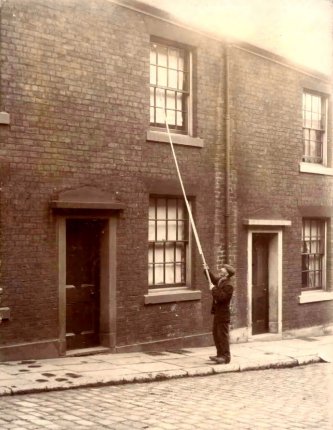
I'm talking about [these guys] (http://genealogyresearchnetwork.com/wp-content/uploads/2011/10/Knocker-up.jpg). Did the employer buy the knocker-up an alarm clock? Seems like this would save money (instead of buying everyone one, you just buy one for the knocker), but wikipedia tells me alarm clocks weren't very reliable in those days. The article didn't elaborate, so I came here. Any help?
1 Answers 2014-05-05
1 Answers 2014-05-05
1 Answers 2014-05-05
This may be silly, but it always seems to go by without much information in non-fiction ww1 accounts, and history books growing up. I'm aware the Germans used some pretty serious artillery against belgian forts at the beginning of the war, and I'd imagine the real problem could have just been the logistics of getting big cannons to the fronts without railroads.
I'm a bit out of my depth, and I'm curious as to why artillery didn't nullify a lot of the protection that trench warfare offered combatants. Thanks for any info.
5 Answers 2014-05-05
So far I've heard about a confirmed DNA and skull analysis, Chinese texts saying that the Japanese claimed descent from a Wu King, and a brief wikipedia sentence saying that the Wu were really good at making swords.
1 Answers 2014-05-05
Do we have anyway of knowing what music they had other than the very basic like knowing which instruments they used? where there musical notation at the time of cezar?
in general, is every piece of music "writen" before the musical notation lost?
1 Answers 2014-05-05
Hi fellow historians, I have summoned you here to ask for any help that you might render.
I have been looking for several months now for information regarding Leo VI's Basilika Code of Laws, which apparently is extremely hard to find. I was able to extract some information about the history of the more modern manuscripts in this Encyclopedia Britannica entry from 1911, but I haven't been able to find any more recent scholarship, save for a small mention of the Basilika in this 1918 review publication. Worldcat and my ever-trusty Harvard Library have sadly yielded next to nothing. As noted, I am very surprised that this highly influential and monumental work has gotten almost no coverage in the modern day, and quite frankly, I find it appalling.
Anyways, I was wondering if anyone might have some clues to helping me track down some of these manuscripts, because it seems there has been little to no interest in translating the work into English (as seems to be the case with many Byzantine works). I have a theory that the existing translations into Latin may go under different names, which may be preventing me from finding what I'm looking for, but I'd like some input from some of my other historical brethren, preferably those knowledgeable in Byzantine sources.
Thanks in advance.
2 Answers 2014-05-05
I have a 10 minute presentation on Egypt to describe the evolution of funerary architecture from Predynastic times to the End of the New Kingdom What are some key developments that I should Mention? NOT ALL GENIUSES ANSWER AT ONCE ;)
1 Answers 2014-05-05
If anyone has seen the movie Ironclad and can comment on the accuracy of the siege warfare depicted therein would be much appreciated.
1 Answers 2014-05-05
Been reading about Ceaser and Augustus on Wikipedia and am so intrigued, but know those article are only scratching the surface.
What are 5 books I can read to get a pretty good sense of the rise to the fall of the Roman Empire. First hand accounts would be awesome.
Thanks
2 Answers 2014-05-05
1 Answers 2014-05-05
Did the level of noise and commotion vary greatly between different eras of battle (before common gunpowder weaponry)? If so, what were some of the most significant sources of noise and would they have made communication difficult? The only source I currently aware of would be the Old Testament of the Bible, which repeatedly describes the din of battle something like "the cries of men and the stampeding of hooves" (not actual quote, heh).
Thanks in advance, and I would be very interested in books that delve deeper into this subject.
1 Answers 2014-05-05
Currently studying this and Supreme Court cases fascinate me. I ask my teachers but they always say there isn't just "one" important one. Maybe Reddit might find one that is most important?
2 Answers 2014-05-05
My teacher meant that advancements such as planes (WWI), submarines (WWI), radars (WWII), etc... happened because men needed to kill each other more efficiently. He even used to claim that the reason why the first stick was used as a tool was probably because a man needed to hit on another one.
I guess what he claimed is that technology followed a chaotic evolution punctuated by big advancements during wars, and then diluting these advances in our every day life, improving our comfort and building the technology we know today. The main reason I think is that huge amounts of money can be found during war times (an ongoing war was never stopped because countries lacked money), but I feel that this trend might have changed during the last 40 years thanks to other large amounts of money that it is possible to find in public markets, or even through Crowdfundings, IPOs, start-ups, and also large joint projects between countries (LHC for example), etc...
Does it mean that we might not need to kill each other (or crush each other) in order to achieve big technological advancements from now on?
Thank you for your time!
4 Answers 2014-05-05
I remember watching it on the military history channel. It was WWII, and it was when some scouting vessels actually held their ground against battleships. I think that the Yamato was there too. I can't remember what it was called. Help?
2 Answers 2014-05-04
1 Answers 2014-05-04
1 Answers 2014-05-04
1 Answers 2014-05-04
http://www.houseofnames.com/sturgeon-family-crest
So, my last name is Sturgeon. This might seem nerdy as hell, but I was thinking of putting together a costume for a Renaissance fair this summer. I've never worn one before.
Anyway, judging from this site my family may have been some kind of minor house in England after the Norman conquest. If I wanted to dress myself as someone from a minor house for the fair, what kind of things should I have? Chain mail and a tunic? What kind of swords were popularly used? 1066 is still pretty far back for anything too fancy, I just figured if I was going to put together a costume I'd make it meaningful.
So what kind of look should I shoot for?
1 Answers 2014-05-04