I’m working on a book set in the time period but I’m looking for a good place to start in my research! Any advice or tips would be greatly appreciated!
1 Answers 2020-12-10
Here are a few clarifications to my question.
Thanks!
1 Answers 2020-12-10
I’ve always wondered why the water supplies wouldn’t get tainted. I assume they could probably fish for meat but how would they preserve fruits and vegetables?
1 Answers 2020-12-10
I'm just curious because obviously the population of San Marino was barely the size of a small town and the Communists were in general kept out of coalitions in Western Europe. I assume it was heavily influenced by the Italian political scene but I'm very curious as to any details about this particular communist party.
1 Answers 2020-12-10
Hi r/AskHistorians
I’m looking for book recommendations on the Arab Conquests and or Crusades from the “Arab” perspective please. It is for my friend; She grew up here but is Syrian and doesn’t know much about “her side”. I feel bad we always talk about it from the European/Christian perspective. We role play occasionally with miniatures it would be good to learn of the opposite side.
A second question if I may:
I am interested in the origins of “Arab”. She is Syrian but she says she is not Arab but “Assyrian”. I know about the Assyrian Empire and thought they would have long since vanished.
While she is not as pale as myself (blonde Dutch/German girl) she is white skinned with green/blue eyes. Is it correct to call all people in Arab countries Arab? Do we call them Arabs purely due to language or culture or did they completely replace the indigenous people? She says not.
I apologise for cheating and asking two questions the book recommends is priority please thank you.
1 Answers 2020-12-09
1 Answers 2020-12-09
I kept hearing that Spain under Philip II was considered a superpower and that it only stopped being so at the Battle of Rocroi. And yet if I look at every "front" they seem to be losing all the time. Against the Dutch they can't seem to defeat the rebel forces. Only minor breakthroughs which most were retaken by Maurice of Nassau (like the capture of breda). By the end of the 80 year's war, the Dutch were doing so well that most of them didn't want to stop the war.
That is not to say for the sea beggars and the enormous amount of piracy which was taking Spanish Gold and the Spanish were incapable of stopping them. And that is considering that the whole thing was a rebellion, not a well funded state.
The supposedly superior Spanish army couldn't stop that revolt, spent enormous time and blood taking cities and was constantly under funded.
The Ottomans also were beating the Spanish severely, both with barbary slave raids that demolished Spanish coastal population, general piracy and even major naval defeats by the ottoman. Even the touted battle of Lepanto was a group effort and a minor set back for the ottomans.
And not to say about the English. The Spanish armada is an unmitigated disaster in all fronts. They were constantly terrified of English pirates like Francis drake that defeated the Spanish in every front possible. The only solution was to fortify their ports and even then they were easily taken by later pirates like Henry Morgan.
This coupled with the fact that they even lost the throne of France to Henry IV who "converted" to Catholicism to end the civil war. And they went bankrupt multiple times from massive inflation, whilst other nations seemed to be able to fight without mountains of gold and silver and never went bankrupt. Did these countries simply not suffer from inflation?
As a final note, the Spanish seemed to be at their most incompetent on the very front that gave them their "power": The Americas. Pirates were easily taking Spanish ships full of gold whilst Spain did nothing. Pirates were devastating, pillaging and raping entire towns in the coasts of New Spain and constantly desecrated churches and the spanish simply took it. Portugal even lost it's Asian dominance because it was in an union with spain by the Dutch (who weren't a nation but a revolt ). Examples like the capture of the Madre de Deus is embarrassing.
I couldn't find a single notable victory of the spanish over pirates on wikipedia.
Sure they had lands everywhere, but they lost everywhere. I'm surprised they managed to hold on to what they had.
So all of that out of the way: Why were the spanish considered a superpower?
Edit: why was this post marked NSFW?
1 Answers 2020-12-09
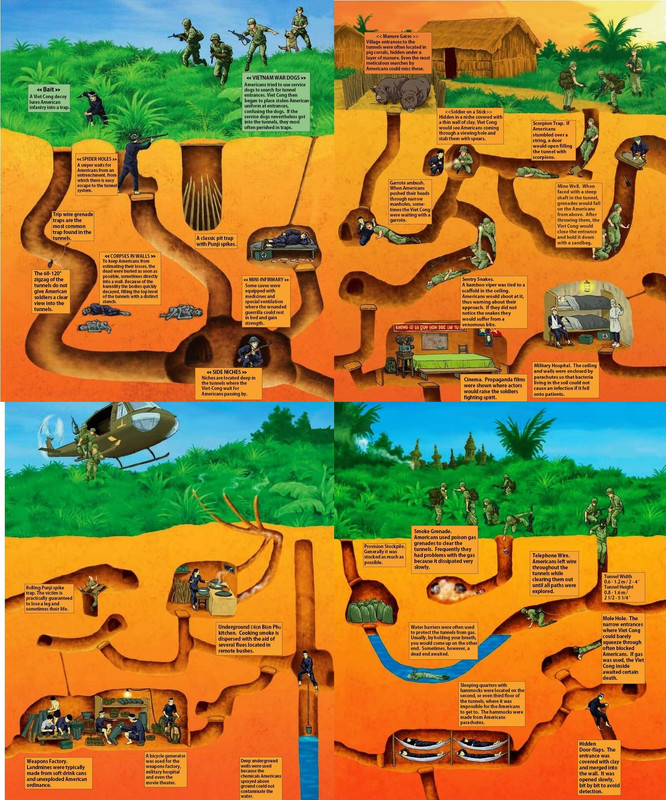
In war movies and documentaries we see American soldiers carefully upending tarps and such, in Vietnamese villages, expecting the possibility of somebody hiding underneath.
I can believe that. Of course some militia irregular might be hiding.
However, you then go on to hear stories, and see drawings, of what I find to be fancifully intricate caves, such all sorts of clever traps and deep features.
Are these types of caves a myth? And if they did exist, were there ever more than a handful?
1 Answers 2020-12-09
I graduated from university in Canada from a relatively large institution.
Most local students lived at home and would commute to school each day, and would condense their courses into a couple of days so they could minimize time spent on campus and work/study during their off days. The dorms were mostly for international students.
The attitude was very much - get in, get your degree, and get out (with a mild bit of involvement along the way).
This differs drastically from the USA model, where everyone seems to be going to school out of their state, living in dorms, spending lots of time on campus, partying, going to tons of sporting events, joining lots of clubs/committees/fraternities etc.
I know I am likely making a generalization, but it seems like all the large US campuses are buzzing with activity, and college is treated as an "experience" instead of an education-first institution.
I am sure that Europe differs as well.
What are the factors that led to this?
1 Answers 2020-12-09
People in that thread are speculating that it had to do with legislature that increased transparency and made it easier for corporations to target politicians to corrupt, but I think it's unlikely it was that simple.
Nixon was president, but our impression of him in 2020 is probably different than the country's impression of him in 1968, so I don't think it makes sense to name him the solve reason either.
What were led to the restructuring of the US economy in the early 70's? Was it a response to protest movements of the 60's? Was it widely known that this was happening? Is 1971 even a significant year, or is it just a convenient point marker for the start of the 70's?
Sorry if this is too scattered. The website in question is called "wtfhappenedin1971" and I'm sure this sub has already had to reject a few posts that site inspired. Thank you for your time!
1 Answers 2020-12-09
Why did the people let their leader continue the war even though it was clear they would lose and they were conscripting children and old men to continue the fight. Unlike nazi Germany they were pretty small in population and land. Also besides their leader who thought he was an military genius they didn’t have napoleon or robert Lee’s in their military and although they had the debates best army in South America and an navy although they were land locked they didn’t have Gatling guns, and more modern weapons which could have decided battles and would have been needed for the war. So my overall question is why did this supposed military genius decide to declare war on basically all there neighbors at the same time that were much bigger then him and why did the people even allow him to continue in the middle of the second half of the war.
1 Answers 2020-12-09
Did they organized texts in genres as we do today? Did they distinguished between religious and non-religious texts? Under what circumstances was someone allowed to view, copy, or borrow one of those texts?
1 Answers 2020-12-09
I love this subreddit. I love the questions and I love how much detail goes into the answers. I unfortunately don’t have the capacity or time to read such long responses. Which makes me miss out on potential the knowledge gained.
I am surprised there aren’t summarised versions of the answers. This would be perfect!
Is it not possible to start a trend where the responder writes a quick tl;dr or summary on the response? I’m sure this would be beneficial for so many people out there, in addition to me.
1 Answers 2020-12-09
I live in a country with almost the same size of the continental USA, and we don't have even half of the number of states that America has.
Is there a reason for so many states in general, or every area of the country has his unique reason for been divided like that?
1 Answers 2020-12-09
Is anyone aware of any quality books on William Seward? I'd appreciate recommendations.
1 Answers 2020-12-09
I know about the Yellow river, but several civilizations had Flood plains(Nile, Indus, Tigris and Euphrates) How did the Han ethnicity remain the largest?
1 Answers 2020-12-09
It seems like there can be multiple judges at once, but there can only be one king. Sometimes it seems like there are judges, but nobody listens to them. In what sense is a person a judge, if anyone can become a judge, and the people might ignore them? What’s the difference between a judge, and a random person the writers of the book of judges happen to like?
Here is 1 Samuel 8:10-19. Do judges avoid all of these things? If so, how do they govern, and live?
10
Samuel told all the words of the LORD to the people who were asking him for a king.
11
He said, "This is what the king who will reign over you will do: He will take your sons and make them serve with his chariots and horses, and they will run in front of his chariots.
12
Some he will assign to be commanders of thousands and commanders of fifties, and others to plow his ground and reap his harvest, and still others to make weapons of war and equipment for his chariots.
13
He will take your daughters to be perfumers and cooks and bakers.
14
He will take the best of your fields and vineyards and olive groves and give them to his attendants.
15
He will take a tenth of your grain and of your vintage and give it to his officials and attendants.
16
Your menservants and maidservants and the best of your cattle [2] and donkeys he will take for his own use.
17
He will take a tenth of your flocks, and you yourselves will become his slaves.
18
When that day comes, you will cry out for relief from the king you have chosen, and the LORD will not answer you in that day."
19
But the people refused to listen to Samuel. "No!" they said. "We want a king over us.
1 Answers 2020-12-09
Pretty straightforward, really: the Mongol Empire (and the Chagatai Khanate post-division) attempted several invasions of India under the Delhi Sultanate, each of which was repelled. They only ever established a dependency in Kashmir, probably like what the United States did with Cuba after defeating Spain in 1898.
So why were the Mongols unable to conquer the Indian subcontinent or make any significant gains in it?
1 Answers 2020-12-09
Not sure if it has to do with Texas being its own country briefly, the fact that it had a relatively turbulent few centuries with the governing body changing several times in the course of a couple centuries or something else that contributed, but it comes up frequently enough that I thought I'd ask.
2 Answers 2020-12-09
I'm talking about the places like Florida, Utah and states like those that were under Spanish control for clarification. How was it governed? To what extent did the Spanish emigrate to these places? What influence did the Spanish have on their culture? I can't really see the Spanish influence at all in these states is their a reason for this or am i just an idiot? I feel like this had something to do with the mexican-american war. What did they do with there American land? I'm pretty interested to hear the responses if i get any.
1 Answers 2020-12-09
I know that the Portuguese and other Europeans established trading posts, fortresses, & the like along the coasts of Africa - were these the earliest Age of Discovery developments in what would become "colonization," or did the idea of establishing new communities in a "wilderness" have another route of development?
1 Answers 2020-12-09
I ask this question as I’ve heard a few youtubers talk about European reaction to the Civil War. In that History Matters simply said that they were unimpressed and elsewhere that there were lessons to be learned there before WW1.
I’ve also heard that the iron clad ships had a massive impact on Naval warfare. So were these immediately adopted in France and Britain or was it a slower process?
I’m also interested how they observed military tactics, as it would seem strange that a foreign military expert would find it easy to observe what was happening.
1 Answers 2020-12-09
1 Answers 2020-12-09
My tween nephew has really been into the Horrible Histories books for a few years, and has really enjoyed them. For those of you not familiar with them, this is a series of illustrated books for kids that describe a lot of history, with an emphasis on things that are gross or outrageous and hopefully, thereby, exciting or appealing to adolescents. This has been spawning an interest in learning more about history, and it seems like he's ready to move up to slightly more sophisticated stuff (although I don't suspect he'll tolerate anything really dry and academic). Members of /r/AskHistorians, what books can you recommend for a young person who wants to read fun, but historically sound, books about history? I'm particularly interested to hear if there were books that you read when you were young, and which maybe helped excite you about history at an impressionable age, but I'm also happy to hear about anything else you might recommend.
2 Answers 2020-12-09