I was able to look through my grandmas immigrant workbook today. I am having trouble reading some of the German handwriting and putting it into context. She rarely talked about the war when she was well, but is now very sick. The book is in possession of another family member who I rarely see and I had never seen this document before.
She was from around Ternopol when it was still Poland (now Ternopil Ukraine). When the Nazi's invaded she was taken to Germany and put into forced labor. I was under the impression that she was doing farm work. After the war she stayed in Germany and met my grandfather. My father was born there and then they immigrated to Australia.
Imgur link: https://imgur.com/a/Cfl1BRv
2 Answers 2020-06-29
I have heard lots of times that Che was very bad with homosexuals but some LGBT supporters use his image so, was he really that bad?
1 Answers 2020-06-29
I've been doing a lot of research (Dunno why, quarantine induced cabin fever maybe) into the Achaemenid Persian Military (Specifically ethnic Persian/Median Infantry) as the Greeks faced them at Marathon, Thermopylae, Mycale and mostly at Plataea. I've been trying to get a picture of what a typical Persian Infantry formation would actually look like.
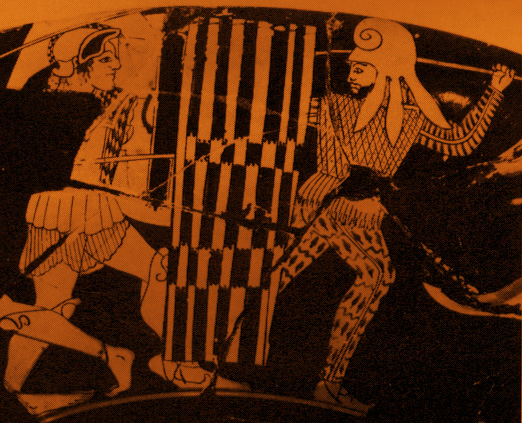
Books by Sekunda and Farroukh (Persian Army and Shadows in the Desert, respectively) loosely give the idea that the front soldier in a Persian battle line would carry a large wicker tower shield, and the nine soldiers behind him would be armed with bows and serve as archers shooting from behind the makeshift wall of shields by this single line. But I wanted to ask how realistic is this actually? Maybe I am mistaken, but it doesn't seem to me that the Achaemenid Persian infantry could have the staying power it showed during the Greek wars if it had a single line of spearmen and archers behind the rest. At Marathon, Herodotus mentions that the Greek center (That faced the ethnic Persian troops) was aligned 4 ranks deep and was broken (or almost broken?) by the Persian center, which was only defeated after the victorious Greek double enveloped them. At Plataeia, Herodotus records the Persian troops fighting against the Spartans for a long time, even if he does say they were unarmored (As a side note, some historians seem to take the word Herodotus' used to mean "unshielded" and others say it's more likely to translate as "unarmored" , what do you think?) He mentions the same of the Persian soldiers on the beach of Mycale. Was Herodotus just saying it was a long fight for dramatic effect? Or was the word he used to describe the shield barricade a poetic reference to an actually deeper line of spearmen in front of the archer ranks?
Also, I can find only one contemporary (Or at least near contemporary, I don't know the date) ancient pictoral source that actually shows this wicker tower shield, and it's on a Greek vase: https://www.ancientbattles.com/Persians/Spara.jpg
Meanwhile, there are hundreds of depictions of Achaemenid soldiers on Persian reliefs in Persepolis, but I can't find a single one depicting that large tower shield. There are plenty of soldiers carrying Shields, but they seem to be the so-called "Dipylon" Shields, shaped like a violin or a circle with holes cut out of the ends. There also seem to be many Persian soldiers carrying bows and spears, or just spears. I understand that these may be the Persian royal guard (Apple bearers? Herodotus seems to mention two royal guard units of 1,000 men each, and then a separate unit he dubs "The Immortals" of 10,000, which is also confusing. Are these actual royal guards? or just the standing Army of Persia, and the "Apple Bearers" are the royal guards?) Herodotus also mentions that the Persian Cavalry was equipped like the infantry (except had metal helmets or something) but I doubt a cavalryman would carry a large wicker pavise.
I am rambling. In short, I want to know what you think of the depiction of the Achaemenid Persian Infantry formation. Do you think it's likely that there is one "spara" or shieldbearer and the other nine behind him are archer/spearmen without shields? Is it more likely that there were actually more conventional separate and deeper spear and archer units? Could it be more like serrated rows, a line of shieldbearers protecting a line of archers repeated? As in:
This seems to be similar to the Assyrian pictoral evidence of their infantry, and I would think more effective if the purpose of the shield bear is to protect the archer. And if battle is joined, the shieldbearers in the back could move to the front to strengthen the line.
Sorry for the long post, just wanted to get someother perspectives.
1 Answers 2020-06-29
This was sparked by me wondering if the Ancient Greeks thought it was odd that Aquarius the Water Carrier was an air sign, but that got me questioning if the Ancient Greeks even sorted the signs by element and mode (cardinal, fixed, ordinal).
If an Ancient Greek astrologer drew up a horoscope, would it bear any resemblance to the horoscope a modern astrologer might produce for me? Did they at least associate the same personality traits to each sign?
And if not, how did modern astrology get the way that it is? Is there an unbroken line of transmission back to Mesopotamia, or was it recreated from historical records/mostly made up? Or is the core true to ancient practices, but then a bunch of other stuff was added to it?
1 Answers 2020-06-29
The various states pre 1870 would have had identities different from the Prussian, and with unification happening there would have been need to create a new identity: German. Except what kind of history would that German identity have? Was it prussian history combined with all the other german histories? Did the Prussian receive more attention?
I was thinking of an example: someone like Frederick the Great who was a Prussian king who did great things for the Prussian state. After 1870 did people conceive of Frederick as a German king who did great things for the German people and that's why we find him important? I imagine that could piss off the Prussian because that feels like someone appropriating your own history, something that belongs to you and not to them.
But then if appropriating isn't possible, does that mean every state just continued to teach their own story? Because that seems kind of counterproductive to the process of creating a nation-state.
1 Answers 2020-06-29
1 Answers 2020-06-29
Reposting: While reading about the Corpus Aristotelicum, I learned that the works we have today were "technical" writings or notes that were supposedly used in the Lyceum, while his exoteric works were developed for a wider public. Now, how "wide" was this public? and how were they published?
Additional question: I've also read that writings by Heraclitus or even other presocratics were only brought to athens when the authors themselves traveled. Did they carry them?
1 Answers 2020-06-29
The Viking Explorer, Leif Erikson sailed to a place called Vinland around the year 1000 A.D. Vinland is now the Canadian province of Newfoundland. Did they ever encounter any of the natives living there? If they did, what did the Vikings think of them and what did the Natives think of the Vikings? What were their relationship? Were they friendly? Were they hostile? Has there ever been a confrontation between the Vikings and Natives?
2 Answers 2020-06-29
Was it just slavery or were there other major differences between the two documents?
1 Answers 2020-06-29
https://www.youtube.com/watch?v=0fgCqauP7YA
From Wikipedia:
As Augustine later told it, his conversion was prompted by hearing a child's voice say "take up and read" (Latin: tolle, lege). Resorting to the Sortes Sanctorum, he opened a book of St. Paul's writings (codex apostoli, 8.12.29) at random and read Romans 13: 13–14: Not in rioting and drunkenness, not in chambering and wantonness, not in strife and envying, but put on the Lord Jesus Christ, and make no provision for the flesh to fulfill the lusts thereof.
Is there a tradition of such miracle convertions in the literature of the time? If so, and since the author was highly trained in rhetoric, should we believe that episode at face value - or is it likely made up to make his "Confessions" more exciting?
Or is his description of his spiritual relationship with Ambrose enough to say "yep, Ambrose was probably to blame, and it was going to happen with or without miracles of singing children".
Looking at the sources we have, who converted Augustine and what was Ambrose's influence on the process?
~~
Edit: Since this is getting some attention, I just want to do a little off-topic plug for something that I'm excited about. If you came here from outside the subreddit and haven't yet heard of the AskHistorians Conference being organized by the mods, then check it out, spread the word and see if you can help!
1 Answers 2020-06-29
1 Answers 2020-06-29
I want to be a historan when I am adult so do you have anything to tell me to be prepared?
1 Answers 2020-06-29
e.g., Wikipedia says "Nor were manors held necessarily by lay lords rendering military service (or again, cash in lieu) to their superior: a substantial share (estimated by value at 17% in England in 1086) belonged directly to the king"
I'm interested in who "ran" the manor in these situations and other special cases -- some sort of steward?
Side question: in the case where the manor was (part of) a bishropic, was the bishop effectively a manor lord and would they have been considered such at the time?
1 Answers 2020-06-29
Under the treaty, the German Empire would gain Ukraine, the breadbasket of Europe, along with coal and other resources. Wouldn’t this have negated the Western Allies’ blockade and allowed Germany to fight on longer?
2 Answers 2020-06-29
The answer doesn't have to be catered to a specific era as I'm sure the roles of the lesser visioned before corrective lenses changed throughout the years. A general explanation though of how people that were born with bad vision functioned in everyday society, how those people were looked at by society, and what roles they took on is really what I'm wondering.
1 Answers 2020-06-29
I am researching the history between Italy and Spain, primarily during their fascists years. One of my friends told me they had a family member named Arturo Maggi who was an ambassador to Spain under Mussolini. Not sure if this is true, but thought I’d dig a bit to see what I could find. Would anyone know some good references for me to look into related to Italian ambassadors? Thank you very much!
1 Answers 2020-06-29
So, I found this publication known as Captivating History, and they cover a LOT of topics in history across many time periods and I am actually interested to read their books on Mongols, Punic Wars, Vikings, Anglo-Saxons, and many other topics.
So, I wanted to ask if these books are accurate and have some depth in them. I don't want coffee-table books which gloss over some finer points of a subject or something of the level used to teach middle-schoolers. Are these books good?
1 Answers 2020-06-29
How did romans describe dates before the founding of Rome/1 AUC? I’m pretty sure negative numbers didn’t exist back then so did they have a separate system that counted backwards like we do now, or maybe they just never need to reference dates before that time because they didn’t have records of exact dates of events?
1 Answers 2020-06-29
Christopher Columbus found the new world in 1492, and the first colony was founded in 1607. So why did Europe wait over 100 years to start establishing colonies?
2 Answers 2020-06-29
I’m writing a historical fiction novel about a US Air Force F-4 Phantom II fighter pilot who is shot down over North Vietnam and taken prisoner in the Hanoi Hilton. A big part of the novel is how he copes with PTSD and the vast changes to his family and his country when he returns to the United States. However, I have so far failed to find any detailed accounts of how the process of returning home worked. Any information would be more than welcome. Thanks in advanxe
CLARIFICATION: I am aware of Operation Homecoming, I am asking about how the prisoners would actually meet their families and such.
1 Answers 2020-06-29
If so are there any stories about their interactions or of them bringing them to mainland Europe?
2 Answers 2020-06-29
Up until modern times, animal intestines have served as strings for instruments. Would I need to go to a specialist to replace my strings? Or is this something most musicians knew how to do themselves?
1 Answers 2020-06-29
I was reading about ancient Russian izba buildings and it said that builders usually didn’t use nails because metal was expensive. Why is that?
2 Answers 2020-06-29
1 Answers 2020-06-29
Apropos of nothing, really, I want to know more about the Picts, i.e., their culture, language, etc. From my understanding, we don't have a ton of knowledge about them, but after some cursory Google searches, I'm not sure what books would be good to start with for someone who is mostly unfamiliar Celtic cultures. I'd really appreciate it if anyone could point me in the right direction!
1 Answers 2020-06-29