[deleted]
1 Answers 2019-10-25
1 Answers 2019-10-25
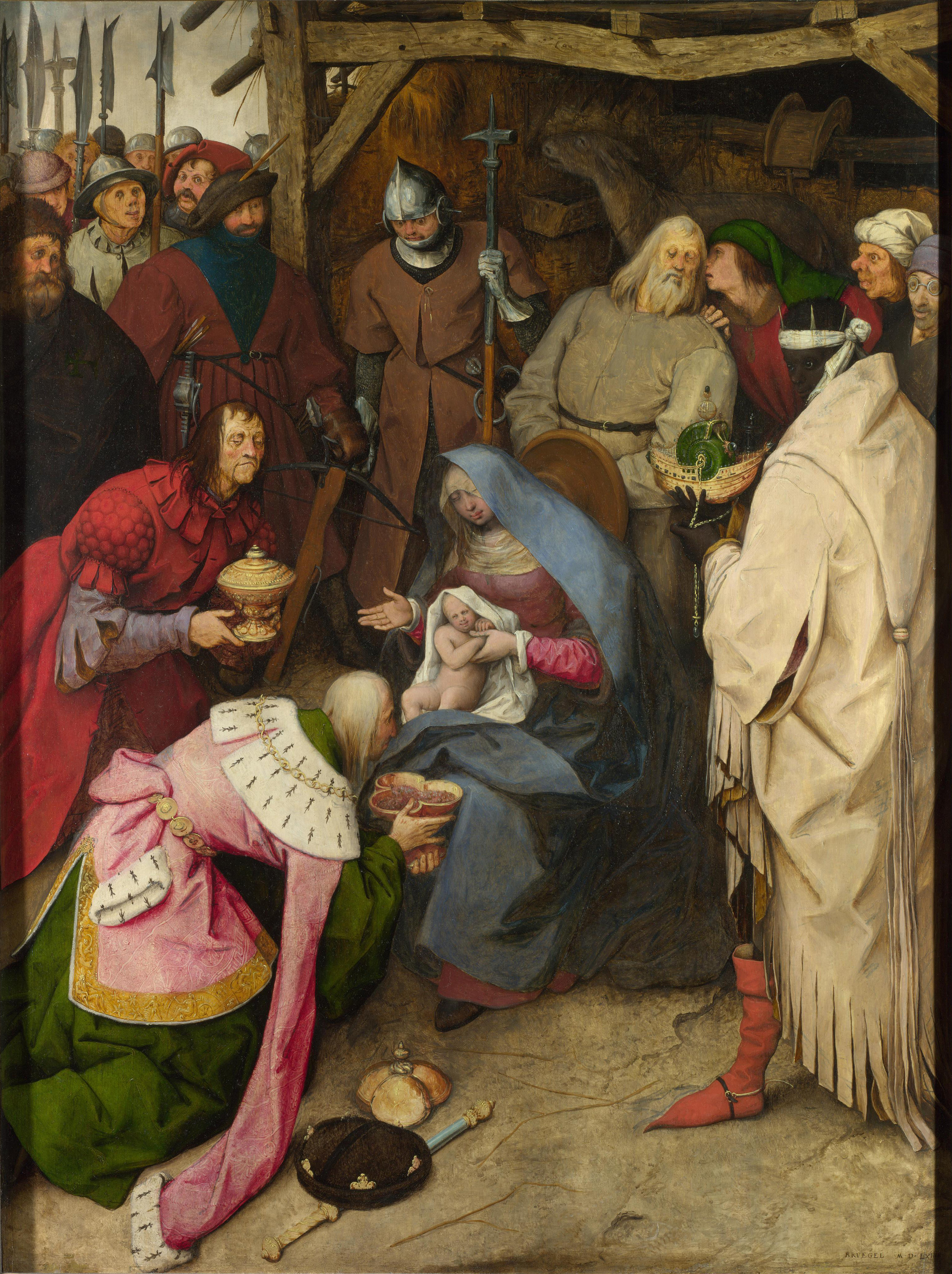
The Bruegel exhibition in Madrid includes a copy of "The Resurrection", and this painting includes a number of (presumably) Roman soldiers looking at the open and empty tomb of Christ. The uniforms they're wearing are clearly not the popular view we have of Roman legionaries with their lorica segmentata, but instead are wearing... what? Is their armour C16 Flemish armour? Would Bruegel have painted using knowingly anachronistic armour?
Unfortunately I can't find a copy of the exact painting online, but the soldiers in this painting are similar: https://upload.wikimedia.org/wikipedia/commons/b/be/Anbetung_der_K%C3%B6nige_%28Bruegel%2C_1564%29_%E2%80%93_cropped.jpg
1 Answers 2019-10-25
So it's a fairly well known fact that for the most part, post WWII there was a good bout of witch hunting going on, leaders that had dubious responsibility for the actions of their subordinates were punished, at times,for things such as simply not stopping the horrid actions of their subordinates.
However, and correct me if I'm wrong, as I'm Australian, so the view I've been taught may likely be skewed, but from what I've been taught, pretty much the entire Second Sino-Japanese War, the atrocities that occurred there,and further the expansion of the Japanese Empire and the atrocities during WWII, were done "for the Emperor" and it was believed that what was being done,was being done at his will and with his express permission.
Now, the topic of why the Emperor's location was never revealed and a Nuclear Blast dropped on him has been done to death,as it would have essentially martyred him in the eyes of the Japanese people and likely strengthened their resolve.
However, why, after the war, like in a lot of wars, why was he not deposed, tried,and likely executed in disgrace and likely with no honour? It would likely have not been an"honourable" death to be hanged/shot/etc.
I mean, there is a strong history of Monarchs being executed for their actions in war, and essentially in Europe at Nuremberg the leaders of the Nazi regime were being torn apart.
But yet, Emperor Shōwa got away essentially scott free and continued to rule until his death in 1989. sure, his empire was heavily sanctioned,bit he was still Emperor and faced no recourse for his actions.
1 Answers 2019-10-25
I always wondered about how could people rely so heavily on rivers - for war, trade and communication - when the rivers themselves are pushing to one diraction. I assume that the exact method changed from place to place and from era to era, but I would like to know specifically about the medivial world, in Europe, the middle east and central Asia. Was the method of sailing different from river to river? And did it have implications for the people using the river?
1 Answers 2019-10-25
Were the U.S. and its allies prepared for a ground invasion of Japan? The prevailing opinion of laymen such as myself is that Japan would have fought to the last man.
1 Answers 2019-10-25
1 Answers 2019-10-25
Being around askhistorians and looking at videos made by actual historians on the profession really got me to rethink my approach to learning history. For the most part I've been into light reading and watching documentaries and occasionally reading a book on the subject (which I realize I should be doing more of), and since I am a fan of military history, I am curious to know if you think Osprey Publishing follows good history practices or does if anyone here has issues with their methods.
2 Answers 2019-10-25
I've not really heard much about the Tongzhi Restoration, so what was it, and how did it proceed?
Also, was there an informed attempt at modernisation, or was that more of a poorly understood concept?
1 Answers 2019-10-25
Or put another way, why don't we have non-Greco-Roman written sources?
1 Answers 2019-10-25
Hi all,
I read in this answer about poisons and tasters written by u/jetpacksforall that near the end of their tumultuous lives, Antony "was so afraid of being poisoned by Cleopatra that he employed a praegustator".
In the source provided by u/jetpacksforall (Poison and Poisoning among the Romans by David B. Kaufman), it states that not only Antony was afraid of being poisoned, but also that Cleopatra tricked him with the flower of her necklace (previously dipped in poison) into almost drinking contaminated wine, thus showing him taht she had the ability to overcome his protections if she wanted to.
Now, I have to confess that most of my knowledge about these two persons come from the classical plays and modern cultural items (HBO's Rome as well, if course), so I'm really puzzled here.
I can understand that Marc-Antony might have been worried that Cleopatra decided it was better to strike a deal with Octave at his exepnse (though I would be happy to have precisions on this matter).
However, I don't see how it was important for Cleopatra to threaten Marc-Antony : did she fear the same ? Was she afraid of reconciliation between Octave & her lover, where the latter would forsake her and resume total Roman control over Egypt ? Was it hubris ? Weren't they basically "in the same boat" after Actium ?
1 Answers 2019-10-25
(Let me start by saying I am generally not well-versed on Chinese history, so I apologize in advance if I get some of the set-up wrong here.)
I have noticed that emperors of China (during at least some dynasties) seemed to have several sets of names: (1) a personal name, (2) an official name as regnant (i’m sure there is a better term for this — but hopefully the examples that follow will make clear what i mean in any event), and, finally, (3) a posthumous name. [Edit: I see some emperors also had (4) a “courtesy name,” which raises the same general questions discussed below.]
So, for example, the Tang emperor Taizong apparently was personally named “Li Shimin,” ruled as “Taizong,” and then was given the posthumous name “Wen Huangdi.” (There also appears to be variants of certain of the names (such as shorter and longer versions), though that seems more intuitive and so i’m not as interested)
i am generally curious about how this system of nomenclature worked and the reasons for it (to the extent known).
so, to give some examples of the types of things i am wondering: how was each name chosen (particularly the names other than the personal name)? when was each given and when was it used? was it predictable or systematic (e.g., was there a way one could know that in the event the person with the personal name Li Shimin took the throne, he would take it as “Taizong”?)
then after his death, was there any taboo against using something other than the posthumous name? would it raise eyebrows to thereafter refer to “Taizong”? (and as before: how, when and by whom would the posthumous name be chosen)? why is he generally known to us as “Taizong” rather than the posthumous name, given that he is at this point assuredly quite posthumous? what is the reason for a separate posthumous name in the first place?
thanks in advance for any insights; please let me know if there’s anything about the question i could clarify!
1 Answers 2019-10-25
Title
1 Answers 2019-10-25
Apologies if I'm wrong about that. I'm currently watching the TV show "Sharpe's Rifles" and I'm just wondering if, as early as the Napoleonic era, whether or not the emphasis should be on [Sharpe's Counterpart In] Artillery as much as it is on Sharpe's Rifles.
1 Answers 2019-10-25
I've heard about Rhodesia recently and have found an article by the new York times about White supremacists linked to it, I had always had the impression the fight was about communism, and avoiding a shift of power that led to Dictatorships and totalitarian regimes, can anyone sort this out?
1 Answers 2019-10-25
I mean Napoleon did sell this massive chunk of land to a different country, how did the locals react? Did they feel betrayed, or did most people simply not care?
1 Answers 2019-10-25
The traditional narrative of the Khwarazmi is simply that of a cautionary tale about killing the Khan's messengers, but it doesn't get into their service as mercenaries to the Egyptian Ayyubids and their conquest of Jerusalem from the Christians. I'd particularly like to know more about the Battle of La Forbie, with the Syrian Ayyubids joining the Christians against the Egyptian Ayyubids and their Khwarazmi mercenaries.
1 Answers 2019-10-25
In most media, peasant life is portrayed as horrible. Peasants are considered as perpetually muddy, sick, enduring backbreaking work and eating rotting bread etc. It is a pretty common trope to regard peasant life as "the worst kind of existence."
However, this seems to be a pretty suspect view. From the various things I've read and considered (though not having read anything particularly in depth on the subject besides 19th century political economy books), small agricultural communities in the middle ages seemed (when not beset by war, plague and other disasters) quite tranquil, stable and capable of meeting most basic and higher order human needs. One would grow up in a tight-knit community where everyone had a purpose and was supported by others, alongside institutions like the local church and such. While people appeal to the grand scale of corruption in the medieval clergy, it seems local churches were mostly means of community services. Peasants would clock off work to enjoy social activities, probably often at the tavern with some drinks, and when farm work was done partake in handicraft, fishing etc. Essentially, peasant communities seem like they were capable of fulfilling people's need for a sense of purpose, social relations, a varied set of activities etc. Clearly the extraction of surplus produce by the feudal system hindered the capacity for these communities to make the most of their means, however I don't see how this would have made peasant life entirely awful besides when there were cases of particularly malevolent Lords.
It seems like people notice the worst of things, e.g. war, famine etc, and get the view that these things were the status quo. Clearly a lot of this is a matter of time and place and varies considerably, but I'd assume many aspects of it were pretty stable.
Is my perspective too rosy? Was everyday peasant life truly awful in a fundamental way?
2 Answers 2019-10-25
By concern, I mean from leading religious or community figures in the American Jewish community who wanted to preserve dietary religious laws. Also, I understand the tradition might be limited to urban American Jews like in New York City or elsewhere.
1 Answers 2019-10-25
1 Answers 2019-10-25
I know that jazz has spent most of its history in bars and clubs or in the halls of academia. It's difficult to find a jazz radio station in most communities and the general public would be hard pressed to name a recent jazz artist or album. Yet when Christmas rolls around, the radio seems to be dominated by jazz standards and jazz infused pop singles. In fact, whenever I play jazz in my classroom, I can guarantee at least one student will ask why I'm playing Christmas music. But Christmas, as a religious and family oriented holiday, seems to be a very odd pairing with this niche music genre. So, why is it?
1 Answers 2019-10-25
3 Answers 2019-10-24