Compared to it's neighbours, Nigeria is extremely populated. What are the reasons for this?
1 Answers 2019-03-12
I watched the movie the other night and was curious why the Confederates were the heroes of the film. When I looked up the film's Wikipedia page, in the ["Production" section](https://en.wikipedia.org/wiki/The_General_(1926_film)#Production) of the article, it reads that
In early 1926, Keaton's collaborator Clyde Bruckman told him about William Pittenger's 1863 memoir The Great Locomotive Chase, about the 1862 Great Locomotive Chase. Keaton was a huge fan of train history and had read the book. Although it was written from the Union Army perspective, Keaton did not believe that the audience would accept Confederates as villains and changed the story's point of view.
Was there a different attitude towards the Confederate States which existed in the 1920s that explains why Buster Keaton thought audiences wouldn't believe they could be villains?
1 Answers 2019-03-12
I was watching a show that suggested, after finding a charred boulder near a Mayan settlement, that it must have been involved in a historical fire ritual rather than the more simple possibility that it had been part of a cooking or celebration area. What tools and best practices do historians and archaeologists have to help categorize finds as ritual as opposed to being related to daily life?
1 Answers 2019-03-12
Was there a change in the way we cure our meats? Were they eating spoiled meat?
2 Answers 2019-03-12
1 Answers 2019-03-12
My 4th great grandfather Thomas Francois Benoit Derussy was a French naval officer in service of John Paul Jones colonial navy. He served aboard the Pallas. What flag might they have flown on the French privateer ship?
1 Answers 2019-03-12
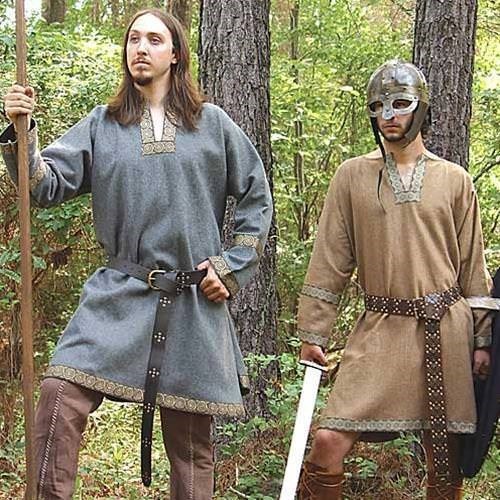
I'm mainly asking out of self interest - they look pretty damn comfortable. When did they stop being a common-wear item for men in the West? Is there anywhere where the tunic is still common-wear, and why did it persevere there?
1 Answers 2019-03-12
Is there any reason why medieval soldiers could not have been organized into the order of battle/organization (in the modern sense) of the Roman Empire by a ruler or empire that chose to do so? Integrating crossbowmen, longbowmen, spearmen, light cavalry, heavy cavalry (Knights), etc.
I know the Komnenian era had a relatively organized army in the Eastern Roman Empire, but they were not at the scale of the professional standing armies of the Roman Empire from my understanding nor were they organized into an order of battle as organized as that of the Roman legions. Perhaps an expert on the subject matter could explain if the Komenian era Eastern Roman Army was as organized as the Roman legions or not.
Is there a reason that the Legion order of battle model could not be applied to medieval warfare though adjusted for more cavalary? The tactics and strategy would of course change. The table of organization would also likely change from the structure of the Roman Legion as a medieval Legion would integrate more heavy cavalry, crossbowmen, longbowmen, etc.
1 Answers 2019-03-12
And how would those answers change at 750 and 1000?
1 Answers 2019-03-12
[deleted]
1 Answers 2019-03-12
From sculptures to coin images of emperors, it seems like from the 4th c. onward many of them had unnaturally large eyes. Why was this? Did the artists just suck at facial portrayals or is there a reason for, or meaning behind, this?
1 Answers 2019-03-12
I stumbled on this picture titled "from the 1950's" and was wondering how prevalent this attitude really was in the 1950's.
2 Answers 2019-03-11
So there's this song my Mom used to play for me as a kid: Sink the Bismarck by Johnny Horton. A song about a German battleship called The Bismarck that's described as being the biggest naval threat in World War II, saying stuff like Churchill sent all the ships out just to get rid of it. My question is how accurate is this song? I'm sure it wasn't actually the #1 threat or anything, but was it actually the strongest ship in the war? Was it because of the people controlling it or the ship itself was that cutting edge?
2 Answers 2019-03-11
I've seen several pictures of shields with in-cut or holes used to guide the spear while in battle. I'm just wondering what the origin of these shields might be and where they may have been used in battle.
1 Answers 2019-03-11
I can find a lot of information of ships, but nothing substantial on what they actually looked like. Were ships painted at all? Were specific colors favored for combat reasons? Did the European powers prefer specific color schemes?
1 Answers 2019-03-11
[deleted]
1 Answers 2019-03-11
Some more context. George Fraser talks about how discontent was simmering and Fakirs and Sadhus (saints) used to distribute chapatis. This was supposed to be a sign to local populace to brace for an upcoming revolution.
Additional questions:
Was this a planned revolution or a random flash point which quickly gained momentum?
If it was unplanned, how did the entire gangetic plain and almost entire North India quickly got into the act?
If it was planned, how did they communicate before telephone and any other modern invention.
Why did the revolution ultimately fail?
Thank you in advance!
1 Answers 2019-03-11
The Dome of Discovery occupied the land where the gardens now sit. The Dome lasted from May 1951 as part of the Festival of Britain, until September 1951 when it was torn down and sold as scrap metal. I then can't find what (if anything) was done with the land until 1977 when the Jubilee Gardens were built for the Silver Jubilee.
I apologise for this very specific question.
1 Answers 2019-03-11
[deleted]
1 Answers 2019-03-11
3 Answers 2019-03-11
E.g. Were the stronger people placed at the end of an oar and the smaller people nearer the water? Vice versa?
1 Answers 2019-03-11
The Sinhalese, the majority native people of Sri Lanka, are an Indo Aryan people related to the Hindustani and Marathi people in Northern India. Yet they are separated by the strait of Palk and hundreds of miles of the Deccan plateaue from their nearest relatives. In between are the Dravidian people, a native Indian peoples unrelated to the Indo Ayrans speaking their own languages and having their own customs. The Tamil Dravidians of southern India as well form a large minority on Sri Lanka. Is this a Madagascar situation in which the Indo Aryans were the original settlers of the island and Dravidian Tamils moved across the strait later on, or is it a Hungarian situation, where the original inhabitants were Tamils and the Sinhalese simply lodged themselves there after a mass migration?
1 Answers 2019-03-11